F-4 Phantom II vs F-8 Crusader
F-4 Phantom II vs F-8 Crusader at a glance — top speed 2,370 vs 1,971 km/h, range 2,699 vs 2,791 km, max takeoff weight 28,030 vs 13,000 kg, built 5,195 vs 1,219 units.
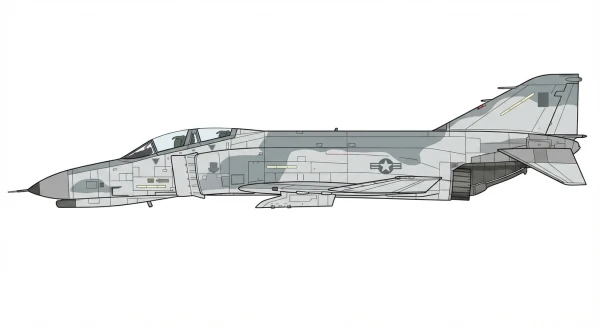
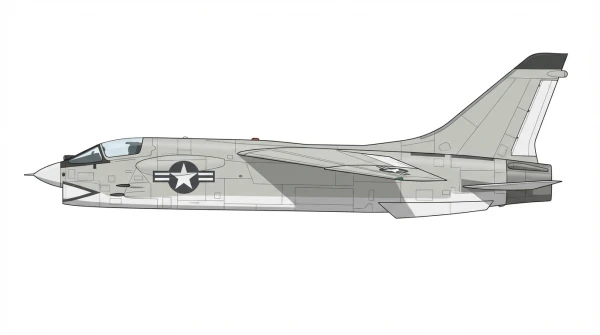
| F-4 Phantom II | F-8 Crusader | |
|---|---|---|
| Origin country | 🇺🇸 United States | 🇺🇸 United States |
| Category | Combat Aircraft | Combat Aircraft |
| Manufacturer | McDonnell | Vought |
| First flight | 27 May 1958 | 25 March 1955 |
| Year introduced | 1962 | 1957 |
| Number produced | 5195 units | 1219 units |
| Average unit price | $2.4 million | $2.5 million |
| Wing area | 49.2 m² | 34.8 m² |
| Wingspan | 11.7 m | 10.9 m |
| Height | 5.0 m | 4.8 m |
| Length | 19.0 m | 16.5 m |
| Maximum speed | 2370 km/h | 1971 km/h |
| Operational range | 2,699 km | 2,791 km |
| Service ceiling | 18,288 m | 17,678 m |
| Max. takeoff weight | 28,030 kg | 13,000 kg |
| Empty weight | 13,757 kg | 7,956 kg |
| Total thrust | 2 x 8,094 kgf | 1 x 8,165 kgf |
Detailed Comparison
Emerging from US Navy carrier requirements in the early 1950s, the McDonnell F-4 Phantom II and Vought F-8 Crusader met supersonic fleet defense demands through opposing aerodynamic and crew models. The F-8 relied on a single-seat, single-engine airframe optimized for visual-range dogfighting, while the F-4 utilized a twin-engine, two-crew configuration built around beyond-visual-range (BVR) missile engagements and heavy payload delivery.
Development and Design
Vought engineered the F-8 to meet a 1952 daytime fighter requirement. To marry high-speed performance with low-speed carrier approach limitations, Vought integrated a variable-incidence wing, pivoting 7° upward during takeoff and landing to increase angle of attack while maintaining forward pilot visibility. McDonnell’s F-4, ordered in 1955, prioritized raw thrust and radar capacity. The inclusion of a Radar Intercept Officer (RIO) or Weapon Systems Officer (WSO) allowed the pilot to focus on aircraft handling while the second crew member managed the complex Westinghouse APQ-72 (and later AWG-10) radar and AIM-7 Sparrow missiles. To resolve lateral instability without redesigning the titanium center fuselage, McDonnell angled the outer wing sections upward by 12° and the stabilators downward by 23°.
Specifications and Performances
The Phantom relies on brute force, generating 16,186 kgf of thrust from its two J79 engines to push a 28,030 kg maximum takeoff weight to 2,370 km/h (Mach 2.23). Its 210 m/s climb rate outright outperforms the F-8's 162 m/s. The Crusader, weighing less than half the F-4 at a 13,000 kg MTOW, utilizes a single Pratt & Whitney J57 generating 4,853 kgf of dry thrust. While slower at 1,971 km/h, the F-8 possesses a lower wing loading that enables tighter turn rates. The F-4’s payload capacity reaches 8,480 kg across nine hardpoints, accommodating heavy ground-attack munitions, whereas the F-8E’s 2,270 kg payload restricts it primarily to a counter-air role.
Deployment and usage
Both airframes flew extensively over Vietnam, exposing doctrinal flaws. The F-8’s four 20mm Colt Mk 12 cannons regularly jammed during high-G maneuvers, forcing pilots to rely on AIM-9 Sidewinders for aerial kills. Furthermore, the Crusader suffered a high mishap rate during carrier recoveries. The F-4 initially lacked an internal cannon, penalizing crews during visual-range engagements against VPAF MiG-17s and MiG-21s—a deficiency McDonnell rectified in the F-4E variant with the M61 Vulcan. Ultimately, the Phantom’s utility expanded well beyond Southeast Asia:
- Israeli F-4s executed deep strike and counter-air missions during the Yom Kippur War
- Iranian Phantoms conducted strategic bombing during the Iran-Iraq War
- USAF F-4Gs flew Wild Weasel radar-suppression sorties during Operation Desert Storm
By contrast, the F-8 saw limited export to the French Navy and Philippine Air Force, and its primary long-term utility was restricted to the RF-8 photo-reconnaissance variant.
Conclusion
The F-4 Phantom II dominates as a theater-level combat asset. Its twin-engine survivability, two-man crew workload division, and multirole 8,480 kg payload capacity allowed it to transition from fleet defense to close air support and radar suppression. The F-8 Crusader holds a tactical edge strictly in close-in visual dogfights where its lower mass and agile airframe outmaneuver the heavier Phantom. However, the F-8's high carrier mishap rate, unreliable cannons, and restrictive 2,270 kg payload capped its operational utility, whereas the F-4's radar-centric, multirole architecture set the baseline for modern fighter procurement.