F-8 Crusader vs MiG-21 Fishbed
F-8 Crusader vs MiG-21 Fishbed at a glance — top speed 1,971 vs 2,125 km/h, range 2,791 vs 660 km, max takeoff weight 13,000 vs 8,625 kg, built 1,219 vs 11,496 units.
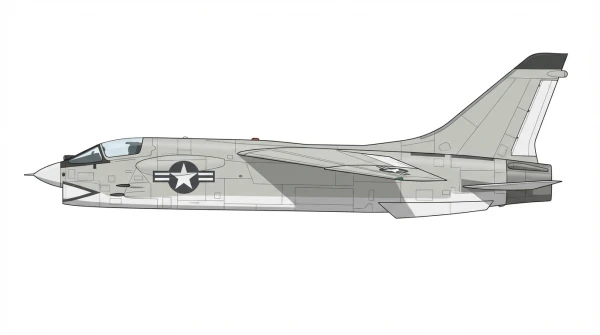
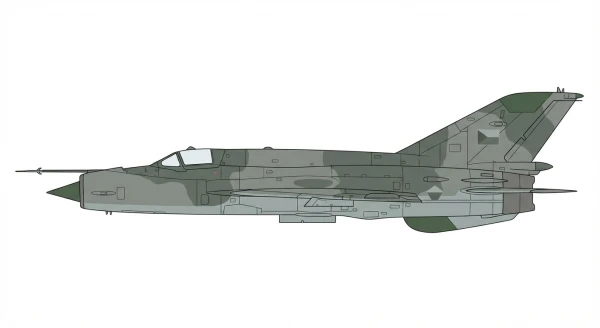
| F-8 Crusader | MiG-21 Fishbed | |
|---|---|---|
| Origin country | 🇺🇸 United States | 🇷🇺 Ex-USSR |
| Category | Combat Aircraft | Combat Aircraft |
| Manufacturer | Vought | Mikoyan-Gurevich |
| First flight | 25 March 1955 | 16 June 1955 |
| Year introduced | 1957 | 1958 |
| Number produced | 1219 units | 11496 units |
| Average unit price | $2.5 million | $2 million |
| Wing area | 34.8 m² | 23.0 m² |
| Wingspan | 10.9 m | 7.2 m |
| Height | 4.8 m | 4.1 m |
| Length | 16.5 m | 13.5 m |
| Maximum speed | 1971 km/h | 2125 km/h |
| Operational range | 2,791 km | 660 km |
| Service ceiling | 17,678 m | 19,000 m |
| Max. takeoff weight | 13,000 kg | 8,625 kg |
| Empty weight | 7,956 kg | 4,871 kg |
| Total thrust | 1 x 8,165 kgf | 1 x 4,689 kgf |
Detailed Comparison
The Vought F-8 Crusader and Mikoyan-Gurevich MiG-21 Fishbed emerged in the mid-1950s as second-generation supersonic fighters, representing divergent Cold War design philosophies. While the F-8 was the final US fighter designed primarily around naval gunnery, the MiG-21 was built as a lightweight, high-speed land-based interceptor relying heavily on emerging missile technology. Both achieved iconic status through widespread export and combat history, particularly their direct clashes over Vietnam.
Development and Design
The F-8, developed from a 1952 US Navy requirement, introduced a unique variable-incidence wing. This innovation allowed the wing to pivot 7° upward, maintaining fuselage visibility during high-angle-of-attack carrier landings. The airframe incorporated an area-ruled fuselage and extensive titanium to manage aerodynamic drag and heat. Conversely, the MiG-21 prioritized high-speed interception through a delta wing configuration. This design facilitated Mach 2 performance and agility but compromised low-speed handling, necessitating long takeoff runs. While the F-8 retained four 20mm Colt Mk 12 cannons, earning it the moniker "The Last Gunfighter," the MiG-21 shifted focus toward missiles, though it retained internal cannons like the GSh-23 in most variants. The F-8 was physically imposing and complex to operate, whereas the MiG-21 was designed for simplicity, ease of maintenance, and mass production.
Specifications and Performance
Performance metrics highlight the F-8 as a heavy naval fighter and the MiG-21 as a lightweight interceptor. The MiG-21 holds a speed advantage, reaching 2,125 km/h compared to the F-8's 1,971 km/h, and a superior service ceiling of 19,000 meters versus 17,678 meters. However, the Crusader is significantly larger and heavier, with a maximum takeoff weight of 13,000 kg against the Fishbed's 8,625 kg. Despite similar engine thrust ratings—roughly 4,800 kgf for the J57 and 4,689 kgf for the Tumansky R-11—the MiG-21's lower mass provides a distinct thrust-to-weight advantage, aiding its climb rate. Range remains a limiting factor for both, with the F-8 offering a marginal operational radius advantage (730 km) over the MiG-21 (660 km).
Deployment and Usage
The F-8 served as the US Navy's primary air superiority fighter until the widespread adoption of the F-4 Phantom II. It saw extensive combat in Vietnam, engaging MiG-17s and performing ground attacks with up to 5,000 lbs of ordnance. Its reconnaissance variant, the RF-8, provided critical low-level intelligence during the Cuban Missile Crisis. In contrast, the MiG-21 became the most produced supersonic jet in history, with over 11,000 units. It served as a primary interceptor for North Vietnam and saw heavy usage in the Middle East and Indo-Pakistan wars. While the F-8 retired from US service in 1987, the MiG-21 remains operational globally due to upgrade packages like the MiG-21 Bison, which add modern radars and BVR (Beyond Visual Range) capabilities.
Conclusion
The F-8 Crusader and MiG-21 Fishbed exemplify the specialized versus the ubiquitous. The F-8 was a complex, potent naval platform that successfully bridged the gap between gunfighters and missile carriers, though its complexity and specific carrier-based design limited its service life compared to multi-role successors. The MiG-21 proved that a simple, lightweight airframe could remain relevant for decades through modernization. While the Crusader offered superior payload and tactical flexibility in its prime, the Fishbed's adaptability and sheer production numbers secured its status as the more strategically significant airframe of the era.