FJ-4 Fury
American carrier-capable swept-wing fighter-bomber, developed in the mid-1950s and used by the US Navy and Marine Corps for ground attack and nuclear strike until the late 1960s. Key figures: top speed 1,094 km/h, range 3,250 km, service ceiling 14,300 m, max takeoff weight 10,750 kg, built 374.
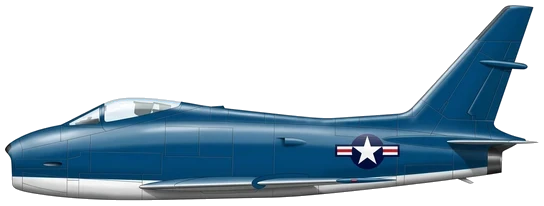
| Crew | 1 |
| Length | 11.1 m (36.3 ft) |
| Wingspan | 11.9 m (39.1 ft) |
| Height | 4.2 m (13.9 ft) |
| Wing area | 31.5 m² (338.6 sqft) |
| Empty weight | 5,992 kg (13,210 lbs) |
| Max. takeoff weight | 10,750 kg (23,700 lbs) |
| Powerplant | 1 × turbojet Wright J65-W-16A 3,493 kgf each |
| Maximum speed | 1094 km/h (680 mph) |
| Operational range | 3,250 km (2,019 mi) |
| Service ceiling | 14,300 m (46,916 ft) |
| Climb rate | 38.9 m/s (127.6 ft/s) |
- Air-to-Air Short-Range AIM-9 Sidewinder
- Air-to-Ground AGM-12 Bullpup (FJ-4B)
- Unguided Bomb up to 3,000 lb (1,400 kg) of underwing ordnance
- Nuclear Free-fall nuclear weapon (FJ-4B)
- Rocket Pod LAU-10 Zuni
- Rocket Pod 70 mm rocket pod
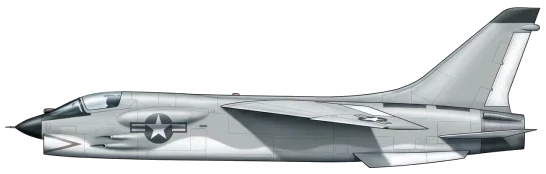
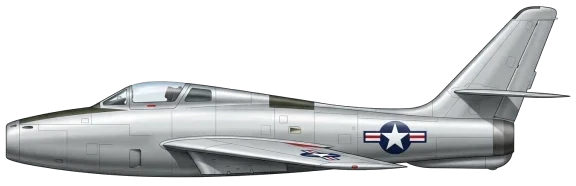
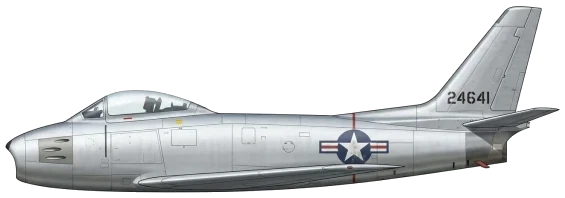
Description
The North American FJ-4 Fury is a single-seat, swept-wing, carrier-capable fighter-bomber built by North American Aviation for the United States Navy and Marine Corps. It was the final development of a lineage that included the US Air Force's F-86 Sabre. The FJ-4 kept the general layout and engine of the FJ-3 but had a new wing and a reworked fuselage. Deliveries began in February 1955. The FJ-4B ground-attack version could deliver nuclear weapons.
Development
The FJ-4 was designed as an all-weather interceptor, a role that required long range on internal fuel. The two prototypes used the FJ-3's Wright J65-W-4 engine, and the first FJ-4 flew on 28 October 1954. Of the original order for 221 aircraft, the last 71 were completed as FJ-4Bs. The Navy wanted to keep a nuclear strike role in its rivalry with the Air Force, and in April 1956 it ordered 151 more FJ-4Bs. Production totalled 152 FJ-4s and 222 FJ-4Bs, and 1,115 FJ aircraft of all variants were delivered.
Design
The new wing had a six percent thickness-to-chord ratio and skin panels milled from solid alloy plate. It had greater area and sharper taper than the FJ-3's wing. Slight camber behind the leading edge improved low-speed handling. The wing was "wet", with integral fuel tanks, and the fuselage was deepened to hold more fuel, which gave it a "razorback" rear deck. Fuel capacity was 50% greater than the FJ-3's, and armour was omitted to save weight.
The main landing gear was redesigned to fold within the thinner wing. Its wider track placed the wheels closer to the centre of gravity, which reduced the load on the nosewheel. Only the outer wing panels folded. The tail surfaces were given a thinner profile, and the cockpit was modified for longer missions. Production aircraft used the 7,700 lbf (34 kN) J65-W-16A, giving a maximum speed of 680 mph (1,094 km/h) at sea level and a service ceiling of 46,800 ft (14,300 m).
The FJ-4B had a strengthened wing and landing gear. It also had additional speed brakes under the aft fuselage, which allowed pilots to land at higher thrust settings and could be used in dive attacks. The aircraft carried the Low-Altitude Bombing System (LABS) for nuclear delivery.
Armament
Fixed armament was four 20 mm Colt Mk 12 cannon with 144 rounds per gun, which was less ammunition than the FJ-3 carried. The FJ-4 had four underwing stations for AIM-9 Sidewinder missiles, 70 mm rocket pods or LAU-10 Zuni pods, with up to 3,000 lb (1,400 kg) of ordnance. The FJ-4B had six stations and double the external load. It could carry six AIM-9s, or five AGM-12 Bullpup missiles with a control pod, and a nuclear weapon on the inboard port station.
Operational History
The Navy equipped 10 squadrons with the FJ-4B, and three Marine Corps squadrons also flew the type. Under the 1962 Tri-Service designation system, the FJ-4 became the F-1E and the FJ-4B became the AF-1E. AF-1Es served with US Naval Reserve units until the late 1960s.
Variants
- XFJ-4: Two prototypes with the J65-W-4 engine and a redesigned fuselage.
- FJ-4: Single-seat fighter-bomber powered by the J65-W-16A, later redesignated F-1E.
- FJ-4B: Ground-attack version with six underwing pylons and nuclear capability, of which 222 were built, later redesignated AF-1E.
- FJ-4F: Two FJ-4 conversions with an AR-1 rocket engine burning hydrogen peroxide and JP-4, which gave 5,000 lbf (22 kN) of additional thrust and allowed the aircraft to reach Mach 1.41 and 71,000 ft (21,600 m).
- AF-1F (NA-295): Proposed TF30-powered light-attack version that would have competed with the A-7, but it was not built.
Frequently Asked Questions
What type of aircraft is the FJ-4 Fury?
What is the maximum speed of the FJ-4 Fury?
What is the range of the FJ-4 Fury?
When did the FJ-4 Fury first fly?
How many FJ-4 Fury have been built?
Which countries operate the FJ-4 Fury?
What is the service ceiling of the FJ-4 Fury?
- OCT 12026 Created Page created: FJ-4 Fury