Folland Gnat
British lightweight jet fighter first flown in 1955, exported to Finland and India, and operated by the RAF as the two-seat Gnat T.1 advanced trainer until 1979. Key figures: top speed 1,119 km/h, range 805 km, service ceiling 15,240 m, max takeoff weight 4,100 kg, built 360.
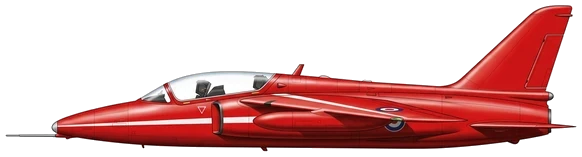
| Crew | 1 |
| Length | 9.1 m (29.8 ft) |
| Wingspan | 6.8 m (22.2 ft) |
| Height | 2.7 m (8.8 ft) |
| Wing area | 12.7 m² (136.6 sqft) |
| Empty weight | 2,177 kg (4,799 lbs) |
| Max. takeoff weight | 4,100 kg (9,039 lbs) |
| Powerplant | 1 × turbojet Bristol Siddeley Orpheus 701-01 2,134 kgf each |
| Maximum speed | 1119 km/h (695 mph) |
| Operational range | 805 km (500 mi) |
| Endurance | 2 hours |
| Service ceiling | 15,240 m (50,000 ft) |
| Climb rate | 101.6 m/s (333.3 ft/s) |
- Unguided Bomb 500 lb bombs
- Rocket Pod 3 in (76 mm) rockets
Description
The Folland Gnat is a British compact, swept-wing, subsonic light fighter developed and produced by Folland Aircraft. Conceived as a low-cost alternative to larger and more expensive combat aircraft, it entered Finnish Air Force service in July 1958 and was also exported to India. The Royal Air Force (RAF) did not adopt it as a fighter but operated the two-seat Gnat T.1 trainer from 1962. The Gnat is known as the display aircraft of the Red Arrows and for its Indian Air Force combat record against Pakistani Sabres.
Development
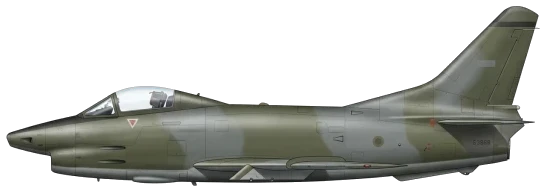
Folland's new managing director and chief engineer, who joined the company in October 1950, concluded that contemporary fighters required too many man-hours and too much material for wartime mass production. Folland funded the Fo-141 Gnat privately, and Operational Requirement OR.303 shaped its design. When the Bristol Saturn engine was cancelled, the Bristol Orpheus was selected. The Viper-powered Fo-139 Midge demonstrator first flew on 11 August 1954 and exceeded Mach 1 in a dive. The Gnat prototype, G-39-2, first flew from RAF Boscombe Down on 18 July 1955, and the Ministry of Supply ordered six evaluation aircraft. The RAF selected the Hawker Hunter after a 1958 evaluation, and the Gnat was not entered in the NATO NBMR-1 competition won by the Fiat G.91. Folland then adapted the design to Specification T.185D. The Fo.144 Gnat Trainer first flew on 31 August 1959 from Chilbolton. After Hawker Siddeley took over Folland, orders for 30, 20 and 41 trainers followed between 1960 and 1962. The final RAF T.1 was delivered in May 1965. Supersonic Gnat 5 and variable-geometry Fo.147 proposals were not built.
Design
The fuselage is a flush-riveted metal stressed-skin structure, with machining, forging and casting kept to a minimum. The airframe could be built on simple jigs without specialised tooling. The wing cost a quarter as much as those of contemporary fighters and needed less than one-fifth of the labour. The Gnat F.1 has a pressurised cockpit and an ejection seat. Its tricycle landing gear allows operation from grass strips. A 4,705 lbf Orpheus 701-01 turbojet gives a maximum speed of Mach 0.98 and a service ceiling above 50,000 ft. Avionics comprise VHF radio, navigation aids, a gyro gunsight and ranging radar. The T.1 has a new wing with more fuel, a lengthened forward fuselage, enlarged tail surfaces and outboard ailerons with conventional flaps.
Armament
The F.1 carries two 30 mm ADEN cannon with 115 rounds per gun, mounted in the intake lips. External loads include twelve 3 in rockets or two 500 lb bombs. The IAF reported that the cannon often failed in flight.
Operational History
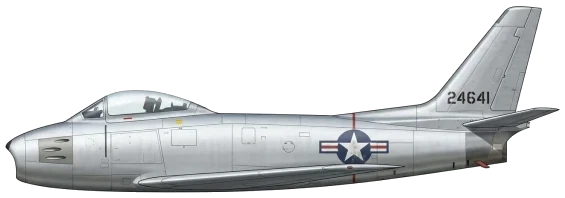
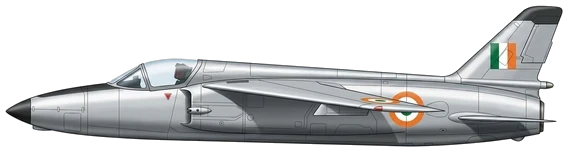
Finland received 13 aircraft, 11 fighters and two reconnaissance aircraft. On 31 July 1958, a Finnish Air Force Gnat pilot became the first Finnish pilot to exceed the speed of sound. After GN-102 was lost to a hydraulic design error on 26 August 1958, the Finnish fleet was grounded for six months. Saab 35 Drakens replaced the Gnats in 1972. Yugoslavia evaluated two aircraft and did not order more. India signed for licence production in September 1956, and No. 23 Squadron formed on the type in March 1960. Indian and independent sources credit Gnats with seven F-86 Sabres in 1965, and one Gnat was captured at Pasrur. In 1971 they destroyed two Sabres at the Battle of Boyra. A Gnat pilot was posthumously awarded the Param Vir Chakra, India's highest gallantry award, the only member of the IAF to receive it. The IAF retired its Gnats in 1991. In the RAF, 4 FTS at RAF Valley used the T.1 until November 1978, and the Red Arrows flew it until 1979. The Hawk replaced it in both roles.
Variants
- Gnat F.1: Single-seat fighter exported to Finland and India (two evaluated by Yugoslavia), 50 built at Hamble and more licence-built by HAL.
- Gnat FR.1: Finnish reconnaissance version with three nose-mounted 70 mm Vinten cameras, two delivered in October 1960.
- Gnat T.1: Two-seat RAF trainer, 105 built by Hawker Siddeley.
- HAL Ajeet: Improved Indian development of the Gnat F.1, built by HAL in Bangalore.
Frequently Asked Questions
What type of aircraft is the Folland Gnat?
What is the maximum speed of the Folland Gnat?
What is the range of the Folland Gnat?
When did the Folland Gnat first fly?
How many Folland Gnat have been built?
Which countries operate the Folland Gnat?
What is the service ceiling of the Folland Gnat?
- SEP 302026 Created Page created: Folland Gnat