Hawker Hunter
British transonic single-seat jet fighter, developed in the early 1950s, widely used as a day interceptor and later as a fighter-bomber and reconnaissance aircraft. Key figures: top speed 1,151 km/h, range 3,058 km, service ceiling 15,240 m, max takeoff weight 11,158 kg, built 1,972.
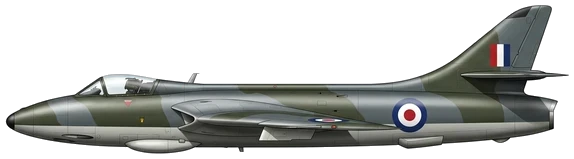
| Crew | 1 |
| Length | 14.0 m (45.9 ft) |
| Wingspan | 10.3 m (33.7 ft) |
| Height | 4.0 m (13.2 ft) |
| Wing area | 32.4 m² (349.0 sqft) |
| Empty weight | 6,406 kg (14,123 lbs) |
| Max. takeoff weight | 11,158 kg (24,599 lbs) |
| Powerplant | 1 × turbojet Rolls-Royce Avon 207 4,602 kgf each |
| Maximum speed | 1151 km/h (715 mph) |
| Operational range | 3,058 km (1,900 mi) |
| Service ceiling | 15,240 m (50,000 ft) |
| Climb rate | 87.4 m/s (286.7 ft/s) |
- Air-to-Air Short-Range AIM-9 Sidewinder
- Air-to-Surface AGM-65 Maverick
- Unguided Bomb Iron bombs
- Rocket Pod Matra rocket pod (18 × SNEB 68 mm)
- Rocket Pod Hispano SURA R80 80 mm rockets
Description
The Hawker Hunter is a British single-seat transonic jet fighter developed by Hawker Aircraft for the Royal Air Force. It entered RAF service in July 1954 as a day interceptor and later served as a fighter-bomber and reconnaissance aircraft. On 7 September 1953 a modified prototype set a world air speed record of 727.63 mph (1,171.01 km/h). A total of 1,972 were built, and the type served with 21 overseas air forces. The last military operator was the Lebanese Air Force, which retired its Hunters in 2014.
Development
Air Ministry Specification F.43/46 of 1946 called for an axial-engined day interceptor. In March 1948 Specification F.3/48 replaced it, requiring 629 mph at 45,000 ft and four 20 mm or two 30 mm cannon. Hawker's P.1067 design was adopted for the new specification. The design evolved from a nose intake and T-tail to wing-root intakes and a conventional tail. The Korean War prompted the RAF to order the P.1067 and the Supermarine Swift "off the drawing board" in 1950.
The first prototype flew from RAF Boscombe Down on 20 July 1951, powered by a 6,500 lbf Avon 103. The Sapphire-powered third prototype followed on 30 November 1952, and the first production F.1 flew on 16 March 1953. The Supermarine Swift broke the Hunter's air speed record on 25 September 1953. Production was shared by Hawker, Hawker Siddeley and licence builders, including SABCA, Avions Fairey and Fokker.
Design
The Hunter is an all-metal monoplane with mid-mounted wings swept 35° and slight anhedral. It has a monocoque fuselage with a removable rear section and triangular wing-root intakes. The airframe was built as six interchangeable major sections so that production could be dispersed. Early Avon engines surged and flamed out when the cannon fired, a problem addressed by "fuel dipping." The 10,000 lbf Avon 203, with a new compressor and annular combustor, powered the F.6. The F.6 also gained a dogtooth leading edge, and late F.6s received an all-moving tailplane. An Ekco ARI 5820 ranging radar fed the gyro gunsight. The F.6 reached 715 mph at sea level, with a 50,000 ft ceiling and a 1,900 mi ferry range.
Armament
Single-seat versions carry four 30 mm ADEN cannon with 150 rounds per gun. The guns sit in a removable pack, and the barrels stay in the aircraft during rearming. Four underwing hardpoints carry 7,400 lb (3,400 kg). Singaporean FGA/FR.74S aircraft were modified to seven hardpoints. Stores include Matra pods with 18 SNEB 68 mm rockets, Hispano SURA 80 mm rockets, RAF 3-inch rockets, iron bombs and 100-gallon drop tanks. Export aircraft carried AIM-9 Sidewinder and AGM-65 Maverick missiles. The Swiss Hunter 80 upgrade added BL755 cluster bombs and chaff/flare dispensers.
Operational History
- Suez, 1956: RAF F.5s of Nos. 1 and 34 Squadrons escorted Canberras over Egypt.
- Brunei Revolt, 1962: RAF Hunters flew strafing runs in support of ground forces.
- Radfan, 1964–1967: Nos. 8 and 43 Squadrons flew ground-attack missions until the withdrawal from Aden in November 1967.
- India: The Indian Air Force ordered 140 Hunters in 1954 and flew them in the 1962, 1965 and 1971 wars. In 1971 Hunters struck Pakistani armour at Longewala and bombed the Attock refinery. India retired the type in 1996.
- Six-Day War, 1967: A Pakistani exchange pilot flying an Iraqi Hunter from H3 shot down three Israeli jets.
- Rhodesia and Chile: Rhodesia used FGA.9s against ZANLA and ZIPRA guerrillas. In the 1973 Chilean coup, Hunters bombed La Moneda.
- Other operators: Sweden received 120 J 34s (retired 1969), Switzerland 130 (retired 1994), Singapore 46 (retired 1992) and Denmark 30 F.51s (retired 1974).
Variants
- F.1: Initial Avon 113-powered production day interceptor, entering service in 1954.
- F.4: Added leading-edge bag fuel tanks, "wet" drop-tank hardpoints and "Sabrina" link collectors.
- F.6: Avon 203-powered version with a dogtooth leading edge and four wet hardpoints.
- FGA.9: Ground-attack conversion of the F.6 and the basis for most export versions.
- T.7: Two-seat trainer, used with the T.8 by the RAF and Royal Navy until the early 1990s.
Frequently Asked Questions
What type of aircraft is the Hawker Hunter?
What is the maximum speed of the Hawker Hunter?
What is the range of the Hawker Hunter?
When did the Hawker Hunter first fly?
How many Hawker Hunter have been built?
Which countries operate the Hawker Hunter?
What is the service ceiling of the Hawker Hunter?
- SEP 302026 Created Page created: Hawker Hunter