Gloster Javelin
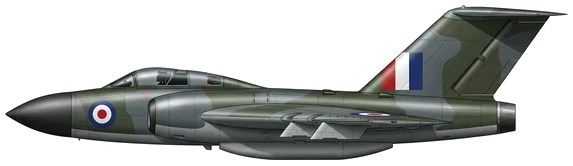
British twin-engined, T-tailed delta-wing all-weather interceptor that entered Royal Air Force service in 1956, armed with ADEN cannon and later Firestreak missiles, and retired in 1968. Key figures: top speed 1,140 km/h, range 1,535 km, service ceiling 16,093 m, max takeoff weight 19,579 kg, built 436.
| Crew | 2 (pilot, navigator) |
| Length | 17.3 m (56.8 ft) |
| Wingspan | 15.9 m (52.0 ft) |
| Height | 4.9 m (16.0 ft) |
| Wing area | 86.1 m² (926.8 sqft) |
| Empty weight | 10,886 kg (23,999 lbs) |
| Max. takeoff weight | 19,579 kg (43,164 lbs) |
| Powerplant | 2 × turbojets Armstrong Siddeley Sapphire 7R 5,579 kgf each |
| Maximum speed | 1140 km/h (708 mph) |
| Operational range | 1,535 km (954 mi) |
| Service ceiling | 16,093 m (52,799 ft) |
| Climb rate | 27.4 m/s (89.9 ft/s) |
- Air-to-Air Short-Range De Havilland Firestreak
Description
The Gloster Javelin is a twin-engined, two-seat all-weather interceptor designed and produced by the Gloster Aircraft Company in the United Kingdom. It is a T-tailed delta-wing aircraft powered by two Armstrong Siddeley Sapphire turbojets. It entered Royal Air Force squadron service in 1956 as the RAF's first purpose-built all-weather interceptor. It was the last aircraft design to bear the Gloster name, and the English Electric Lightning replaced it, with the last examples withdrawn from operational service in 1968.
Development
The Gloster Javelin originated in Air Ministry specification F.44/46 of 1947. The specification called for a two-seat night fighter able to intercept at 40,000 ft or higher, reach 525 kn at that height and climb to 45,000 ft within ten minutes of engine start. Gloster worked through a series of delta-wing studies and designs derived from the Gloster Meteor, and the P.241, with a T-tail, closely resembled the final aircraft.
On 13 April 1949 the Ministry of Supply ordered four prototypes each of the Gloster GA.5 and the competing de Havilland DH.110. Cost-cutting temporarily reduced the Gloster Javelin prototypes to two, and the resulting delays meant the first production aircraft flew within two days of the fifth prototype. The first prototype flew at Moreton Valence on 26 November 1951. The second prototype crashed on 11 June 1953 after a deep stall, killing its pilot, and a stall-warning device was later developed.
The production order came in mid-1953, with work subcontracted to Armstrong Whitworth and other Hawker Siddeley companies. The United States Air Force funded aircraft for the RAF under the Mutual Defense Aid Program at £36.8 million. Production totalled 427 aircraft plus seven prototypes. Proposed reconnaissance, fighter-bomber and supersonic "thin-wing" versions were not pursued, and the thin-wing aircraft was cancelled in 1957.
Design
The delta wing housed fuel and armament, while the fuselage held the engines and crew. The combination of delta wing and tailplane was chosen to give manoeuvrability at high speed and control at low landing speeds. Production aircraft had fully power-assisted controls with hydraulic feel and variable airbrakes that gave 1g deceleration. Ejector seats were fitted from service entry. The structure was mainly aluminium alloy, with removable nose and rear fuselage sections for servicing.
Engine thrust rose from 8,000 lbf (Sapphire Sa.6) to 12,300 lbf with reheat (Sa.7R) above 20,000 ft. Radars were the British AI.17 and the Westinghouse AN/APQ-43 (AI.22). The FAW 9 reached Mach 0.93 and had a service ceiling of 52,800 ft.
Armament
Early marks carried four 30 mm ADEN cannon in the wings. The FAW 5 had provision for missile pylons, but these were never fitted. The FAW 7 introduced two ADEN cannon plus four de Havilland Firestreak air-to-air missiles, although FAW 7s equipping two squadrons retained four cannon only. The FAW 9R carried underwing fuel tanks.
Operational History
The first deliveries went to No. 46 Squadron at RAF Odiham. Javelins equipped units in Fighter Command, RAF Germany, the Near East Air Force (No. 29 Squadron, Cyprus, 1963–1967) and the Far East Air Force. During the Indonesian Confrontation, crews flew low-level patrols in Malaysia on one engine to extend endurance. Several NATO air forces showed interest, but no export orders followed. The last flight was on 24 January 1975, when XH897 was delivered to Duxford for preservation.
Variants
- FAW 1: Initial version with Sapphire Sa.6 engines, AI.17 radar, four ADEN cannon and an electrically operated tailplane.
- FAW 2: Fitted with AN/APQ-43 radar and a hydraulically operated tail; 30 built.
- T 3: Radarless dual-control trainer with a bulged canopy and lengthened fuselage; 22 built plus one prototype.
- FAW 7: Sa.7 engines, powered rudder, extended rear fuselage and Firestreak capability; 142 built.
- FAW 9: 118 FAW 7s rebuilt with the FAW 8 wing and reheated engines, 44 of which received refuelling probes.
Frequently Asked Questions
What type of aircraft is the Gloster Javelin?
What is the maximum speed of the Gloster Javelin?
What is the range of the Gloster Javelin?
When did the Gloster Javelin first fly?
How many Gloster Javelin have been built?
Which countries operate the Gloster Javelin?
What is the service ceiling of the Gloster Javelin?
- SEP 302026 Created Page created: Gloster Javelin