DH.110 Sea Vixen
British twin-boom, carrier-based fighter, significant in the Cold War era, deployed during Suez Crisis and other Royal Navy operations. Key figures: top speed 1,127 km/h, range 1,270 km, service ceiling 15,000 m, max takeoff weight 21,205 kg, unit price $1.5M, built 151.
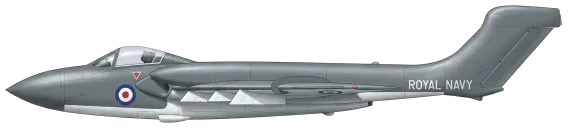
| Crew | 2 (pilot, radar operator) |
| Length | 16.9 m (55.6 ft) |
| Wingspan | 15.5 m (51.0 ft) |
| Height | 3.3 m (10.8 ft) |
| Wing area | 60.2 m² (648.0 sqft) |
| Empty weight | 12,680 kg (27,955 lbs) |
| Max. takeoff weight | 21,205 kg (46,749 lbs) |
| Powerplant | 2 × turbojets Rolls-Royce Avon 208 4,990 kgf each |
| Ejection seat | Martin-Baker Mk 4 |
| Maximum speed | 1127 km/h (700 mph) |
| Operational range | 1,270 km (789 mi) |
| Service ceiling | 15,000 m (49,213 ft) |
| Climb rate | 46.0 m/s (150.9 ft/s) |
Description
The de Havilland DH.110 Sea Vixen was a British twin-engine, twin-boom, two-seat carrier-based all-weather fleet air-defence fighter operated by the Fleet Air Arm from 1959 to 1972. Designed by the de Havilland Aircraft Company at Hatfield and redesignated Hawker Siddeley Sea Vixen after the 1960 merger, it was the first British two-seat combat aircraft to exceed the speed of sound, though only in a dive, and the first Fleet Air Arm fighter with no gun armament.
Development
De Havilland opened discussions with the Admiralty in 1946 on a two-seat, twin-engined, swept-wing radar-equipped night fighter. Specifications N.40/46 and F.44/46 were issued in January 1947, and nine DH.110 prototypes were ordered for the RAF and four for the Fleet Air Arm. The Royal Navy chose the cheaper Sea Venom in 1949 and the RAF cut its order to two prototypes, but de Havilland continued privately. The first prototype, WG236, flew from Hatfield on 26 September 1951 with John Cunningham at the controls. On 6 September 1952 WG236 disintegrated during a display at the Farnborough Airshow, killing 31 people including pilot John Derry and observer Tony Richards; the investigation traced the failure to the wing leading-edge skin ahead of the main spar. The surviving prototype was modified with an all-moving tailplane and cambered leading-edge extensions, flying again in July 1954. The RAF selected the Gloster Javelin; the Fleet Air Arm ordered 110 aircraft in February 1955. Semi-navalised prototype XF828 first flew from Christchurch on 20 June 1955 and made its first arrested landing aboard HMS Ark Royal the following year. The first FAW.1 flew on 20 March 1957. Production began at Christchurch in March 1957 and moved to Hawarden in August 1962. The FAW.2 first flew in 1962 and entered squadron service in 1964; 29 were newly built and 67 FAW.1s were rebuilt to the standard. Of 145 Sea Vixens built, 55 were lost in accidents.
Design
The airframe used an all-metal structure with 45-degree swept wings, a one-piece central and stub-wing assembly, powered folding outer wings, and chemically and machine-milled skin panels. Twin booms housed fuel and avionics and were enlarged on the FAW.2. Power came from two Rolls-Royce Avon 208 turbojets of 11,000 lbf each, giving 690 mph and a 48,000 ft ceiling. The pilot's canopy was offset to port; the observer sat submerged to starboard in the darkened "Coal Hole" with GEC AI.18 radar, both on Martin-Baker Mk.4 seats. Equipment included TACAN, UHF radio, autopilot and a refuelling probe.
Armament
Six hardpoints carried four Firestreak or, on the FAW.2, Red Top air-to-air missiles slaved to the AI.18 radar. Ground-attack loads comprised two AGM-12 Bullpup missiles, Matra SNEB or Microcell 2-inch rocket pods, two internal 14-rocket launchers, and four 500 lb or two 1,000 lb bombs. The FAW.1 was cleared for the Red Beard nuclear bomb.
Operational History
Sea Vixens flew patrols during the 1961 Kuwait crisis and operated from HMS Centaur during the January 1964 Tanganyika mutiny, covering 45 Commando. Later that year they struck rebel forces in the Radfan and deployed off Indonesia during the Confrontation. They served on the Beira Patrol and covered the 1967 withdrawal from Aden from HMS Eagle.
Variants
- FAW.1: Initial production all-weather fighter, first flown 20 March 1957, armed with four Firestreak missiles.
- FAW.2: Improved version with extended tail booms, additional fuel, Red Top capability, improved escape system and added ECM.
- TT.2: Target-tug conversions of FAW.2 airframes.
- D.3: Drone conversion; four aircraft completed, including XP924, the last airworthy example.
Frequently Asked Questions
What type of aircraft is the DH.110 Sea Vixen?
What is the maximum speed of the DH.110 Sea Vixen?
What is the range of the DH.110 Sea Vixen?
When did the DH.110 Sea Vixen first fly?
How many DH.110 Sea Vixen have been built?
Which countries operate the DH.110 Sea Vixen?
How much does a DH.110 Sea Vixen cost?
What is the service ceiling of the DH.110 Sea Vixen?
- AUG 302026 Updated Description updated
- AUG 52026 Updated Thrust updated
- APR 72026 Updated Sources and cross-references refreshed
- JAN 242026 Updated Thrust updated