JF-17 Thunder
Summary
| Category | Combat Aircraft |
| Origin country | 🇨🇳 China • 🇵🇰 Pakistan |
| Manufacturer | CAC / PAC |
| First flight | 25 August 2003 |
| Year introduced | 2007 |
| Number produced | 144 units |
| Average unit price | $30 million |
Technical specifications
| Version: JF-17 Block 1 | |
|---|---|
| Crew | 1 pilot |
| Operational range | 900 km (559 mi) |
| Maximum speed | 1960 km/h (1218 mph) |
| Wing area | 24.4 m² (262.6 sqft) |
| Wingspan | 9 m (29.5 ft) |
| Height | 4.8 m (15.6 ft) |
| Length | 14 m (45.9 ft) |
| Service ceiling | 16,700 m (54,790 ft) |
| Empty weight | 6,411 kg (14,134 lbs) |
| Max. takeoff weight | 12,701 kg (28,001 lbs) |
| Powerplant | 1 x turbojet Klimov RD-93 delivering 5097 kgf each |
| Ejection seat | Martin-Baker Mk 16LE |
Current operating countries
| Country | Units | ||
|---|---|---|---|

|
Pakistan | 156 (+27) | |

|
Myanmar | 7 (+9) | |

|
Azerbaijan | 5 (+35) | |

|
Nigeria | 3 | |

|
Libya | 0 (+16) | |
Armament
Missiles payload:
- Air-to-Surface AM39 Exocet
- Air-to-Surface CASIC YJ-83 (CSS-N-8 Saccade)
- Air-to-Air Medium-Range Leihua Electronic Technology Research Institute PL-12
- Anti-Radiation MAR-1
- Cruise Missiles NESCOM Ra'ad
- Air-to-Air Short-Range PL-5
Bombs payload:
- Guided KAB-500
- Anti-Runway Matra BLU-107/B Durandal
- Cluster Mk 20 Mod 0 Rockeye
- Low-Drag Mk 82
- Low-Drag Mk 84
- Laser-Guided NESCOM H-2
- Guided NESCOM H-4
- Laser-Guided Raytheon GBU-10 Paveway II
- Laser-Guided Raytheon GBU-12
Description
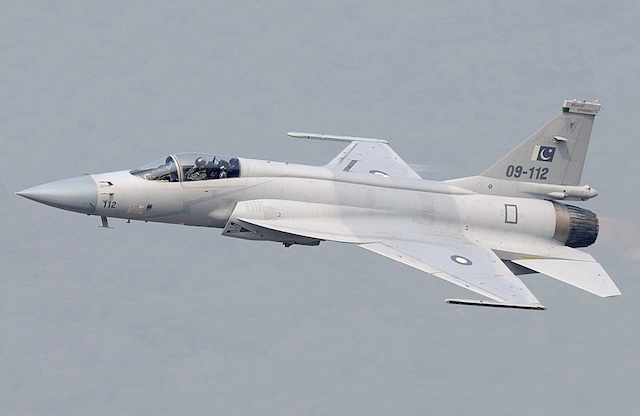
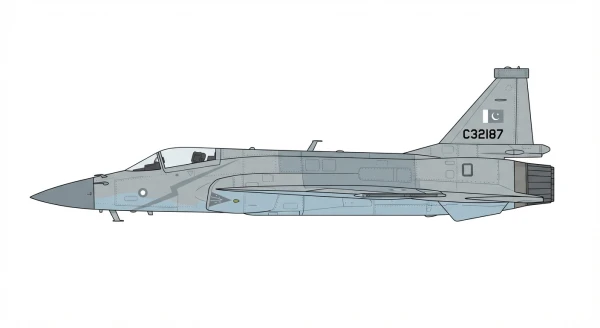
The JF-17 Thunder is a lightweight, single-engine, multi-role combat aircraft developed jointly by the Pakistan Aeronautical Complex (PAC) and the Chengdu Aircraft Corporation (CAC) of China. The "JF" stands for "Joint Fighter," reflecting its collaborative development. It was designed to replace the aging fleet of fighter jets in the Pakistan Air Force (PAF), and also to be an affordable export option for other countries. The project began in 1995, and the aircraft made its first flight in 2003. It became operational with the PAF in 2007. The aircraft serves not only in the Pakistan Air Force but has also been exported to other countries, such as Myanmar and Nigeria.
The development of the JF-17 Thunder aimed to produce a cost-effective, modern multi-role fighter that could fulfill various operational roles while replacing older models in the Pakistan Air Force. To achieve this, Pakistan and China entered into a joint venture, pooling resources and expertise. The design phase took inspiration from earlier models but aimed to incorporate modern avionics, aerodynamics, and weapon systems.
The aircraft's design focuses on simplicity. It features a single RD-93 afterburning turbofan engine, which is a variant of the Russian Klimov RD-33 engine. The use of a single engine was a conscious choice to keep both procurement and operational costs low. The airframe is constructed mainly from aluminum alloys, and employs a conventional aerodynamic layout, with a relaxed stability design to improve maneuverability.
In terms of avionics, the JF-17 comes with a glass cockpit and a hands-on-throttle-and-stick (HOTAS) control system. The avionics software incorporates the concept of open architecture. Instead of the military-optimised Ada programming language, the software is written using C++, enabling the use of the numerous civilian programmers available.
Weaponry on the JF-17 is designed to handle a mix of Chinese, Western, and other foreign systems. It can be armed with a variety of air-to-air missiles, precision-guided munitions, and anti-ship missiles, making it capable of carrying out multiple roles including air-to-air combat, ground attack, and anti-ship roles.
Armament
The aircraft features seven hardpoints for carrying external stores: four under the wings, two on the wingtips, and one under the fuselage. This allows for a good mix of weapons to be carried, depending on the mission requirements.
Air-to-Air: For air-to-air engagements, the JF-17 can be equipped with short to beyond-visual-range (BVR) missiles. The aircraft can carry the PL-5EII and PL-9 short-range infrared-guided missiles and the PL-12 or SD-10 BVR radar-guided missiles.
Air-to-Ground: For ground-attack roles, the JF-17 can carry a range of precision-guided munitions including laser-guided bombs like the LT-2, GPS-guided bombs, and conventional unguided bombs. It can also carry specialized munitions like anti-runway bombs.
Anti-Ship: For maritime roles, the aircraft can be armed with anti-ship missiles like the C-802A, which have a range of up to 180 kilometers.
Other Weapons: The aircraft is also equipped with a 23mm GSh-23-2 twin-barrel autocannon for close-in combat scenarios. Additionally, it can carry rocket pods for ground-attack missions.
Operational history
The JF-17 Thunder became operational in the Pakistan Air Force (PAF) in 2007, serving as a replacement for several older models like the Nanchang A-5, the Dassault Mirage III/5, and the Chengdu F-7. In terms of combat, its first known engagement was during the 2019 India-Pakistan border skirmishes. While Pakistan claimed that a JF-17 was used to shoot down an Indian aircraft, India disputed this claim. Nevertheless, this event was a milestone in the aircraft's operational use in a live combat situation.
The aircraft has also successfully entered the export market. Nigeria and Myanmar have both acquired JF-17s, and the aircraft has been showcased in multiple international air exercises to demonstrate its capabilities. Ongoing upgrades have been implemented to keep the aircraft competitive; for instance, the Block II version introduced air-to-air refueling capabilities. The latest version, Block III, is in the process of receiving advanced avionics, an AESA radar, and enhanced weapon systems.
The JF-17 has been employed in a variety of operational roles within the PAF, including air-to-air combat, ground-attack, and anti-ship missions. Additionally, it's considered part of Pakistan's strategic deterrence arsenal, with the capability to carry nuclear weapons, although specific details on this aspect are classified.
Variants
- JF-17 Block I: Initial variant, operational in 2007, basic avionics, no air-to-air refueling.
- JF-17 Block II: Introduced in 2013, air-to-air refueling, improved avionics, increased payload.
- JF-17B Block II: Two-seat version of Block II, fully operational, first flight in 2017.
- JF-17 Block III: Advanced AESA radar, better avionics, improved cockpit.