JF-17 Thunder vs Tejas
JF-17 Thunder vs Tejas at a glance — top speed 1,960 vs 2,220 km/h, range 900 vs 3,000 km, max takeoff weight 12,701 vs 13,500 kg, built 144 vs 38 units.
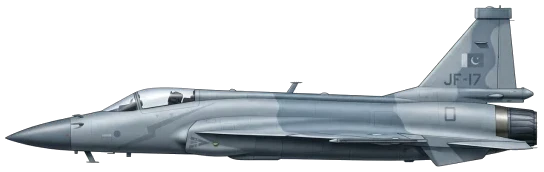
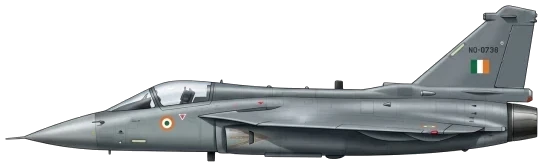
| JF-17 Thunder | Tejas | |
|---|---|---|
| Origin country | 🇨🇳 China🇵🇰 Pakistan | 🇮🇳 India |
| Category | Combat Aircraft | Combat Aircraft |
| Manufacturer | CAC/PAC | HAL |
| First flight | 25 August 2003 | 4 January 2001 |
| Year introduced | 2007 | 2015 |
| Number produced | 144 units | 38 units |
| Average unit price | $25 million | $26 million |
| Wing area | 24.4 m² | 38.4 m² |
| Wingspan | 9.0 m | 8.2 m |
| Height | 4.8 m | 4.4 m |
| Length | 14.0 m | 13.2 m |
| Maximum speed | 1960 km/h | 2220 km/h |
| Operational range | 900 km | 3,000 km |
| Service ceiling | 16,700 m | 16,000 m |
| Max. takeoff weight | 12,701 kg | 13,500 kg |
| Empty weight | 6,411 kg | 6,560 kg |
| Total thrust | 1 x 8,606 kgf | 1 x 8,600 kgf |
Detailed Comparison
Islamabad and New Delhi initiated their lightweight fighter programs to replace legacy interceptors, but their procurement outcomes diverged sharply. Pakistan’s JF-17, developed jointly with China, prioritized rapid fielding and cost control, entering service in 2007 and reaching 144 units. India’s Tejas took a highly localized, technologically ambitious route, resulting in a protracted development cycle that delayed squadron induction until 2015, with only 38 units built.
Development and Design
The Tejas airframe incorporates carbon-fibre composites for 45% of its weight, paired with a tailless compound delta-wing and relaxed static stability. This configuration maximizes maneuverability for point-defense but complicated the engineering process, exacerbated by the failure of the indigenous Kaveri engine and 1998 US sanctions. HAL ultimately integrated the General Electric F404-GE-IN20 turbofan. Conversely, CAC and PAC built the JF-17 around a conventional aerodynamic layout and an aluminum alloy airframe. By selecting the Russian-derived Klimov RD-93 and utilizing a C++ based open-architecture avionics suite, the developers bypassed integration bottlenecks. The JF-17 accepted lower aerodynamic sophistication in exchange for manufacturability.
Specifications and Performances
Data indicates the Tejas leverages its GE F404 engine to achieve higher top speeds of 2220 km/h against the JF-17’s 1960 km/h. A structural comparison reveals their distinct loadouts:
- Tejas: 13,500 kg maximum takeoff weight, 8600 kgf thrust, 9 hardpoints
- JF-17: 12,701 kg maximum takeoff weight, 5097 kgf thrust, 7 hardpoints
The Indian fighter maintains an advantage in raw kinematics and payload density, capable of carrying 5,300 kg. However, the JF-17 outranges the Tejas with a 900 km radius compared to 739 km, optimizing for longer loiter times and beyond-visual-range (BVR) engagements using the PL-12 and PL-15 missiles.
Deployment and usage
The Pakistan Air Force operates the JF-17 as a frontline multirole asset, utilizing it in strikes against militants and during the 2019 Operation Swift Retort against India. The platform secured export contracts with Myanmar and Nigeria, validating its viability in lower-tier defense budgets. The Tejas lacks combat exposure. The Indian Air Force stationed its first squadrons (No. 45 and No. 18) at Sulur Air Force Station, deploying them along the western border in 2020. The Tejas currently functions as a peacetime airspace patrol asset and technology demonstrator for India's defense industry, testing domestic weapons like the Astra missile.
Conclusion
The JF-17 wins the procurement and fleet replacement battle. By accepting off-the-shelf components and conventional aerodynamics, PAC and CAC delivered a functional, mass-producible fighter that stabilized PAF squadron numbers and won export market share. The Tejas holds the kinematic edge. Its composite construction, higher thrust, and heavier payload capacity make it a more capable dogfighter and strike platform on paper. For a nation requiring immediate, expendable combat mass, the JF-17 outpaces its rival. For a force willing to absorb decades of delays to master domestic aerospace manufacturing, the Tejas provides a higher aerodynamic performance ceiling.