Mi-14 Haze
Soviet-made amphibious helicopter, known for Cold War-era naval usage, including anti-submarine and anti-ship roles. Key figures: top speed 230 km/h, range 1,135 km, service ceiling 3,500 m, max takeoff weight 14,000 kg, built 273. In service with 7 air forces as of 2026 — Syria (10), North Korea (8), Ukraine (4) and 4 others.
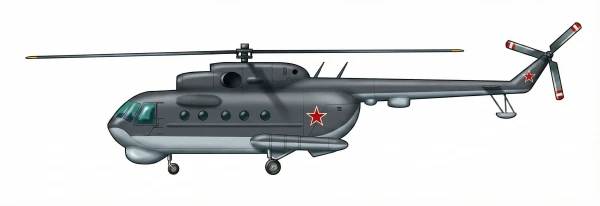
| Crew | 4 |
| Length | 18.4 m (60.3 ft) |
| Wingspan | 21.3 m (69.8 ft) |
| Height | 6.9 m (22.7 ft) |
| Empty weight | 11,750 kg (25,904 lbs) |
| Max. takeoff weight | 14,000 kg (30,865 lbs) |
| Powerplant | 2 × turboshafts Klimov TV3-117MT 1,454 kW each |
| Maximum speed | 230 km/h (143 mph) |
| Operational range | 1,135 km (705 mi) |
| Service ceiling | 3,500 m (11,483 ft) |


- Anti-Submarine PLAB-250-120
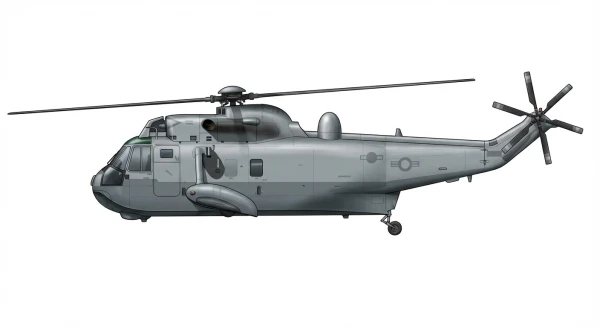
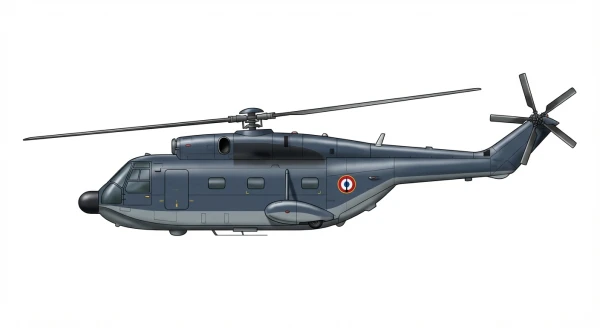
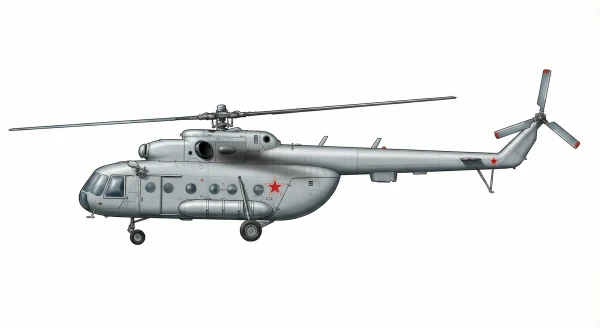
Description
The Mil Mi-14 (NATO reporting name: Haze) is a Soviet shore-based amphibious anti-submarine warfare helicopter, derived from the Mi-8 and built by Kazan Helicopters. Capable of carrying a nuclear depth charge, it entered service on 11 May 1976 with Soviet naval aviation and is distinguished by its watertight boat-type hull and its retractable four-point landing gear.
Development
Development of an ASW version of the Mi-8 was authorised in April 1965 by the Central Committee of the Communist Party and the Council of Ministers, the aim being to replace the Mil Mi-4 in the short-range coastal anti-submarine role. The specification required an endurance of 2 hours on station at a radius of 222 km from base. The first V-14 prototype, converted from a Mi-8 and powered by Klimov TV2-117s, flew on 1 August 1967. Avionics problems and the reliability of the TV3-117 engines delayed the programme, with production at Kazan not beginning until 1973. Nearly 300 examples were built between 1973 and 1986, of which around 230 had been delivered by 1991; approximately 44 remain in active service. In January 2016, Russian Helicopters told TASS that no decision to resume production had been taken, with feasibility and financing studies under way.
Design
The Mi-14 differs from the Mi-8 by a watertight hull comparable to that of the Sea King, allowing water landings, and by retractable landing gear whose main wheels retract into sponsons at the rear of the fuselage. Power comes from two Klimov TV3-117MT turboshafts of 1,454 kW each; the main rotor has a diameter of 21.29 m and blades of NACA 23012 section. A radome housing a search radar is installed under the nose. The crew numbers four: pilot, co-pilot, flight engineer and weapon systems operator. The Mi-14PL carries a towed APM-60 magnetic anomaly detector, OKA-2 sonobuoys, a dipping sonar and a retractable Type 12-M radar. Maximum take-off weight: 14,000 kg; maximum speed 230 km/h; service ceiling 3,500 m; ferry range 1,135 km.
Armament
A watertight weapons bay is fitted along the fuselage centreline, allowing the internal carriage of a single torpedo or eight depth charges. The Mi-14PL can carry an AT-1 or APR-2 torpedo, or a Skat nuclear depth charge. A single Mi-14PL was used for trials of the Kh-23 (AS-7 Kerry) air-to-surface missile, a modification that apparently did not enter service.
Operational History
From 2013, Syrian Navy Mi-14s were employed as improvised bombers, dropping naval mines and barrel bombs from high altitude on opposition-held urban areas; one of them crashed on 22 March 2015, its pilot being killed after capture. On 7 May 2022, Colonel Ihor Bedzay, deputy chief of the Ukrainian Navy, was killed when his Mi-14PS was shot down by a Russian Su-35. Exports went to Bulgaria, Cuba, East Germany, Libya, Poland and Syria; current users include Georgia, Libya, Poland, the Republic of the Congo, Ukraine (10th Naval Aviation Brigade) and Yemen.
Variants
- V-14: prototype of the Mi-14 helicopter.
- Mi-14PL (Haze-A): anti-submarine warfare version with APM-60 MAD, OKA-2 sonobuoys and Type 12-M radar.
- Mi-14PLM: improved ASW version fitted with the Os'minog suite with new radar, dipping sonar and digital computer, employed in limited numbers.
- Mi-14BT (Haze-B): mine countermeasures version without ASW equipment, fitted for towing mine-warfare sleds, 25 to 30 built including six exported to East Germany and two to Bulgaria.
- Mi-14PS (Haze-C): search and rescue version with searchlights, sliding doors and a winch.
Frequently Asked Questions
What type of aircraft is the Mi-14 Haze?
What is the maximum speed of the Mi-14 Haze?
What is the range of the Mi-14 Haze?
When did the Mi-14 Haze first fly?
How many Mi-14 Haze have been built?
Which countries operate the Mi-14 Haze?
What is the service ceiling of the Mi-14 Haze?
- AUG 302026 Updated Description updated
- AUG 102026 Updated Description updated
- AUG 52026 Updated Powerplant updated in a site-wide editorial pass
- APR 72026 Updated Sources and cross-references refreshed
- FEB 72026 Updated Wingspan added
- JAN 122026 Updated Range updated in a site-wide editorial pass