Ka-31
Soviet naval airborne early warning and control helicopter, developed in the late 1980s, deployed in naval operations by Russia, China, and India. Key figures: top speed 250 km/h, range 600 km, max takeoff weight 12,500 kg, built 28. In service with 3 air forces as of 2026 — India (14), China (9), Russia (3).
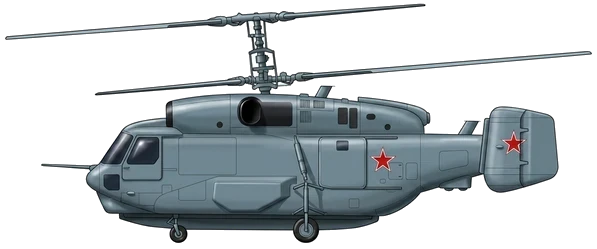
| Crew | 2 |
| Length | 12.5 m (41.0 ft) |
| Wingspan | 15.9 m (52.2 ft) |
| Height | 5.6 m (18.4 ft) |
| Wing area | 397.2 m² (4275.4 sqft) |
| Max. takeoff weight | 12,500 kg (27,558 lbs) |
| Powerplant | 2 × Isotov TV3-117VMA 1,864 kW each |
| Maximum speed | 250 km/h (155 mph) |
| Operational range | 600 km (373 mi) |
| Endurance | 2 hours |


Description
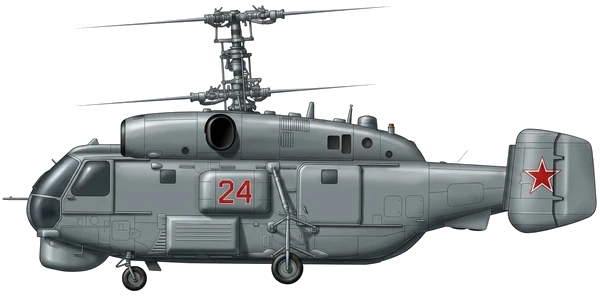
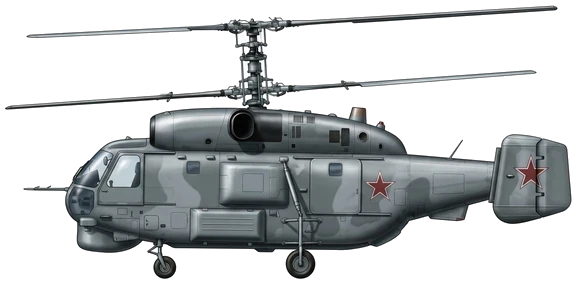
The Kamov Ka-31 (NATO reporting name Helix) is an airborne early warning and control helicopter originally developed for the Soviet Navy. In 1985, the Soviet Navy commissioned the Kamov design bureau to develop the helicopter, initially designated Ka-252RLD, to operate from carriers and other aviation-capable ships. Based on the Ka-27 airframe, two prototypes were constructed from Ka-29 airframes. The radar integration was designed by the Nizhny Novgorod Radio Engineering Institute, and the helicopter's first flight occurred in 1987. State trials began in 1988, followed by ship-based trials on the aircraft carrier Admiral Kuznetsov between 1990 and 1991. The helicopter was officially accepted for Russian Navy service in 1995. Total production reached 28 units.
Design
The Ka-31 utilizes co-axially mounted contra-rotating main rotors. Its airframe lacks anti-submarine warfare equipment and features a wider cockpit than the Ka-27/29, fitted with two additional multi-function displays. Power is supplied by two Klimov TV3-117VMAR turboshaft engines, with a TA-8Ka auxiliary power unit providing electrical power for the radar and C4ISR systems. Sensor and navigation equipment includes a Kronstadt Kabris 12-channel global positioning system and a 16-channel digital communication suite with a range of 400 km. The helicopter is equipped with the E-801 Oko L-band radar, which uses a 6-by-1-meter antenna that rotates under the fuselage. The radar detects and tracks up to 40 targets simultaneously at altitudes between 5 and 3,500 meters, with a detection range of 110 km for fighter-sized targets and 200 km for ships. The landing gear retracts to prevent radar interference, and the antenna folds under the fuselage when not in use. The Ka-31 lacks onboard processing systems, transferring radar data directly to nearby ships.
Operational History
The Russian Navy deployed both prototypes on the Admiral Kuznetsov. In 2008, Russia ordered two Ka-31R variants, which were delivered in 2012. Export customers include India and China. The Indian Navy ordered four Ka-31s in 1999 (delivered 2003), five in 2001 (delivered 2005), and five in 2009 (delivered 2011–2012). Indian Ka-31s operate from carriers, destroyers, and land-based air stations. To address limited endurance, Hindustan Aeronautics Limited was tasked to develop a helicopter-to-helicopter refueling system. In May 2022, negotiations for 10 additional units were suspended. China ordered nine Ka-31s in 2008, which were delivered between 2010 and 2011 and operate from eastern Chinese naval bases.
Variants
- Ka-31: Original naval early warning variant sold to India and China.
- Ka-31R: Naval variant used by the Russian Navy.
- Ka-35: Land-based version of the Ka-31R equipped with a 15S100.10 radar, a modernized cockpit, and a Vitebsk self-protection system.
Frequently Asked Questions
What type of aircraft is the Ka-31?
What is the maximum speed of the Ka-31?
What is the range of the Ka-31?
When did the Ka-31 first fly?
How many Ka-31 have been built?
Which countries operate the Ka-31?
- JUL 12026 Created Page created: Ka-31