KC-767
American military aerial refueling tanker and transport aircraft, developed in the early 2000s, used for strategic airlift and aerial refueling operations. Key figures: top speed 915 km/h, range 12,200 km, service ceiling 12,200 m, max takeoff weight 186,880 kg, built 9. In service with 3 air forces as of 2026 — Italy (4), Japan (4), Colombia (1).
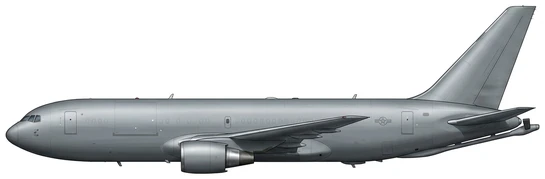
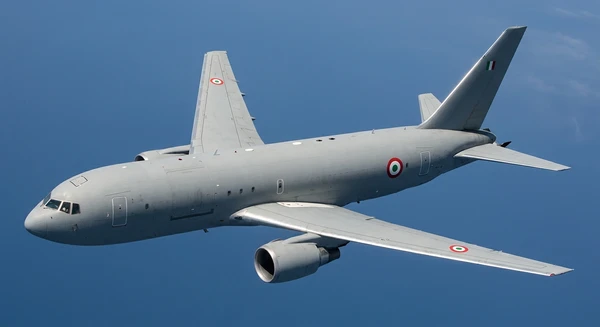
| Crew | 3 (2 pilots, boom operator) |
| Length | 48.5 m (159.1 ft) |
| Wingspan | 47.6 m (156.2 ft) |
| Height | 15.8 m (51.8 ft) |
| Empty weight | 82,377 kg (181,610 lbs) |
| Max. takeoff weight | 186,880 kg (411,999 lbs) |
| Powerplant | 2 × GE CF6-80C2 268 kN each |
| Maximum speed | 915 km/h (569 mph) |
| Operational range | 12,200 km (7,581 mi) |
| Service ceiling | 12,200 m (40,026 ft) |


Description
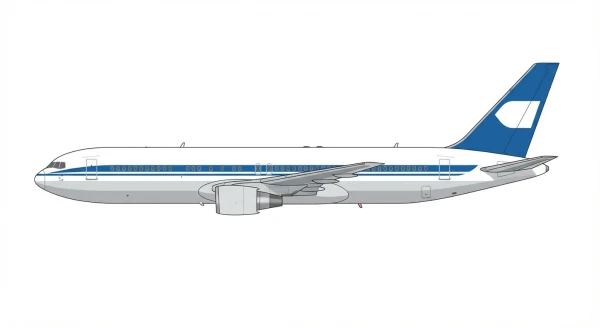
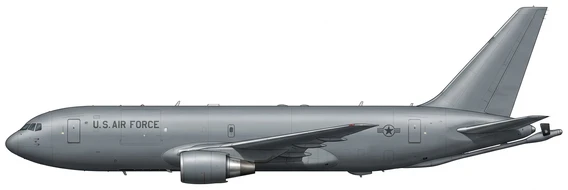
The Boeing KC-767 is a military aerial refueling tanker and transport aircraft developed from the commercial Boeing 767-200ER. Boeing initially designed the KC-767A to replace United States Air Force (USAF) KC-135Es, but the contract was canceled in January 2006 following corruption allegations. A revised proposal was selected in February 2011 for the USAF KC-X program under the designation KC-46. Nine aircraft have been produced, comprising eight new-builds and one conversion. The first flight of a KC-767 occurred on 21 May 2005.
Design
The aircraft is powered by two General Electric CF6-80C2 turbofans, each producing 60,200 lbf of thrust. It features manual flight controls with an unrestricted flight envelope. Refueling operations are controlled via a remote video console rather than a prone operator station. The tanker utilizes a fly-by-wire telescoping boom. Italian variants include centerline and wing-pod hose-drogue systems, while Japanese versions use the boom exclusively. Israel Aerospace Industries (IAI) also offers the KC-767 Multi Mission Tanker Transport (MMTT) conversion, incorporating a cargo door, interchangeable cabin configurations, ARP3 wing pods, and a fly-by-wire boom. The MMTT has a maximum takeoff weight of 400,000 lb and holds up to 200,000 lb of fuel.
Operational History
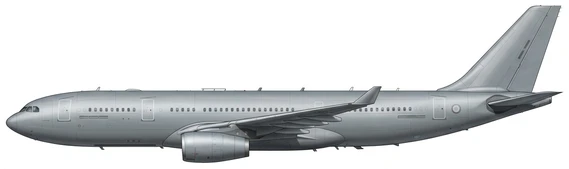
During testing at Edwards Air Force Base, the KC-767 performed its first dry hookup with a B-52 on 23 January 2007 and its first fuel transfer on 5 March 2007. The Italian Air Force operates four KC-767As with the 14º Stormo; these entered service in May 2011 and supported NATO operations in Libya and Afghanistan. The Japan Air Self-Defense Force operates four KC-767Js with the 404th Tactical Airlift Tanker Squadron, achieving initial operational capability in May 2009. The Colombian Air Force operates one IAI-converted MMTT, delivered in 2010, which supported US Navy EA-18G Growlers during Exercise Red Flag 19-2 in 2019. Procurement bids in Australia, the United Kingdom, and South Korea selected the competing Airbus A330 MRTT, and a Brazilian project was abandoned.
Variants
- KC-767A: A tanker variant based on the 767-200 originally intended for the USAF, with four units ultimately delivered to the Italian Air Force.
- KC-767J: The designation for the four boom-only refueling tankers built for the Japan Air Self-Defense Force.
- KC-46A: A modified tanker variant of the 767-2C selected by the USAF to replace its KC-135 fleet.
- KC-767 MMTT: A multi-role tanker and cargo transport variant converted from pre-owned commercial Boeing 767s by Israel Aerospace Industries.
- KC-X2: A planned conversion of Boeing 767-300ER aircraft for the Brazilian Air Force that was abandoned before completion.
Frequently Asked Questions
What type of aircraft is the KC-767?
What is the maximum speed of the KC-767?
What is the range of the KC-767?
When did the KC-767 first fly?
How many KC-767 have been built?
Which countries operate the KC-767?
What is the service ceiling of the KC-767?
- JUL 242026 Created Page created: KC-767