M-55 Mystic
Soviet high-altitude reconnaissance aircraft, developed during the 1980s, used for high-altitude reconnaissance and atmospheric research. Key figures: top speed 750 km/h, range 4,965 km, service ceiling 21,500 m, max takeoff weight 23,800 kg, built 5.
| Crew | 1 |
| Length | 22.9 m (75.0 ft) |
| Wingspan | 37.5 m (122.9 ft) |
| Height | 4.8 m (15.7 ft) |
| Wing area | 131.6 m² (1416.5 sqft) |
| Empty weight | 13,995 kg (30,854 lbs) |
| Max. takeoff weight | 23,800 kg (52,470 lbs) |
| Powerplant | 2 × turbofans Soloviev D-30-V12 93 kN each |
| Maximum speed | 750 km/h (466 mph) |
| Operational range | 4,965 km (3,085 mi) |
| Endurance | 6 hours |
| Service ceiling | 21,500 m (70,538 ft) |



Description
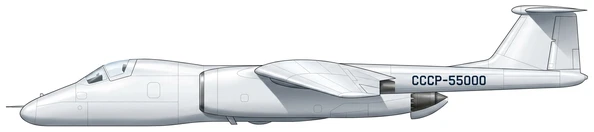
The Myasishchev M-55 (NATO reporting name Mystic-B) is a twin-engine, high-altitude reconnaissance and research aircraft developed by OKB Myasishchev in the Soviet Union. Featuring a twin-boom fuselage and tail design, it was developed as a heavier, twin-engine evolution of the earlier M-17 Stratosphera. The type entered service in the late 1980s for atmospheric research roles following its first flight in 1988. It is known for its high-altitude capabilities and setting multiple FAI aviation world records.
Development
The program originated with Subject 34, a high-altitude balloon interceptor designed to counter American reconnaissance balloons over Soviet territory. The initial Subject 34 prototype, named Chaika, was destroyed during a taxi test accident in December 1978. The concept was redesigned into the M-17 Stratosphera, which first flew on 26 May 1982. In 1987, the interceptor concept was canceled and replaced by the M-17RN, later designated M-55 Geophysica. First flying on 16 August 1988, five M-55 airframes were constructed, including one dual-control trainer.
Design
The M-55 uses a twin-boom fuselage configuration with straight-tapered wings featuring an aspect ratio of 10.6. Power is provided by two un-reheated Soloviev D-30-10V turbofan engines generating 93.192 kN of thrust each. The airframe has a maximum takeoff weight of 23,800 kg and a service ceiling of 21,500 meters. Internal space accommodates high-altitude research sensors, though the trainer variant trades sensor space for a second rear cockpit.
Armament
The preliminary Subject 34 interceptor proposal was designed to carry two air-to-air missiles and two GSh-23 cannons with 600 rounds per gun in a dorsal turret. A ground-attack variant designated M-55Sh was also proposed, but it was never constructed, leaving all operational M-55 airframes unarmed.
Operational History
M-55 airframes performed atmospheric research missions during the 1990s, including studies over the Arctic in 1996–1997 and Antarctica in 1999. The aircraft set 15 FAI world records, including a class altitude record of 21,360 meters on 21 September 1993. Irish communications firm Qucomhaps later signed a 1-billion USD agreement to use the M-55 as a high-altitude digital communications platform in Southeast Asia. As of 2023, the UK Ministry of Defence reported Russian efforts to reactivate the single flyable M-55 for military service.
Variants
- Subject 34: Initial single-seat balloon interceptor prototype, named Chaika, which was destroyed during taxi testing in 1978.
- M-17 Stratosphera: Single-engine reconnaissance variant powered by a Kolesov RD-36-51 turbojet that first flew in May 1982.
- M-55 Geophysica: Production high-altitude research aircraft fitted with two Soloviev D-30-10V turbofans and sensor equipment.
- M-55UTS: Dual-control trainer variant equipped with a second cockpit located directly behind the main pilot station.
- M-55Sh: Proposed ground-attack variant that was never built.
Frequently Asked Questions
What type of aircraft is the M-55 Mystic?
What is the maximum speed of the M-55 Mystic?
What is the range of the M-55 Mystic?
When did the M-55 Mystic first fly?
How many M-55 Mystic have been built?
Which countries operate the M-55 Mystic?
What is the service ceiling of the M-55 Mystic?
- AUG 62026 Created Page created: M-55 Mystic