MiG-27 Flogger
Soviet ground-attack aircraft, prominent for its use in the Afghan War, optimized for air-to-ground operations. Key figures: top speed 1,885 km/h, range 2,500 km, service ceiling 14,000 m, max takeoff weight 20,670 kg, unit price $5M, built 1,075.
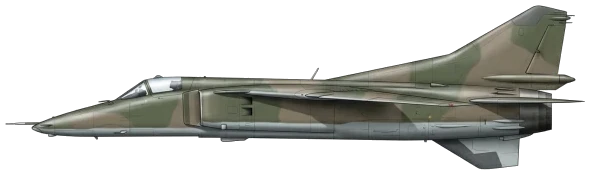
| Crew | 1 |
| Length | 17.1 m (56.0 ft) |
| Wingspan | 14.0 m (45.8 ft) |
| Height | 5 m (16.4 ft) |
| Wing area | 37.4 m² (402.0 sqft) |
| Empty weight | 11,908 kg (26,253 lbs) |
| Max. takeoff weight | 20,670 kg (45,569 lbs) |
| Powerplant | 1 × turbojet Khatchaturov R-29B-300 11,502 kgf each |
| Ejection seat | Mikoyan-Gourevitch KM-1 |
| Maximum speed | 1885 km/h (Mach 1.8) |
| Operational range | 2,500 km (1,553 mi) |
| Service ceiling | 14,000 m (45,932 ft) |
| Climb rate | 200.0 m/s (656.2 ft/s) |
- Air-to-Surface Vympel Kh-25 (AS-10 Karen)
- Anti-Radiation Vympel Kh-27 (AS-12 Kegler)
- Air-to-Surface Vympel Kh-29 (AS-14 Kedge)
- Air-to-Air Short-Range Vympel R-60 / K-60 (AA-8 Aphid)
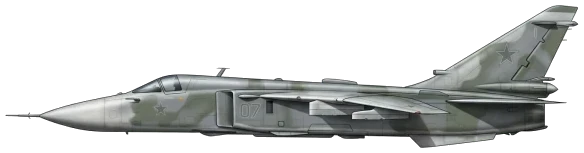
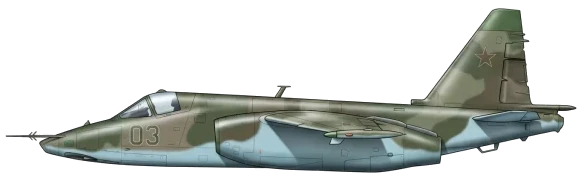
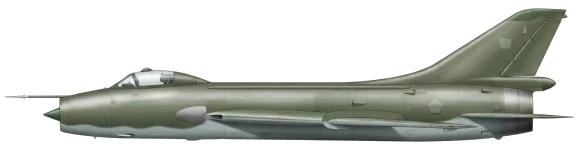
Description
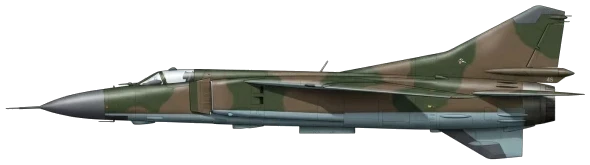
Based on the MiG-23BN airframe (NATO designation: Flogger-H) already dedicated to ground attack, the MiG-27 (Flogger-D) shares many similarities with the Dassault Mirage 5. The MiG-27 is essentially a ground attack aircraft derived from an interceptor, simplified and tailored for air-to-ground missions.
Design
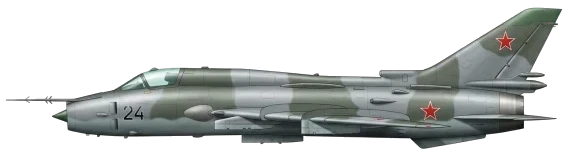
Numerous modifications have been made to the MiG-23 airframe. The engines and air intakes were simplified, while cockpit protection was reinforced with new armor. The landing gear was also strengthened and equipped with low-pressure tires to facilitate operations on unprepared terrain. Armament was increased through the installation of additional wing pylons, allowing for a military payload of up to 4 tons. The avionics system received special attention from Soviet engineers, particularly the attack and navigation systems. Later versions were equipped with a 30mm GSh-6-23M six-barreled cannon and advanced electronic equipment, including a laser targeting system enabling the use of air-to-ground missiles like the Kh-29L and guided bombs. Designed to operate close to the front lines, the MiG-27 had the characteristic flaw shared by many Soviet aircraft of its time, namely a limited range of 1080 kilometers for low-altitude missions (without in-flight refueling capability). It also reportedly suffered from frequent breakdowns and difficult maintenance, a flaw it shared with the MiG-23. Nevertheless, it proved to be a valuable aircraft for the air forces of the Warsaw Pact, allowing for the replacement of older and outdated aircraft like the Sukhoi Su-7.
Operational History
In total, approximately one thousand MiG-27s were produced by Soviet factories in Irkutsk and Ulan-Ude. Currently, it appears that only the Indian Air Force (165 aircraft built, with at least a hundred still in active service), Kazakh Air Force (possibly 120), and Sri Lankan Air Force (7 Ukrainian aircraft) still operate the MiG-27. Russian aircraft were retired following the collapse of the Soviet Union.
Variants
Key versions:
-
MiG-27 (Flogger-D): Initial version, possibly 360 units produced.
-
MiG-27M (Flogger-J): Upgraded MiG-27, notably featuring a 30mm six-barreled cannon in a ventral pod and a Kylon target designator. Produced between 1978 and 1983; the standard to which MiG-27s were upgraded between 1982 and 1985.
-
MiG-27K (Flogger-J2): The final version of the MiG-27, produced in nearly 200 units from 1982 onwards. Equipped with a laser designator, TV or laser-guided missiles, and more advanced avionics compared to its predecessors.
-
Bahadur (sometimes referred to as MiG-27ML): Licensed production of the MiG-27 by India, equivalent to the MiG-27M. 120 aircraft were modernized between 2002 and 2009, incorporating a new inertial navigation system, a laser designation pod, and partially indigenous avionics.
-
Nanchang Q-6: Aborted Chinese attempt to produce a copy of the MiG-27. Currently, it appears that no Q-6 aircraft ever entered service.
Frequently Asked Questions
What type of aircraft is the MiG-27 Flogger?
What is the maximum speed of the MiG-27 Flogger?
What is the range of the MiG-27 Flogger?
When did the MiG-27 Flogger first fly?
How many MiG-27 Flogger have been built?
Which countries operate the MiG-27 Flogger?
How much does a MiG-27 Flogger cost?
What is the service ceiling of the MiG-27 Flogger?
- AUG 122026 Updated Range corrected to the ferry range
- AUG 52026 Updated Thrust updated
- AUG 12026 Updated Manufacturer updated
- JUL 232026 Updated Sources and cross-references refreshed
- APR 72026 Updated Sources and cross-references refreshed