Sea Hawk
British single-seat carrier-based jet fighter-bomber, first flown in 1947 and in service from 1953 to 1983 with the Royal Navy, West Germany, the Netherlands and India. Key figures: top speed 966 km/h, range 772 km, service ceiling 13,564 m, max takeoff weight 7,326 kg, built 542.
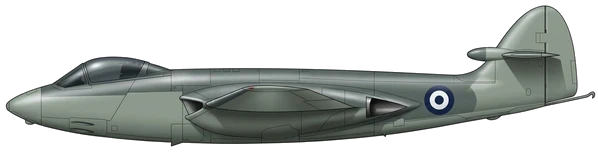
| Crew | 1 |
| Length | 12.1 m (39.7 ft) |
| Wingspan | 11.9 m (39.0 ft) |
| Height | 2.6 m (8.7 ft) |
| Wing area | 25.8 m² (278.0 sqft) |
| Empty weight | 4,208 kg (9,277 lbs) |
| Max. takeoff weight | 7,326 kg (16,151 lbs) |
| Powerplant | 1 × turbojet Rolls-Royce Nene 103 2,359 kgf each |
| Maximum speed | 966 km/h (600 mph) |
| Operational range | 772 km (480 mi) |
| Service ceiling | 13,564 m (44,501 ft) |
| Climb rate | 29.0 m/s (95.1 ft/s) |
- Air-to-Air Short-Range AIM-9 Sidewinder
- Unguided Bomb 500 lb bombs
- Rocket Pod RP-3 60 lb unguided rockets
Description
The Hawker Sea Hawk is a British single-seat carrier-borne jet day fighter and fighter-bomber built by Hawker Aircraft and Armstrong Whitworth Aircraft for the Fleet Air Arm of the Royal Navy. Derived from the piston-engined Hawker Fury, it was Hawker's first jet aircraft. It entered service with 806 Squadron in 1953, flew ground-attack missions during the 1956 Suez Crisis, and was exported to West Germany, the Netherlands and India. The Indian Navy retired the last operational examples in 1983.
Development
Hawker's 1944 P.1035 study replaced the Fury's Griffon engine with a mid-fuselage Rolls-Royce Nene turbojet. It was revised in December 1944 as the P.1040. The RAF withdrew interest after the war, so Hawker continued the design as a private venture. In January 1946 Hawker offered a naval version, the P.1046, to the Admiralty, which ordered three prototypes in May 1946 under Specification N.7/46.
The first prototype, VP401, flew at RAF Boscombe Down on 2 September 1947. The navalised VP413 followed on 31 August 1948 and the production-representative VP422 on 17 October 1949. Trials aboard HMS Illustrious led to a 30 in increase in wingspan. A contract for 151 aircraft followed on 22 November 1949, and the first production F1 flew on 14 November 1951. After the Korean War began, Prime Minister Winston Churchill granted the programme 'Super-Priority' status in 1951. After 35 F1s had been completed at Kingston, production moved to Armstrong Whitworth at Coventry. Over 500 were built. Swept-wing derivatives, the P.1052 and P.1081, contributed to the design of the Hawker Hunter.
Design
The Sea Hawk has a straight tapered wing and a tricycle undercarriage, the first nosewheel layout on a Hawker aircraft. The air intakes are in the wing-root leading edges. The jet pipe is bifurcated into two "trouser leg" exhausts at the wing-root trailing edges, which reduced pressure losses and freed the rear fuselage for fuel tanks fore and aft of the engine. The tailplane was raised to clear the exhausts. The F1 used a 5,000 lbf Nene 101, reached 599 mph at sea level and had an 800-mile range on internal fuel. The afterburning Rolls-Royce Tay was cancelled in 1950, so later aircraft received the 5,200 lbf Nene 103. The FGA 6 has a service ceiling of 44,500 ft. The German Mk 101 carried an EKCO search radar pod.
Armament
The fixed armament is four 20 mm Hispano Mk V cannon with 200 rounds per gun. From the FB 3 onward, a strengthened structure allowed stores on four hardpoints; the FGA 6 specification lists six underwing hardpoints. Loads included 20 RP-3 rockets, four 500 lb bombs, napalm, mines, reconnaissance cameras or two 90 imp gal drop tanks. From 1959 Dutch aircraft each carried two AIM-9 Sidewinder missiles.
Operational History
During Operation Musketeer in 1956, six squadrons flew ground-attack sorties from HMS Eagle, HMS Albion and HMS Bulwark, and several aircraft were damaged by anti-aircraft fire. The last front-line squadron, 806, disbanded at RNAS Brawdy on 15 December 1960, and the Fleet Requirements Unit at Hurn retired its FGA 6s in 1969. West Germany ordered 68 aircraft in 1956 and operated them until the F-104 Starfighter replaced them. Dutch aircraft served aboard HNLMS Karel Doorman and were withdrawn in 1964. Indian Sea Hawks operated from INS Vikrant from 1960 and fought in the 1965 and 1971 Indo-Pakistani wars. In 1971 they sank about a dozen Pakistani gunboats and cargo ships without loss.
Variants
- Sea Hawk F1: Initial fighter with the Nene 101; 95 built.
- Sea Hawk FB 3: Fighter-bomber with a strengthened wing for external stores; 116 built.
- Sea Hawk FGA 6: Ground-attack variant with the Nene 103; 101 produced, 86 of them new-build.
- Sea Hawk Mk 50: Dutch export variant based on the FGA 6 with a Philips UHF radio; 22 built.
- Sea Hawk Mk 101: German all-weather variant with an underwing search radar pod; 32 built.
Frequently Asked Questions
What type of aircraft is the Sea Hawk?
What is the maximum speed of the Sea Hawk?
What is the range of the Sea Hawk?
When did the Sea Hawk first fly?
How many Sea Hawk have been built?
Which countries operate the Sea Hawk?
What is the service ceiling of the Sea Hawk?
- SEP 302026 Created Page created: Sea Hawk