T-39 Sabreliner
American twin-jet utility trainer and transport, the military version of the Sabreliner business jet, in service since 1962 with the USAF, US Navy and US Marine Corps. Key figures: top speed 885 km/h, range 4,020 km, service ceiling 12,192 m, max takeoff weight 8,056 kg, built 200.
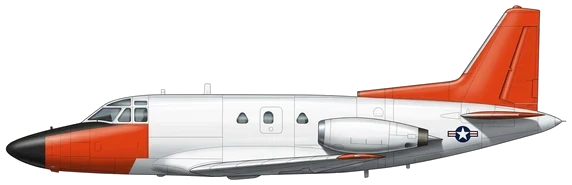
| Crew | 4–5 |
| Length | 13.4 m (44.0 ft) |
| Wingspan | 13.6 m (44.5 ft) |
| Height | 4.9 m (16.0 ft) |
| Wing area | 31.8 m² (342.2 sqft) |
| Empty weight | 4,199 kg (9,257 lbs) |
| Max. takeoff weight | 8,056 kg (17,760 lbs) |
| Powerplant | 2 × turbojets Pratt & Whitney J60-P-3 1,361 kgf each |
| Maximum speed | 885 km/h (550 mph) |
| Operational range | 4,020 km (2,498 mi) |
| Service ceiling | 12,192 m (40,000 ft) |
Description
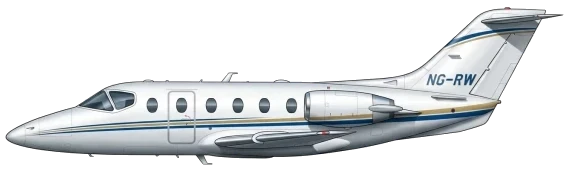
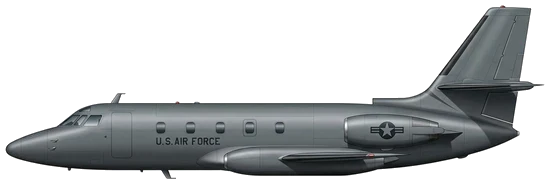
The North American T-39 Sabreliner is an American twin-engine jet trainer and utility transport built by North American Aviation as the military version of the Sabreliner business jet. The USAF ordered it in 1959 under the Utility Trainer Experimental (UTX) program, and it entered service in 1962. The United States Air Force, United States Navy and United States Marine Corps flew it as a pilot proficiency trainer, radar and navigator trainer, and cargo and personnel transport. Its name comes from the similarity of its wing and tail to the North American F-86 Sabre.
Development
North American began the Sabreliner in the mid-1950s as the in-house NA-265 project and submitted it for the UTX requirement. UTX sought one aircraft for both personnel transport and combat readiness training. Lockheed offered a twin-engined JetStar and McDonnell Douglas proposed a four-engined design resembling a scaled-down DC-8. The NA-265 prototype first flew on 16 September 1958 with two General Electric YJ85 turbojets. The production T-39A had the same configuration as the prototype but used Pratt & Whitney JT12A/J60-P3 turbojets. Military deliveries took priority over civil orders. Of more than 800 Sabreliners built, 200 were T-39s: 149 went to the USAF and 51 to the USN. Production ended in 1981, and Sabreliner Corporation was formed in 1982 to support remaining operators.
Design
The Sabreliner was built to military specifications for strength, performance and flying qualities, and also to FAA transport category rules. As a result, its structure and systems are heavy-duty and include features such as fuel heaters. The swept wing has milled aluminium skins fastened with bolts rather than rivets. Its leading-edge slats extend aerodynamically as angle of attack increases. A large air brake sits on the belly aft of the cockpit. Flight controls are mechanically actuated through cables and bellcranks. The aircraft has no tendency to Dutch roll, so it needs no yaw damper. Early aircraft also lacked a stick shaker, because natural stall buffet gave sufficient warning. The cockpit has ten windows. The cabin's high doorsill was a military requirement meant to slow water entry after a ditching. The T-39D is 44 ft 0 in (13.41 m) long, spans 44 ft 6 in (13.56 m) and has a maximum takeoff weight of 17,760 lb (8,056 kg). Its two 3,000 lbf (13 kN) J60-P-3 engines give a maximum speed of 478 kn, a range of 2,170 nmi and a ceiling of 40,000 ft.
Operational History
On 28 January 1964, a Soviet MiG-19 shot down a USAF T-39 that had strayed into East German airspace, killing all three aboard. From late 1965, T-39s replaced Martin B-57 Canberras flying high-priority cargo, such as reconnaissance film, from outlying bases to Saigon. The Navy's T3J-1 (later T-39D) first trained F3H Demon radar operators. It then served in Naval Flight Officer training in three configurations: without radar, with AN/APQ-126 radar for attack-aircraft crews, and with AN/APQ-94 radar for F-8 Crusader pilots. The T-39G and T-39N remain in use for NFO Strike and Strike Fighter training, including for NATO and allied students. On 20 April 1985, a CT-39A overran the runway at Wilkes-Barre/Scranton and burned, killing all five aboard, among them the commander of Tactical Air Command. A former USAF T-39A converted for civil use was acquired for al-Qaeda in 1993 and was abandoned after overrunning the runway at Khartoum around October 1994.
Variants
- T-39A: USAF pilot proficiency trainer and utility transport with J60-P3 engines; 143 built.
- CT-39A: T-39A modified as a cargo and personnel transport.
- T-39B: USAF radar trainer with F-105D avionics, including R-14 NASARR and AN/APN-131 doppler radar; six built.
- T-39D: USN radar systems trainer, originally the T3J-1, with 42 delivered from 1963.
- CT-39G: USN cargo transport based on the stretched Sabreliner 60 with thrust reversers; 13 bought, later converted as T-39G trainers.
Frequently Asked Questions
What type of aircraft is the T-39 Sabreliner?
What is the maximum speed of the T-39 Sabreliner?
What is the range of the T-39 Sabreliner?
When did the T-39 Sabreliner first fly?
How many T-39 Sabreliner have been built?
Which countries operate the T-39 Sabreliner?
What is the service ceiling of the T-39 Sabreliner?
- OCT 12026 Created Page created: T-39 Sabreliner