C-140 JetStar
American four-jet business and utility transport, flown by the USAF from 1961 as the C-140 for navaid flight inspection and as the VC-140B for VIP and presidential transport. Key figures: top speed 922 km/h, range 3,774 km, service ceiling 11,582 m, max takeoff weight 19,051 kg, built 202.
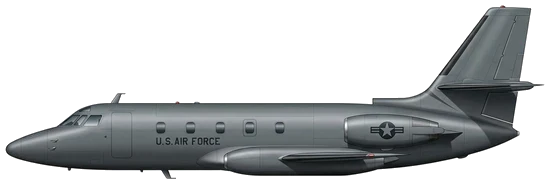
| Crew | 2 |
| Length | 18.4 m (60.4 ft) |
| Wingspan | 16.4 m (53.7 ft) |
| Height | 6.3 m (20.5 ft) |
| Wing area | 50.4 m² (542.5 sqft) |
| Empty weight | 8,755 kg (19,301 lbs) |
| Max. takeoff weight | 19,051 kg (42,000 lbs) |
| Powerplant | 4 × turbojets Pratt & Whitney J60-P-5 1,361 kgf each |
| Maximum speed | 922 km/h (573 mph) |
| Operational range | 3,774 km (2,345 mi) |
| Service ceiling | 11,582 m (37,999 ft) |
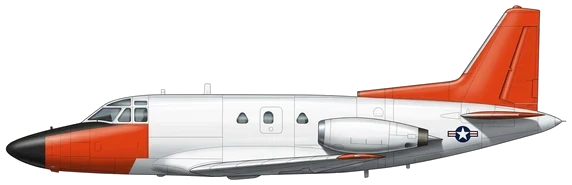
Description
The Lockheed C-140 is the United States Air Force (USAF) designation for the JetStar, an American four-engined business jet built by Lockheed. The first C-140B was delivered in late 1961, and C-140As began operating in 1962. The USAF used the type for navigational-aid flight inspection, personnel transport and VIP transport. VC-140Bs of the 89th Military Airlift Wing occasionally carried the president, flying under the presidential call sign, during the 1970s and 1980s.
Development
The JetStar began as a private Lockheed project intended for a USAF requirement that was later dropped because of budget cuts. Lockheed continued development for the civil market, with design work starting on 6 January 1957. The first prototype flew over Burbank, California, on 4 September 1957, 241 days later. It had two Bristol Siddeley Orpheus turbojets. When Lockheed failed to obtain a US production licence for the Orpheus, it re-engined the second prototype with four Pratt & Whitney JT12 turbojets in 1959. The first production aircraft flew in mid-1960, and the type entered commercial service in 1961. Lockheed also entered the JetStar in a USAF competition for a compact four-engined utility and personnel transport. It won and received the designation C-140. Total JetStar production exceeded 200 aircraft, including 40 turbofan-powered JetStar IIs built from 1976.
Design
The JetStar has a 30° swept wing and a cruciform tail. Its four engines are mounted in side-by-side pairs on the rear fuselage. Slipper-style tanks at about half-span each hold 4,000 lb (1,800 kg) of fuel, and the wings hold another 10,000 lb (4,500 kg), for a total of 18,000 lb (8,200 kg). The wing has leading-edge flaps outboard of the tanks, double-slotted trailing-edge flaps and inflatable rubber de-icing boots. The tail has no de-icing. All flight controls are power-augmented, and roll control uses ailerons without spoilers. The entire fin and stabiliser assembly pivots for pitch trim, and a ventral air brake aids deceleration. The original JetStar used four JT12A-8 turbojets of 3,300 lbf (15 kN) each. Maximum take-off weight is 44,500 lb (20,200 kg), and maximum cruise is Mach 0.8 at 21,000 ft. Range is 2,500 mi (4,000 km) with a 3,500 lb (1,600 kg) payload. The cabin seats eight to ten passengers, and a sunken aisle allows a person to walk upright.
Operational History
The USAF procured five C-140As for the Air Force Communications Service, which used them to flight-check airport navigational aids from 1962. These combat-coded "Flight Check" aircraft deployed to Southeast Asia during the Vietnam War. Besides navaid testing, they loitered offshore as communications relays between the Pentagon and the battlefield. They remained in service until the early 1990s. The USAF also acquired eleven C-140Bs for personnel transport with Military Airlift Command. Six of them (61-2488 to 61-2493) received VIP interiors as VC-140Bs and served with the 89th Military Airlift Wing at Andrews AFB. Presidents Nixon, Ford, Carter and Reagan used VC-140Bs frequently. Carter's dedicated aircraft was known in the Special Air Missions Wing as "Peanut One." Other military operators included the air forces of West Germany, Indonesia, Iran, Libya, Mexico and Saudi Arabia, and NASA and the FAA also flew the type. On 5 January 1995, an Islamic Republic of Iran Air Force JetStar crashed during an emergency landing, killing all 12 aboard, including the commander of the IRIAF. VC-140B 61-2492 is displayed at the National Museum of the United States Air Force.
Variants
- C-140A: Flight inspection aircraft similar to the JetStar I; five were built.
- C-140B: Passenger and cargo transport similar to the C-140A; five were built.
- VC-140B: VIP transport similar to the C-140B, operated by the 89th Military Airlift Wing; six were built.
- C-140C: Two JetStar 6s ordered by the US Navy, originally designated UV-1, but not delivered.
- T-40: Proposed trainer version of the C-140 for evaluation; not built.
Frequently Asked Questions
What type of aircraft is the C-140 JetStar?
What is the maximum speed of the C-140 JetStar?
What is the range of the C-140 JetStar?
When did the C-140 JetStar first fly?
How many C-140 JetStar have been built?
Which countries operate the C-140 JetStar?
What is the service ceiling of the C-140 JetStar?
- OCT 12026 Created Page created: C-140 JetStar