T-67 Firefly
British aerobatic aircraft, renowned in the 1980s, used extensively for military training worldwide. Key figures: top speed 282 km/h, range 753 km, service ceiling 5,791 m, max takeoff weight 1,157 kg, unit price $0.5M, built 250. In service with 1 air force as of 2026 — Bahrain (3).
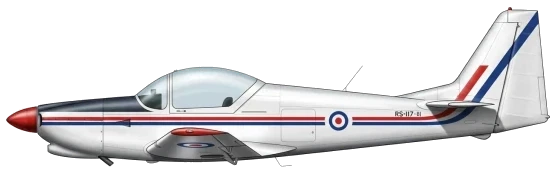
| Crew | 2 |
| Length | 7.6 m (24.8 ft) |
| Wingspan | 10.7 m (35.1 ft) |
| Height | 2.4 m (7.7 ft) |
| Wing area | 13 m² (139.9 sqft) |
| Empty weight | 794 kg (1,750 lbs) |
| Max. takeoff weight | 1,157 kg (2,551 lbs) |
| Powerplant | 1 × pistons engine Lycoming AEIO-540-D 194 kW each |
| Maximum speed | 282 km/h (175 mph) |
| Operational range | 753 km (468 mi) |
| Service ceiling | 5,791 m (18,999 ft) |
| Climb rate | 7.0 m/s (23.0 ft/s) |

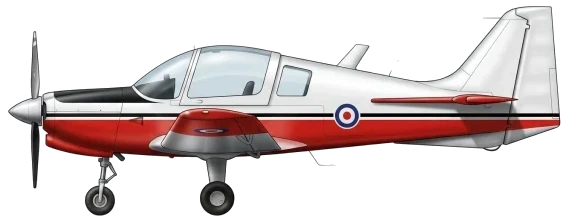
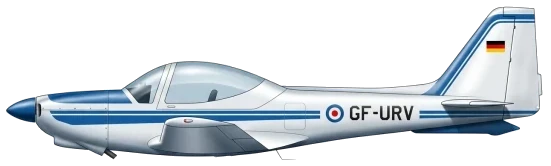
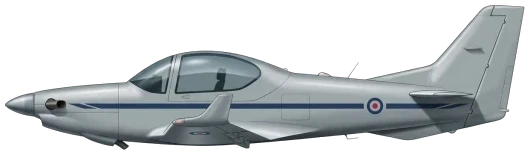
Description
The Slingsby T67 Firefly, originally developed as the Fournier RF-6, is a two-seat aerobatic training aircraft manufactured by Slingsby Aviation in Kirkbymoorside, Yorkshire, England. Operating in both military and civilian roles, the aircraft entered service with armed forces in the early 1990s, including the Canadian Forces in 1992 and the United States Air Force in 1993. The type is known for its poor spin recovery characteristics, which contributed to at least 36 fatal accidents and led to the grounding and scrapping of the U.S. Air Force fleet.
Development
Designed by René Fournier, the wooden RF-6 made its first flight on 12 March 1974 before production at Nitray ceased after approximately 40 aircraft due to financial unviability. Slingsby Aviation purchased the development rights to the RF-6B in 1981, renaming it the T67 and replacing its wooden structure with composite materials. Slingsby progressively upgraded the airframe with larger engines, constant-speed propellers, and inverted fuel and oil systems to target the military training market. Total production exceeded 250 aircraft, primarily composed of the T67M260 and T-3A variants.
Design
The T67 Firefly features a glass-reinforced plastic composite structure with a high aspect-ratio wing using NACA 23015/23013 airfoils. Engine configurations range from a 100 hp Continental O-200 to a six-cylinder 260 hp Textron Lycoming AEIO-540-D engine driving a constant-speed propeller. Military variants incorporate fuel injection and inverted fuel and oil systems to permit sustained negative-G aerobatics. In variants such as the T67M260, the cockpit is built to be flown solo from the right-hand seat to accommodate pilots accustomed to left-hand military throttles.
Operational History
The United States Air Force was the largest operator, taking delivery of 113 T-3A Fireflies between 1993 and 1995 for its Enhanced Flight Screening Program. Following three fatal crashes at the U.S. Air Force Academy and uncommanded flight engine stoppages, the USAF fleet was grounded in July 1997 and scrapped in 2006. The Royal Air Force operated 22 T67M260 trainers from 1995 to 2010, accumulating over 100,000 flight hours across military flying training schools. Additional military operators include the Canadian Forces (designated CT-111), the Royal Jordanian Air Force, the Royal Hong Kong Auxiliary Air Force, and the air arms of Bahrain, Belize, and the Netherlands.
Variants
-
RF-6B: Initial production variant designed by René Fournier, featuring all-wooden construction and a 100 hp Continental O-200 engine.
-
T67A: Slingsby-built wooden variant powered by a 118 hp Lycoming O-235 engine with a two-blade fixed-pitch propeller.
-
T67M Firefly: First composite military variant, equipped with a 160 hp fuel-injected Lycoming AEIO-320 engine, constant-speed propeller, and inverted fuel systems.
-
T67M260 Firefly: High-powered variant featuring a 260 hp Lycoming AEIO-540 engine, three-blade propeller, and right-seat solo capability.
-
T67M260-T3A Firefly: Military variant produced for the United States Air Force featuring an added air conditioning system.
Frequently Asked Questions
What type of aircraft is the T-67 Firefly?
What is the maximum speed of the T-67 Firefly?
What is the range of the T-67 Firefly?
When did the T-67 Firefly first fly?
How many T-67 Firefly have been built?
Which countries operate the T-67 Firefly?
How much does a T-67 Firefly cost?
What is the service ceiling of the T-67 Firefly?
- AUG 62026 Updated Description updated
- JUL 232026 Updated Sources and cross-references refreshed
- APR 72026 Updated Sources and cross-references refreshed
- JAN 122026 Updated Range updated in a site-wide editorial pass