Tu-104 Camel
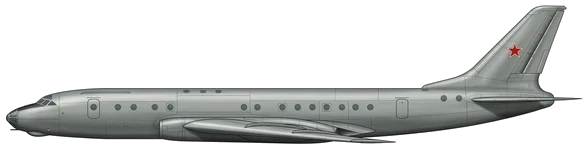
Soviet twin-turbojet airliner derived from the Tu-16 bomber, introduced in 1956 and later flown by the Soviet military as a staff transport, navigator trainer and zero-gravity trainer. Key figures: top speed 950 km/h, range 2,750 km, service ceiling 12,000 m, max takeoff weight 78,100 kg, built 201.
| Crew | 5 (2 pilots, navigator, flight engineer, radio operator) |
| Length | 40.1 m (131.4 ft) |
| Wingspan | 34.5 m (113.3 ft) |
| Height | 11.9 m (39.0 ft) |
| Wing area | 183 m² (1969.8 sqft) |
| Empty weight | 43,800 kg (96,562 lbs) |
| Max. takeoff weight | 78,100 kg (172,181 lbs) |
| Powerplant | 2 × turbojets Mikulin AM-3M-500 9,707 kgf each |
| Maximum speed | 950 km/h (590 mph) |
| Operational range | 2,750 km (1,709 mi) |
| Service ceiling | 12,000 m (39,370 ft) |
| Climb rate | 10.0 m/s (32.8 ft/s) |
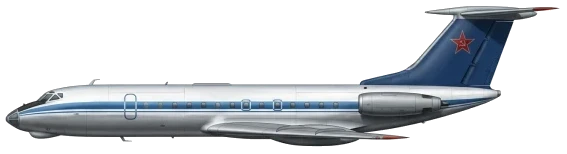
Description
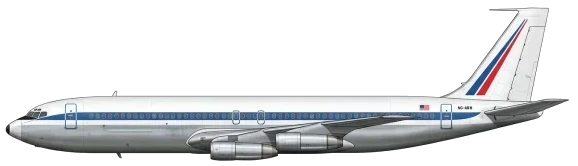
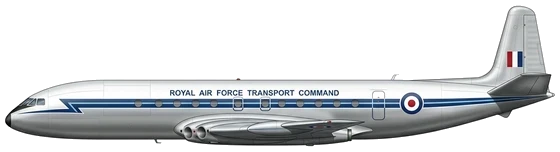
The Tupolev Tu-104 (NATO reporting name: Camel) is a medium-range, narrow-body, twin-turbojet airliner built by the Tupolev OKB in the Soviet Union. It entered revenue service with Aeroflot on 15 September 1956. It was the second jetliner to enter regular service, after the de Havilland Comet, and was the only jetliner in operation worldwide from 1956 to 1958, while the Comet was grounded. The Tu-104 carried over 90 million passengers with Aeroflot and was also operated by ČSA Czechoslovak Airlines and the Soviet Air Force.
Development
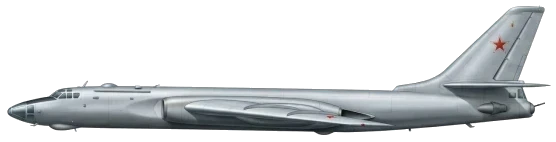
In the early 1950s Aeroflot needed an airliner with greater capacity and performance than its piston-engined fleet. Tupolev based the design on the Tu-16 "Badger" strategic bomber. It kept the bomber's wings, engines and tail surfaces and added a wider, pressurised fuselage for 50 passengers. The prototype, built at MMZ "Opit", first flew on 17 June 1955. The first serial aircraft flew on 5 November 1955. Production totalled 29 Tu-104, 80 Tu-104A and 95 Tu-104B airframes. Experience with the type led Tupolev to develop the Tu-124 and Tu-134.
Design
Two Mikulin AM-3 turbojets were mounted in the wing roots, as on the Tu-16. The Tu-104B used AM-3M-500 engines rated at 95 kN each. The crew comprised two pilots, a navigator seated in the glazed "bomber" nose, a flight engineer, and a radio operator, whose position was later eliminated. A drag parachute shortened the landing distance by up to 400 m. Western observers called the cabin "Victorian" because of its mahogany, copper and lace fittings.
The Tu-104B is 40.06 m long, has a wingspan of 34.54 m and a gross weight of 78,100 kg. It has a maximum speed of 950 km/h and a service ceiling of 12,000 m. Its range is 2,120 km with a 12,000 kg payload.
The aircraft was heavy on the controls, fast on final approach, and prone to Dutch roll. It also tended to pitch up and stall with little warning. Crews therefore landed at 270–300 km/h, about 50 km/h above the recommended speed.
Operational History
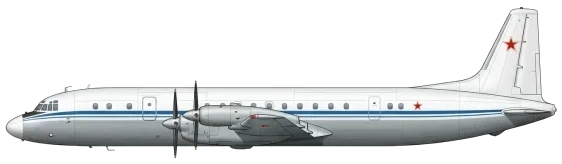
The first route was Moscow–Omsk–Irkutsk, where the Tu-104 replaced the Ilyushin Il-14 and cut flight time from 13 hours 50 minutes to 7 hours 40 minutes. By 1957 Aeroflot flew it from Vnukovo to London, Budapest, Copenhagen, Beijing, Brussels, Ottawa, Delhi and Prague.
ČSA was the only export customer and bought six Tu-104As configured for 81 passengers. In 1957 it became the first airline to fly a route exclusively with jets, between Prague and Moscow.
Sixteen Tu-104s were lost in crashes. After the Kanash crash of 17 October 1958, the type was limited to 9,000 m and its stabilisers were redesigned. The deadliest accident, Aeroflot Flight 964 on 13 October 1973, killed 122 people. Aeroflot retired the type in March 1979 after the Flight 1691 crash. The Soviet military continued to use the Tu-104 as a staff transport and zero-gravity trainer until a crash at Pushkin on 7 February 1981 killed 50, including 16 admirals. The last flight was a ferry flight to the Ulyanovsk museum on 11 November 1986.
Variants
- Tu-104: Initial 50-seat version with Mikulin AM-3 engines, of which 29 were built.
- Tu-104A: Definitive 70-seat production version with AM-3M engines, of which 80 were built, including six for Czechoslovakia.
- Tu-104B: Version with a fuselage stretched by 1.2 m, AM-3M-500 engines and 100 seats, which entered service on 15 April 1959; 95 were built.
- Tu-104AK: Tu-104A converted as a zero-gravity trainer for cosmonaut training.
- Tu-104LL: Test-bed conversions used to trial Tu-22M electronics and air-to-air missile systems, including launches.
Frequently Asked Questions
What type of aircraft is the Tu-104 Camel?
What is the maximum speed of the Tu-104 Camel?
What is the range of the Tu-104 Camel?
When did the Tu-104 Camel first fly?
How many Tu-104 Camel have been built?
Which countries operate the Tu-104 Camel?
What is the service ceiling of the Tu-104 Camel?
- OCT 12026 Created Page created: Tu-104 Camel