Tu-134 Crusty
Soviet jet airliner, ubiquitous during the Cold War, extensively utilized for civil and military operations. Key figures: top speed 950 km/h, range 3,000 km, service ceiling 12,100 m, max takeoff weight 47,600 kg, built 854. In service with 3 air forces as of 2026 — Russia (49), Kazakhstan (1), Tajikistan (1).
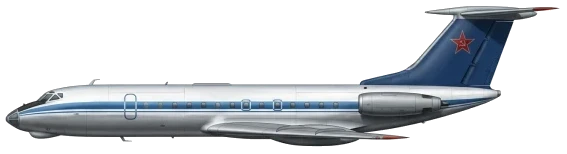
| Length | 37.1 m (121.7 ft) |
| Wingspan | 29 m (95.1 ft) |
| Height | 9.0 m (29.6 ft) |
| Wing area | 127.3 m² (1370.2 sqft) |
| Empty weight | 27,960 kg (61,641 lbs) |
| Max. takeoff weight | 47,600 kg (104,940 lbs) |
| Powerplant | 2 × turbofans Soloviev D-30-II 6,799 kgf each |
| Maximum speed | 950 km/h (590 mph) |
| Operational range | 3,000 km (1,864 mi) |
| Service ceiling | 12,100 m (39,698 ft) |


Description
The Tupolev Tu-134 (NATO reporting name: Crusty) is a twin-engined, narrow-body short- and medium-haul jet airliner built in the Soviet Union between 1966 and 1989. Beyond civil passenger work it was used in air force, army and navy support roles, for pilot and navigator training, and for aviation research and test programmes. It is known for its glazed-nose early configuration, its ability to operate from unpaved airfields, and its widespread use across the former Comecon states, where some European operators scheduled up to 12 takeoffs and landings per aircraft per day.
Development
The layout followed the Sud Aviation Caravelle's introduction of rear-fuselage pylon-mounted engines, an arrangement adopted by manufacturers worldwide for its clean wing airflow and reduced cabin noise. Mounting heavy engines that far aft complicated the relationship between the centre of gravity and the centre of lift at the wings, and required the tailplanes to be relocated to the fin, which had to be strengthened and therefore added further weight aft. The prototype retained the designation Tu-124A under the registration CCCP-45075; all subsequent aircraft were designated Tu-134. A total of 854 aircraft of all versions were built, including test-bed examples.
Design
The Tu-134A has a fuselage 37.1 m long and 2.9 m in diameter, a wingspan of 29.01 m and a wing area of 127.3 m². Power comes from two Soloviev D-30-II turbofans of 66.68 kN thrust each, giving a maximum speed of 950 km/h, a cruise speed of 850 km/h, a service ceiling of 12,100 m and a range of 1,900–3,000 km. Maximum takeoff weight is 47,600 kg, empty weight 27,960 kg, and fuel capacity 13,200 litres. Early aircraft carried the radar in a chin radome beneath a glazed navigator's nose; the Tu-134B moved the radar into a solid nose radome. Crew is three to five flight crew plus three to four cabin attendants, with 72–84 passengers or 8,200 kg of payload.
Operational History
The first scheduled flight, Moscow–Adler, took place in September 1967. It was the first Soviet airliner to receive ICAO international certification, and Aeroflot consequently operated most of its fleet on international routes; domestic services from Sheremetyevo to Baku, Yerevan, Kyiv, Kishinev, Krasnodar, Leningrad, Omsk, Riga and Sochi began in 1972. Interflug, LOT Polish Airlines and Malév Hungarian Airlines were the first export customers in 1968, and the type was shown at the 1969 Paris Air Show. Tighter ICAO noise standards in 2002 barred it from most Western European airports; 245 remained in service in early 2006, 162 of them in Russia. Aeroflot withdrew its fleet on 1 January 2008, and after the RusAir Flight 9605 crash in June 2011 President Dmitry Medvedev ordered its removal from use by 2012. The last Russian passenger flight was on 22 May 2019, and Air Koryo remains the final commercial operator.
Variants
- Tu-134: Initial glass-nosed production version, seating 64 and later 72 passengers.
- Tu-134A: Second series with uprated engines, revised avionics and seating for up to 84.
- Tu-134B: 80-seat version with the radar moved to a nose radome, some fitted with underfuselage long-range tanks.
- Tu-134UBL: Tu-160 crew trainer fitted with a Tu-160 nose cone; the Tu-134UBK was a one-off naval derivative.
- Tu-134Sh: Bomber crew and navigator trainer series, the Sh-1 fitted with bomb racks.
Frequently Asked Questions
What type of aircraft is the Tu-134 Crusty?
What is the maximum speed of the Tu-134 Crusty?
What is the range of the Tu-134 Crusty?
When did the Tu-134 Crusty first fly?
How many Tu-134 Crusty have been built?
Which countries operate the Tu-134 Crusty?
What is the service ceiling of the Tu-134 Crusty?
- AUG 302026 Updated Description updated
- AUG 52026 Updated Description updated
- APR 72026 Updated Sources and cross-references refreshed
- JAN 122026 Updated Range updated in a site-wide editorial pass