DH.106 Comet
British four-engine jet airliner, the world's first to enter commercial service in 1952, also flown by the RAF and RCAF as a military transport and electronic surveillance aircraft. Key figures: range 5,190 km, service ceiling 12,800 m, max takeoff weight 70,760 kg, unit price $3.2M, built 114.
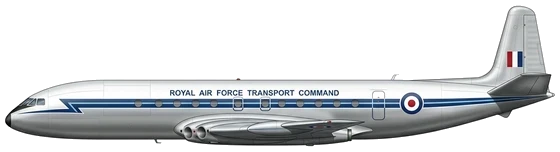
| Crew | 4 (2 pilots, flight engineer, radio operator/navigator) |
| Length | 34.0 m (111.5 ft) |
| Wingspan | 35.1 m (115.0 ft) |
| Height | 9.0 m (29.5 ft) |
| Wing area | 197 m² (2120.5 sqft) |
| Max. takeoff weight | 70,760 kg (155,999 lbs) |
| Powerplant | 4 × turbojets Rolls-Royce Avon 524 4,763 kgf each |
| Operational range | 5,190 km (3,225 mi) |
| Service ceiling | 12,800 m (41,995 ft) |
Description
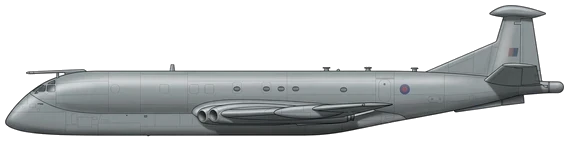
The de Havilland DH.106 Comet is a four-engine narrow-body jet airliner designed and built by de Havilland in the United Kingdom. It was the world's first commercial jet airliner. The prototype first flew on 27 July 1949, and BOAC began scheduled passenger service on 2 May 1952. Within two years of entering service, three Comets were lost in mid-flight break-ups, two caused by metal fatigue, which led to grounding and redesign. The type also served in military transport and electronic surveillance roles and formed the basis of the Hawker Siddeley Nimrod.
Development
A wartime government committee on post-war civil airliners, formed on 11 March 1943, called for a pressurised transatlantic mailplane carrying 1 long ton at 400 mph. De Havilland proposed a turbojet-powered design, and de Havilland received a contract in 1945 under the designation Type 106. BOAC placed a firm order for 10 aircraft in December 1945. A design team was formed in 1946, and two tailless DH 108s were built to test swept-wing configurations. In September 1946, BOAC requirements led to a 36-seat redesign with a 20-degree swept wing. The aircraft was named Comet in December 1947. The first production aircraft, G-ALYP, flew on 9 January 1951. The court of inquiry's water-tank tests on G-ALYU and reconstruction of G-ALYP traced the failures to fatigue cracking at the ADF antenna cut-out. De Havilland responded with thicker skin and reworked cut-outs. The Comet 4 first flew on 27 April 1958, and 76 were delivered between 1958 and 1964.
Design
The Comet is an all-metal low-wing cantilever monoplane with a four-person flight crew: two pilots, a flight engineer and a navigator. Its four turbojets are mounted in pairs within the wing roots, which avoids podded-engine drag and allows a smaller fin. Armour surrounds the engine cells. The Comet 1 used 5,050 lbf Ghost 50 Mk1 engines, later replaced by 5,700 lbf Ghost DGT3s. From the Comet 2 onward, it used 7,000 lbf Rolls-Royce Avons. The skin was riveted and bonded with Redux adhesive. Systems included irreversible powered flight controls, four hydraulic systems and pressurised refuelling. Weather radar and "Q feel" artificial control feel were added after the 1953 Calcutta crash. The Comet 4 carried an EKCO E160 radar in the nose.
Operational History
Comets carried 30,000 passengers in their first year of service. The following fatal break-ups occurred:
- G-ALYV crashed near Calcutta on 2 May 1953, killing 43.
- G-ALYP crashed off Elba on 10 January 1954, killing 35.
- G-ALYY crashed near Naples on 8 April 1954, killing 21.
After the third loss, the Certificate of Airworthiness was revoked. The Comet 4 opened the first regular transatlantic jet service, London–New York, on 4 October 1958. Customers included Aerolíneas Argentinas, East African Airways, BEA, Olympic Airways, Kuwait Airways, Mexicana, Middle East Airlines, Misrair and Sudan Airways. Dan-Air acquired 48 Comets.
In military service, the RAF operated the type with No. 216 Squadron (Comet C2 and C4, 1956–1975), and with Nos. 51 and 192 Squadrons, whose Comet 2Rs monitored Warsaw Pact signal traffic from 1958. RCAF No. 412 Squadron flew Comet 1As from 1953 to 1963.
The type recorded 25 hull losses, including 13 fatal crashes with 492 deaths. Commercial service ended in 1981. Comet 4C XS235 made the last flight on 14 March 1997.
Variants
- Comet 1: Initial production model with Ghost engines and four-wheel bogies; 12 were built, plus 10 Comet 1As with greater fuel capacity.
- Comet 2: Lengthened Avon-powered version; most were rebuilt with heavier-gauge skin and delivered to the RAF from 1955.
- Comet 3: Development aircraft lengthened by 15 ft 5 in with wing pinion tanks; G-ANLO later served as the Nimrod mock-up.
- Comet 4: Redesigned long-range series seating 74 to 81, plus the 4B, a short-range BEA derivative with a longer fuselage and shorter wing (18 built).
- Comet 4C: Combined the 4B fuselage with Comet 4 wings and tanks; 28 were built, and the last two became Nimrod prototypes.
Frequently Asked Questions
What type of aircraft is the DH.106 Comet?
What is the range of the DH.106 Comet?
When did the DH.106 Comet first fly?
How many DH.106 Comet have been built?
Which countries operate the DH.106 Comet?
How much does a DH.106 Comet cost?
What is the service ceiling of the DH.106 Comet?
- OCT 12026 Created Page created: DH.106 Comet