MiG-31 Foxhound
Soviet interceptor jet, famed for its Cold War period deployment, primarily used for high-speed, high-altitude defensive missions. Key figures: top speed 3,000 km/h, range 3,000 km, service ceiling 20,600 m, max takeoff weight 46,200 kg, unit price $55M, built 519. In service with 1 air force as of 2026 — Russia (128).
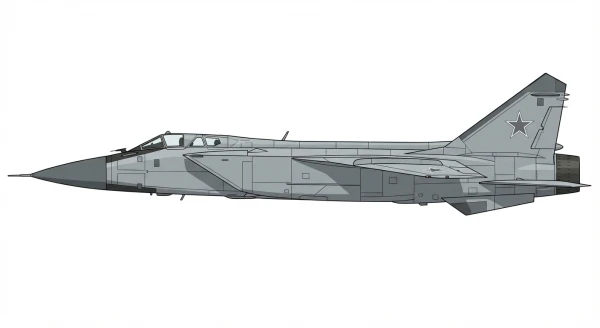
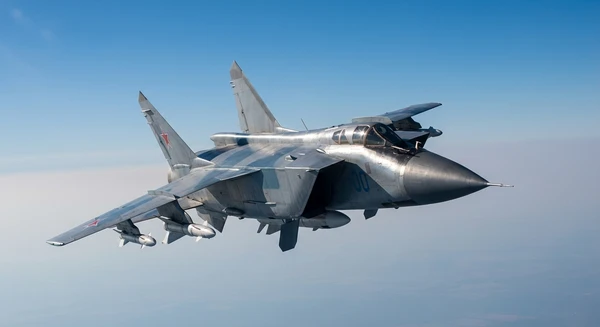
| Crew | 2 (pilot, WSO) |
| Length | 22.7 m (74.4 ft) |
| Wingspan | 13.5 m (44.2 ft) |
| Height | 6.2 m (20.2 ft) |
| Wing area | 61.6 m² (663.1 sqft) |
| Empty weight | 21,830 kg (48,127 lbs) |
| Max. takeoff weight | 46,200 kg (101,853 lbs) |
| Powerplant | 2 × turbofans Soloviev D-30F6 15,500 kgf each |
| Ejection seat | Zvezda K-36DM |
| Maximum speed | 3000 km/h (Mach 3.0) |
| Operational range | 3,000 km (1,864 mi) |
| Service ceiling | 20,600 m (67,585 ft) |
| Climb rate | 208.0 m/s (682.4 ft/s) |

- Air-to-Air Medium-Range Bisnovat R-40 (AA-6 Acrid)
- Air-to-Air Long-Range Vympel R-33 (AA-9 Amos)
- Air-to-Air Long-Range Vympel R-37 (AA-13 Arrow)
- Air-to-Air Short-Range Vympel R-60 / K-60 (AA-8 Aphid)
- Air-to-Air Short-Range Vympel R-73 (AA-11 Archer)
- Air-to-Air Medium-Range Vympel R-77 RVV-AE (AA-12 Adder)
- Hypersonic Air-to-Surface Kh-47M2 Kinzhal (AS-24 Killjoy)
Recent Events — MiG-31 Foxhound
5 events →
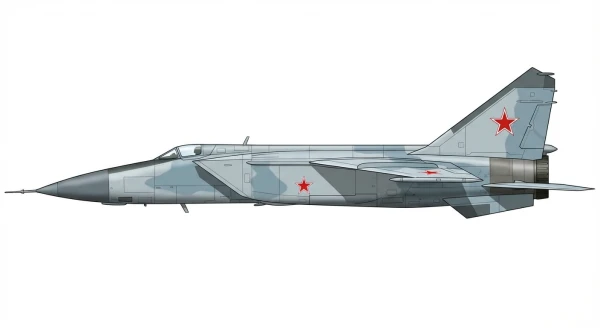
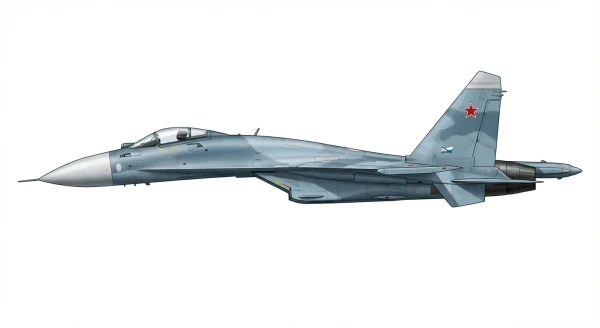
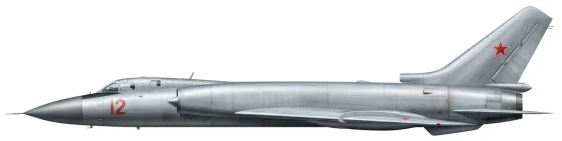
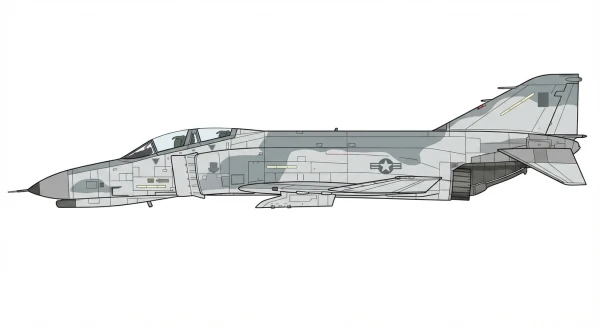
Description
The Mikoyan MiG-31 (NATO reporting name: Foxhound) is a two-seat supersonic interceptor aircraft developed in the Soviet Union by the Mikoyan design bureau as a replacement for the MiG-25. It entered operational service with the Soviet Air Defence Forces in 1981 and remains in service with the Russian Aerospace Forces. The MiG-31 is known as the fastest operational combat aircraft, with a top speed of approximately 3,000 km/h (Mach 2.83).
Development
Development began with the Ye-155MP prototype, which made its first flight on 16 September 1975. Serial production started in 1979 at the Sokol plant, producing an initial batch of 519 baseline aircraft, followed by 101 MiG-31DZs and 69 MiG-31Bs. In 2010, Russia initiated a program to upgrade existing airframes to the MiG-31BM standard. Development of a replacement interceptor under the PAK-DP (MiG-41) program began in 2013.
Design
The MiG-31 is a twin-engine aircraft featuring shoulder-mounted wings, twin vertical tailfins, and two cockpits housing a pilot and a weapon systems officer. The airframe construction consists of 49% arc-welded nickel steel, 33% light metal alloy, 16% titanium, and 2% composite materials. Powered by two Soloviev D30-F6 afterburning turbofans producing 152 kN of thrust each, it reaches Mach 1.23 at low altitude and Mach 2.83 at high altitude. Avionics include the Zaslon passive electronically scanned array radar, an infrared search and track system, and APD-518 datalinks for inter-aircraft data sharing.
Armament
The aircraft features an internal 23 mm GSh-6-23 rotary cannon and four semi-recessed fuselage bays alongside four underwing pylons capable of carrying up to 9,000 kg of payload. Primary long-range air-to-air armament includes R-33 and R-37 missiles, complemented by short- to medium-range R-40TD1, R-60, R-73, and R-77 missiles. Surface strike variants carry air-to-surface munitions including Kh-31, Kh-58, Kh-29, and Kh-59 missiles, KAB-500 or KAB-1500 guided bombs, or a single Kh-47M2 Kinzhal ballistic missile.
Operational History
The Soviet Air Defence Forces accepted the MiG-31 into service in 1981, and airframes were divided between Russia and Kazakhstan following the dissolution of the Soviet Union. Kazakhstan retired its airframes in 2023. During the Russian invasion of Ukraine, Russian MiG-31s operated at high altitude to launch long-range R-37M air-to-air missiles and Kh-47M2 Kinzhal ballistic missiles.
Variants
- MiG-31: The baseline serial production interceptor variant, with 349 units produced between 1976 and 1988.
- MiG-31B: A production variant introduced in 1990 equipped with upgraded ECM, an updated Zaslon radar, and an in-flight refueling probe.
- MiG-31BM: A modernized multirole variant featuring a Baget 55-06 computer, expanded target-tracking capabilities, and compatibility with air-to-surface missiles and precision bombs.
- MiG-31BSM: An upgraded interceptor variant equipped with improved heat-resistant canopy glass, new navigation systems, and multi-functional cockpit displays.
- MiG-31K: A modified attack variant dedicated to carrying the Kh-47M2 Kinzhal air-launched ballistic missile following the removal of air-to-air missile targeting systems.
Frequently Asked Questions
What type of aircraft is the MiG-31 Foxhound?
What is the maximum speed of the MiG-31 Foxhound?
What is the range of the MiG-31 Foxhound?
When did the MiG-31 Foxhound first fly?
How many MiG-31 Foxhound have been built?
Which countries operate the MiG-31 Foxhound?
How much does a MiG-31 Foxhound cost?
What is the service ceiling of the MiG-31 Foxhound?
- AUG 132026 Updated Service entry corrected to the 1981 PVO adoption
- AUG 62026 Updated Description updated
- AUG 52026 Updated Thrust updated
- AUG 12026 Updated Manufacturer updated
- JUL 232026 Updated Sources and cross-references refreshed
- APR 72026 Updated Sources and cross-references refreshed
- APR 52026 Updated Ejection seat added