Mi-38
Russian multi-purpose helicopter, developed in the early 21st century, primarily used for passenger and cargo transport tasks. Key figures: top speed 300 km/h, range 880 km, service ceiling 5,100 m, max takeoff weight 15,600 kg, built 13. In service with 2 air forces as of 2026 — Myanmar (3), Russia (2).
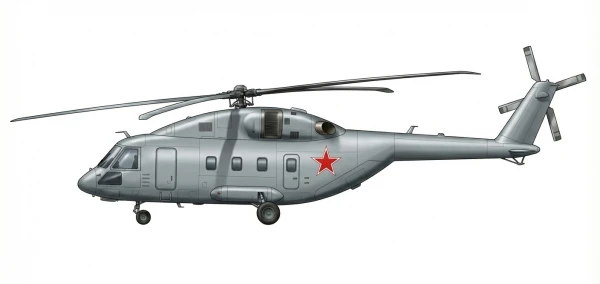
| Length | 19.7 m (64.6 ft) |
| Wingspan | 21.1 m (69.2 ft) |
| Height | 5.1 m (16.8 ft) |
| Empty weight | 8,300 kg (18,298 lbs) |
| Max. takeoff weight | 15,600 kg (34,392 lbs) |
| Powerplant | 2 × turboshafts Klimov TV7-117V 2,059 kW each |
| Maximum speed | 300 km/h (186 mph) |
| Operational range | 880 km (547 mi) |
| Service ceiling | 5,100 m (16,732 ft) |


Description
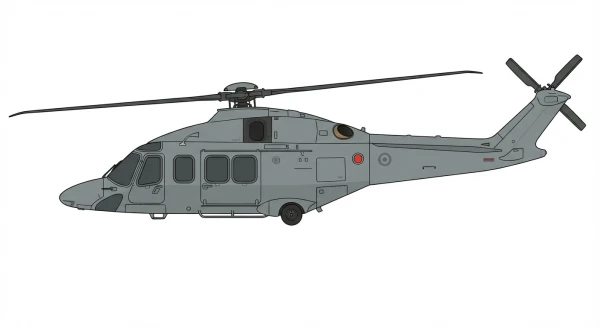
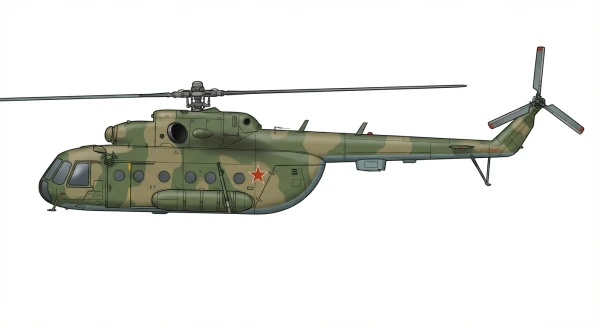
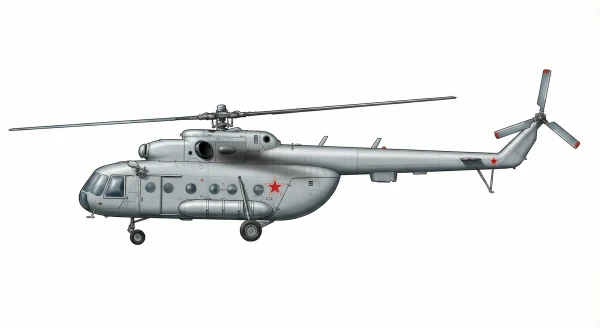
The Mil Mi-38 was conceived as a replacement for the Mi-8 and Mi-17 helicopters. Development efforts by Kazan Helicopters began in the early 1980s, with a mockup first showcased at the 1989 Paris Air Show. Following the dissolution of the Soviet Union, Kazan Helicopters collaborated with Eurocopter to adapt the Mi-38 for the international market, leading to the establishment of Euromil JSC in September 1994. Sextant and Pratt & Whitney Canada were brought on board as suppliers for avionics and powerplant equipment. On 18 August 1999, a contract was signed for the completion of the first demonstrator. Testing of the Mi-38's rotor blades occurred on a Mi-17 in 2001. The first Mi-38 demonstrator (PT-1) achieved its maiden flight on 22 December 2003, taking off above the Kazan Helicopters plant. The second prototype (OP-2), powered by Pratt & Whitney Canada PW127/TS engines, first flew on 2 December 2010. Rosaviatsiya certified the Mi-38 on 30 December 2015, paving the way for production.
Design
Prototypes have been powered by different engines; Western versions use Pratt & Whitney PW127TS engines while Russian versions incorporate Klimov TV7-117V engines. The second prototype was equipped with the IBKO-38 or IBKV-38 aviation complex, developed by Transas Aviation, featuring a glass cockpit concept. The military variant, Mi-38T, is designed with all-Russian components, including engines and avionics, due to international sanctions. The specifications indicate a capacity for a 6,000 kg (13,000 lb) internal payload and a 7,000 kg (15,000 lb) external payload.
Operational History
Since its certification in 2015, the Mi-38 has seen limited operational use. The Russian Defence Ministry took delivery of its first two serial Mi-38s in December 2019 and planned to acquire approximately 15 helicopters by 2020. A military variant, the Mi-38T, tailored to meet specific requirements of the Russian MoD and featuring exclusively Russian-made components, performed its maiden flight in November 2018. In January 2020, orders were placed by an export customer from the Middle East for Mi-38Ts configured for both transport and increased passenger comfort, with deliveries expected in 2021-2022. Domestically, the RF Defense Ministry ordered additional Mi-38s in August 2020, configured with increased cabin comfort, while the Ministry of Emergency Situations ordered nine in August 2021. In 2023, the government of Zimbabwe received an Mi-38 helicopter. By March 2024, Kolyma Aviation introduced two Mi-38 helicopters into commercial service, operating flights within the Magadan Oblast.
Variants
Main Variants:
-
Mi-38-1: The Western version of the Mi-38, distinguished by its Pratt & Whitney PW127TS engines and demonstrated high-altitude flight capabilities during testing, reaching above 8,000 m (26,000 ft).
-
Mi-38-2: This is the Russian variant of the Mi-38, utilizing Klimov TV7-117V engines.
-
Mi-38T: A Russian military version of the Mi-38, designed to meet specific requirements of the Russian Ministry of Defense, incorporating domestically produced components including engines and avionics.
Frequently Asked Questions
What type of aircraft is the Mi-38?
What is the maximum speed of the Mi-38?
What is the range of the Mi-38?
When did the Mi-38 first fly?
How many Mi-38 have been built?
Which countries operate the Mi-38?
What is the service ceiling of the Mi-38?
- AUG 52026 Updated Powerplant updated in a site-wide editorial pass
- AUG 12026 Updated Manufacturer updated
- APR 72026 Updated Sources and cross-references refreshed
- FEB 72026 Updated Wingspan added
- JAN 122026 Updated Range updated in a site-wide editorial pass