Yak-42 Clobber
Soviet mid-range three-engined passenger jet airliner, developed in the 1970s and deployed primarily for commercial passenger transport. Key figures: top speed 810 km/h, range 4,000 km, service ceiling 9,600 m, max takeoff weight 57,500 kg, built 187.
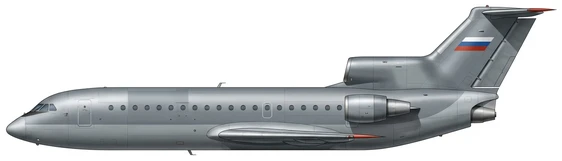
| Crew | 2–3 |
| Length | 36.4 m (119.4 ft) |
| Wingspan | 34.9 m (114.4 ft) |
| Height | 9.8 m (32.3 ft) |
| Wing area | 150 m² (1614.6 sqft) |
| Empty weight | 33,000 kg (72,752 lbs) |
| Max. takeoff weight | 57,500 kg (126,766 lbs) |
| Powerplant | 3 × turbofans Lotarev D-36 64 kN each |
| Maximum speed | 810 km/h (503 mph) |
| Operational range | 4,000 km (2,485 mi) |
| Service ceiling | 9,600 m (31,496 ft) |
Description
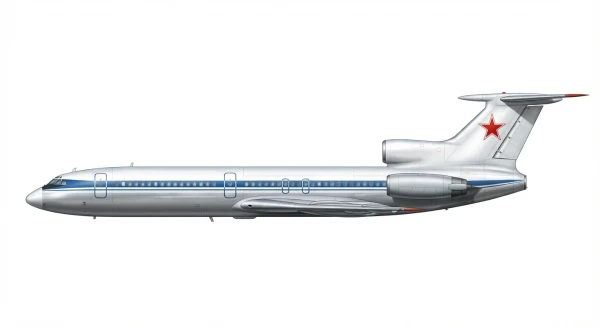
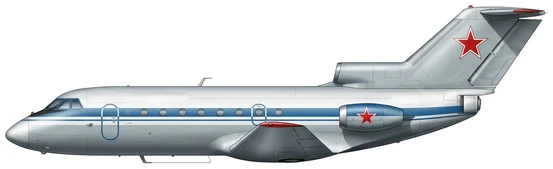
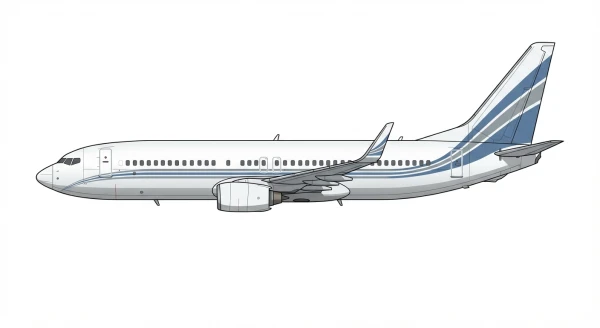
The Yakovlev Yak-42 (NATO reporting name "Clobber") is a Soviet three-engined mid-range passenger jet developed to replace the Tupolev Tu-134. It was the first airliner produced in the Soviet Union powered by high-bypass turbofan engines. Entering service with Aeroflot on 22 December 1980, the aircraft was built to carry 100 to 120 passengers on regional and domestic routes.
Development
The Yakovlev design bureau began work on the Yak-42 in 1972 as a replacement for the Tu-134, Il-18, An-24, and An-26. Initial straight-wing twin-engine proposals were rejected in favor of a three-engine configuration powered by Lotarev D-36 high-bypass turbofans providing 63.90 kN (14,330 lbf) of thrust each. The first prototype, featuring an 11-degree wing sweep, flew on 7 March 1975, followed by a second prototype with a 23-degree wing sweep that was subsequently selected for production. The first production model was completed on 28 April 1978, and a total of 185 aircraft were produced by 1 January 1995.
Design
The Yak-42 is an all-metal, low-winged monoplane featuring a pressurized circular-section fuselage, a swept T-tail, and a service lifespan of 30,000 flight hours. Its propulsion layout consists of three Lotarev D-36 turbofans—two podded on the sides of the rear fuselage and one mounted internally using an S-duct inlet—operating without thrust reversers. Serial production aircraft utilize a 23-degree wing sweep with leading-edge slats, slotted trailing-edge flaps, and four-wheel main landing gear units. Passenger access is accommodated by a port-side forward cabin door and a ventral rear airstair built into the lower tail cone.
Operational History
Aeroflot introduced the Yak-42 into scheduled service on 22 December 1980 on the Moscow–Krasnodar route. Following a fatal accident on 28 June 1982 caused by a horizontal stabilizer actuator failure, all Yak-42 aircraft were grounded until October 1984. Export sales of the longer-range Yak-42D variant were made to operators in Bosnia, China, Cuba, and Iran. Russian carriers, including Izhavia and KrasAvia, continued operating the type into the 2020s.
Variants
-
Yak-42: Original baseline production variant with a maximum takeoff weight of 54,000 kg.
-
Yak-42D: Long-range production variant featuring increased fuel capacity that replaced the standard Yak-42 in production.
-
Yak-142: Updated derivative of the Yak-42D equipped with AlliedSignal avionics, descent spoilers, and an enlarged cabin door.
-
Yak-42F: Conversion model equipped with large underwing electro-optical sensor pods for geophysical survey and environmental monitoring.
-
Yak-42LL: Engine testbed aircraft modified to carry a single 8,090 kW Progress D-236 propfan engine on a starboard wing pylon.
Frequently Asked Questions
What type of aircraft is the Yak-42 Clobber?
What is the maximum speed of the Yak-42 Clobber?
What is the range of the Yak-42 Clobber?
When did the Yak-42 Clobber first fly?
How many Yak-42 Clobber have been built?
Which countries operate the Yak-42 Clobber?
What is the service ceiling of the Yak-42 Clobber?
- AUG 62026 Created Page created: Yak-42 Clobber