Yak-40 Codling
Soviet regional jet airliner and VIP transport, introduced in the late 1960s and operated for short-haul passenger and cargo routes. Key figures: top speed 858 km/h, range 1,800 km, service ceiling 8,000 m, max takeoff weight 15,500 kg, built 1,011.
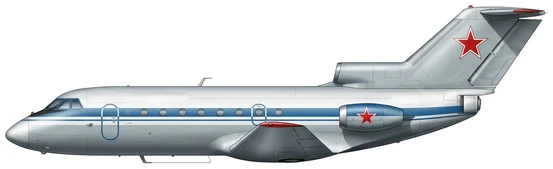
| Crew | 3 (2 pilots, flight mechanic) |
| Length | 20.4 m (66.8 ft) |
| Wingspan | 25 m (82.0 ft) |
| Height | 6.5 m (21.3 ft) |
| Wing area | 70 m² (753.5 sqft) |
| Empty weight | 9,400 kg (20,723 lbs) |
| Max. takeoff weight | 15,500 kg (34,172 lbs) |
| Powerplant | 3 × turbofans Ivchenko AI-25 1,500 kgf each |
| Maximum speed | 858 km/h (533 mph) |
| Operational range | 1,800 km (1,118 mi) |
| Service ceiling | 8,000 m (26,247 ft) |
| Climb rate | 8.0 m/s (26.2 ft/s) |
Description
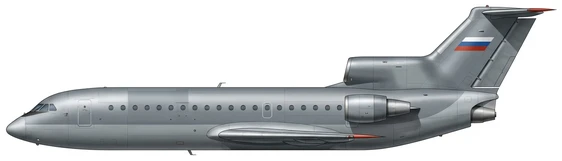
The Yakovlev Yak-40 (NATO reporting name: Codling) is a Soviet regional trijet airliner designed by the Yakovlev design bureau. Manufactured at the Saratov Aviation Plant, the aircraft was developed to operate from short, unpaved airfields lacking ground support equipment. It made its maiden flight in 1966 and entered service with Aeroflot in 1968. The Yak-40 was the first Soviet-built airliner designed to Western airworthiness standards.
Development
In the early 1960s, Soviet state airline Aeroflot sought a turbine-powered replacement for piston-engined Il-12, Il-14, and Li-2 airliners operating on local routes. Yakovlev was assigned to design an aircraft capable of operating from unpaved runways shorter than 700 meters in poor weather. After evaluating turboprop, jet, and vertical take-off concepts, the bureau selected a straight-winged trijet design powered by Ivchenko AI-25 turbofans. The first prototype flew on 21 October 1966, and production at the Saratov Aviation Plant ran from 1967 to November 1981, yielding over 1,000 airframes.
Design
The Yak-40 is a low-wing cantilever monoplane featuring unswept wings, a T-tail swept back at 50 degrees, and retractable tricycle landing gear. Power is provided by three 14.7 kN Ivchenko AI-25 two-shaft turbofans, with two mounted on exterior fuselage pylons and one positioned internally via an S-duct. An auxiliary power unit allows autonomous engine starting at unequipped airfields. The 2.4-meter-diameter pressurized fuselage accommodates two pilots and 24 to 32 passengers, who enter through rear ventral airstairs. Internal wing tanks carry 3,800 liters of fuel, and short-field performance relies on low wing loading and trailing-edge slotted flaps.
Operational History
Aeroflot initiated passenger operations with the Yak-40 on 30 September 1968 following Soviet certification. The aircraft served as the primary short-haul transport for Aeroflot, connecting 276 domestic destinations by 1980 and carrying 354 million passengers by 1993. A total of 130 airframes were exported to foreign operators across 21 countries, including Cuba, Poland, Syria, and North Korea. The type was also the first Soviet airliner to gain airworthiness certificates in Italy and West Germany. In July 2021, an experimental Yak-40 testbed began flight testing with an electric propeller engine fitted to its nose.
Variants
- Yak-40: Initial production passenger airliner model.
- Yak-40K: Convertible passenger and cargo version featuring a large freight door, produced from 1975 to 1981.
- Yak-40D: Extended-range passenger variant configured with increased fuel capacity for non-stop flights.
- Yak-40-25: Military Elint conversion fitted with the nose section of a MiG-25R reconnaissance aircraft.
- Yak-40 Akva: Military conversion equipped with a nose probe, underwing active jammer pods, and pylon-mounted sensors.
Frequently Asked Questions
What type of aircraft is the Yak-40 Codling?
What is the maximum speed of the Yak-40 Codling?
What is the range of the Yak-40 Codling?
When did the Yak-40 Codling first fly?
How many Yak-40 Codling have been built?
Which countries operate the Yak-40 Codling?
What is the service ceiling of the Yak-40 Codling?
- AUG 62026 Created Page created: Yak-40 Codling