Z-8
Chinese three-engined heavy-lift military transport helicopter, developed in the late 20th century, utilized for transport, anti-submarine warfare, search and rescue, and utility missions. Key figures: top speed 273 km/h, range 800 km, service ceiling 3,050 m, max takeoff weight 13,000 kg. In service with 1 air force as of 2026 — China (181).
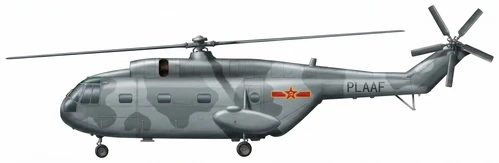
| Crew | 2 |
| Length | 23.0 m (75.6 ft) |
| Wingspan | 18.9 m (62.0 ft) |
| Height | 6.7 m (21.9 ft) |
| Empty weight | 7,095 kg (15,642 lbs) |
| Max. takeoff weight | 13,000 kg (28,660 lbs) |
| Powerplant | 3 × turboshafts Changzhou WZ-6 1,128 kW each |
| Maximum speed | 273 km/h (170 mph) |
| Operational range | 800 km (497 mi) |
| Endurance | 4 hours |
| Service ceiling | 3,050 m (10,007 ft) |
| Climb rate | 6.6 m/s (21.7 ft/s) |

Description
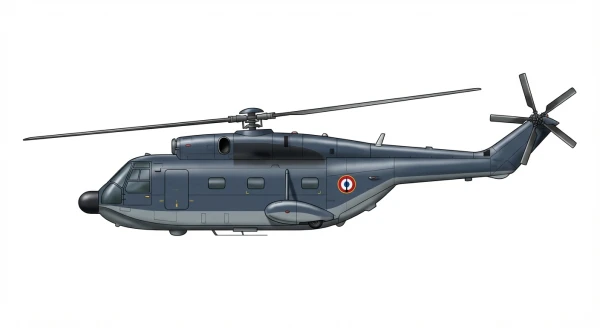
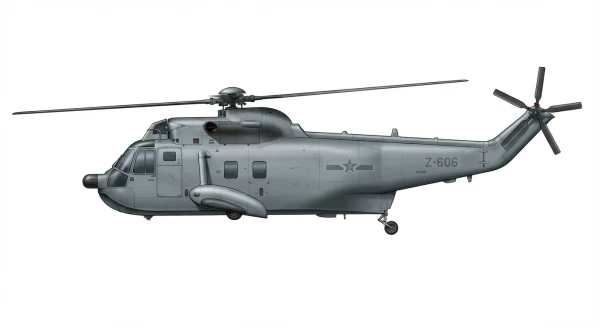
The Changhe Z-8 is a Chinese three-engined heavy-lift military transport helicopter produced by Changhe Aircraft Industries Corporation, built under licence from the French Aérospatiale SA 321 Super Frelon. It serves the People's Liberation Army Naval Air Force, Ground Force Aviation, Air Force and the People's Armed Police in transport, anti-submarine warfare, search and rescue, medical evacuation and firefighting roles. The first Chinese-built example flew on 11 December 1985 and the type was certified on 12 November 1994.
Development
China purchased the SA 321 Super Frelon in the 1970s and began licensed production in 1976 at the Changhe Aircraft Company under the designation Z-8. The programme encountered difficulties and was halted until 1984. The first Chinese-produced Z-8 flew on 11 December 1985 and a second prototype followed in October 1987, with initial production aircraft delivered to PLA Naval Aviation for trials in mine clearance, minelaying and anti-submarine warfare. Production slowed during the 1990s because the PLA Navy operated few warships with hangars large enough for the type, and the smaller Harbin Z-9 was preferred; output totalled roughly 15–20 airframes. A new programme launched in 2002 to improve avionics and adapt the design for other service branches, leading to the Z-8F utility variant for the PLA Ground Force, which first flew in April 2004. More than a dozen variants followed, along with the improved Changhe Z-18 and the civil Avicopter AC313.
Design
The Z-8 retains the Super Frelon's three-engine layout and boat-hulled amphibious fuselage, with sponsons and, on early variants, stabilising floats. The Z-8F introduced Pratt & Whitney Canada PT6B-67A turboshaft engines together with new intake filtration systems, composite rotor blades, de-icing systems, new avionics and a new auxiliary power unit. The Z-8B added a digital cockpit and electronic flight control system while deleting the floats. The Z-8L widened the fuselage, increasing internal cargo bay width from 1.8 m to 2.4 m and enlarging the fuel sponsons. The Z-8AEW carries a retractable AESA radar antenna with 360-degree coverage, a redesigned nose and a FLIR turret.
Operational History
The type saw its production expand following the 2008 Sichuan earthquake, after which new engines and design changes addressed long-standing deficiencies. Z-8s have been used in subsequent earthquake relief operations for rescue and logistics. The People's Armed Police ordered 18 Z-8s, with at least five delivered by 2013, most assigned to forestry firefighting units. As of 2025 the PLA Ground Force Aviation operated 135 Z-8Fs; the PLA Air Force held 18 aircraft as of 2024, and PLA Naval Aviation fielded 9 Z-8, 13 Z-8J, 4 Z-8JH and 2 Z-8S. No export customers have been recorded.
Variants
- Z-8: Original production variant for the PLA Naval Air Force.
- Z-8A: Improved Z-8 with higher domestic content, operated by the PLA Ground Force.
- Z-8F: Version powered by Pratt & Whitney Canada PT6B-67A engines with composite rotor blades, de-icing and a new APU.
- Z-8K/Z-8KA: PLA Air Force search and rescue and combat search and rescue variants.
- Z-8L: Wide-body development of the Z-8G with enlarged sponsons, first observed in January 2019.
Identified in 2 sorties in the official China-Taiwan Tensions activity reports between 2021 and 2021 — a floor, not a census: only sorties the source identified by type are counted, and how much it disclosed varies by year.
Frequently Asked Questions
What type of aircraft is the Z-8?
What is the maximum speed of the Z-8?
What is the range of the Z-8?
When did the Z-8 first fly?
Which countries operate the Z-8?
What is the service ceiling of the Z-8?
- AUG 302026 Updated Description updated
- AUG 52026 Updated Powerplant and thrust updated
- AUG 42026 Created Page created: Z-8; then thrust updated