R-4
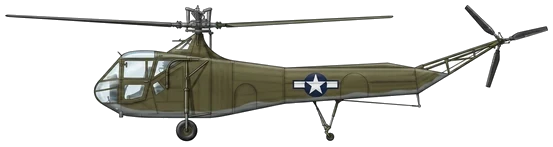
American helicopter from the 1940s, first to be produced in quantity, used primarily in World War II for rescue operations. Key figures: top speed 121 km/h, range 210 km, service ceiling 2,400 m, max takeoff weight 1,150 kg, unit price $0.01M, built 131.
| Crew | 1 |
| Length | 10.8 m (35.4 ft) |
| Wingspan | 11.6 m (38.1 ft) |
| Height | 3.8 m (12.5 ft) |
| Empty weight | 950 kg (2,094 lbs) |
| Max. takeoff weight | 1,150 kg (2,535 lbs) |
| Maximum speed | 121 km/h (75 mph) |
| Operational range | 210 km (130 mi) |
| Service ceiling | 2,400 m (7,874 ft) |

Description
The Sikorsky R-4 is a two-seat light helicopter designed by Igor Sikorsky in the United States, with a single three-blade main rotor and a radial engine. The world's first helicopter produced in large numbers, it was also the first placed in service by the United States Army Air Forces, the US Navy, the US Coast Guard, the Royal Air Force and the Royal Navy. It was designated HNS-1 in the Navy and the Coast Guard, and Hoverfly in the United Kingdom.
Development
The VS-316 derives from the experimental VS-300, publicly demonstrated in 1940. Designated XR-4 in the USAAF's "Rotorcraft" series, it flew on 14 January 1942 and was accepted by the Army on 30 May 1942. The prototype made a 1,225 km ferry flight from Bridgeport, Connecticut, to Wright Field, Ohio, reached an altitude of 3,700 m and logged 100 flying hours without major incident, at a maximum speed approaching 145 km/h. On 5 January 1943, the USAAF ordered 29 prototypes, including three YR-4As with a 180 hp Warner R-550-1 engine and a rotor enlarged by 30 cm. Evaluation required moving the tail wheel rearwards, directing the exhaust sideways and adding 19 L of fuel, changes that produced the YR-4B. United Aircraft announced on 5 November 1944 the completion of the hundredth example, at a rate of five every six days. The British Admiralty received two of the first eight aircraft; after the loss of the Empire Mersey in 1942, deck landing trials were carried out in 1944 from the SS Daghestan.
Design
The blades are made of wooden ribs around a steel spar, covered with doped fabric. They remained difficult to keep in track and vibrated heavily, the cyclic describing small continuous orbits. No governor controlled rotor speed: the pilot had to correlate throttle with collective pitch constantly. The R-4B is powered by a 185 hp Warner R-550-1 seven-cylinder air-cooled radial, with a 12 m diameter rotor. Empty weight 912 kg, maximum weight 1,152 kg, maximum speed 121 km/h, cruise 105 km/h, range 210 km, ceiling 2,400 m. A stretcher could be carried externally.
Operational History
After the sinking of USS Turner in January 1944, Commander Frank Erickson (USCG) carried out the first American helicopter rescue, carrying plasma from New York. On 22 and 23 April 1944, Lieutenant Carter Harman of the 1st Air Commando Group carried out the first combat evacuation in a YR-4B in Burma, recovering four men two at a time. Under Operation Ivory Soap, six repair ships sailed on 23 May 1944 with two R-4s each. From 15 June to 29 July 1945, 2LT Louis Carle and five other pilots evacuated 75 to 80 wounded from the heights north-east of Manila, under Japanese machine-gun fire. In the RAF, the Helicopter Training School was formed in January 1945 at RAF Andover; many Hoverfly Mk Is were later transferred to the Royal Navy.
Variants
- XR-4: two-seat dual-control VS-316A prototype with a 165 hp Warner R-500-3 engine, becoming the XR-4C after re-engining.
- YR-4A: version with a larger-diameter rotor and a 180 hp Warner R-550-1 engine; three built.
- YR-4B: version modified for trials and training; 27 aircraft then a batch of 14, seven of which were delivered to the US Navy as the HNS-1.
- R-4B: production version with a 200 hp Warner R-550-3 engine; 100 built, including 20 for the US Navy and 45 for the RAF.
- Hoverfly I: British designation of the R-4 for the RAF and the Royal Navy; 52 delivered, one of which was later transferred to the Royal Canadian Air Force.
Frequently Asked Questions
What type of aircraft is the R-4?
What is the maximum speed of the R-4?
What is the range of the R-4?
When did the R-4 first fly?
How many R-4 have been built?
Which countries operate the R-4?
How much does a R-4 cost?
What is the service ceiling of the R-4?
- AUG 302026 Updated Description updated
- JUL 232026 Updated Sources and cross-references refreshed
- APR 72026 Updated Sources and cross-references refreshed
- JAN 122026 Updated Range updated in a site-wide editorial pass