Su-17 Fitter
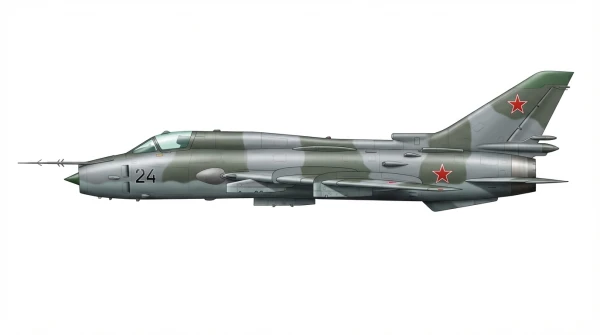
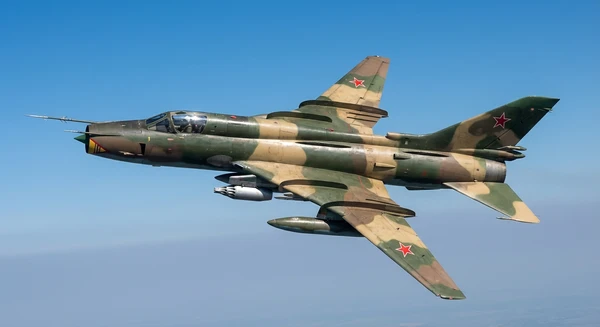
Soviet-era fighter-bomber, extensively deployed in varied conflicts worldwide, known for its variable-sweep wing design and robust operational capacity. Key figures: top speed 2,140 km/h, range 2,300 km, service ceiling 14,500 m, max takeoff weight 7,890 kg, unit price $6M, built 2,867. In service with 6 air forces as of 2026 — Syria (39), Vietnam (25), Yemen (20) and 3 others.
| Crew | 1 |
| Length | 15.3 m (50.0 ft) |
| Wingspan | 10.0 m (32.6 ft) |
| Height | 4.5 m (14.8 ft) |
| Wing area | 27.5 m² (296.0 sqft) |
| Empty weight | 5,932 kg (13,078 lbs) |
| Max. takeoff weight | 7,890 kg (17,394 lbs) |
| Powerplant | 1 × turbojet TR-3 4,000 kgf each |
| Ejection seat | Severin KS-4 |
| Maximum speed | 2140 km/h (Mach 2.14) |
| Operational range | 2,300 km (1,429 mi) |
| Service ceiling | 14,500 m (47,572 ft) |
| Climb rate | 47.6 m/s (156.2 ft/s) |




Recent Events — Su-17 Fitter
5 events →-
FEB 282026
 Iran
×2
Two IRGC Su-22 Fitter aircraft destroyed on ground at Iranian military airfield by USAF precision strikes; CENTCOM released strike footage.
Shot down
Iran
×2
Two IRGC Su-22 Fitter aircraft destroyed on ground at Iranian military airfield by USAF precision strikes; CENTCOM released strike footage.
Shot down
-
SEP 112025
 Poland
×18
Poland retired its last 18 Su-22M4/UM3K Fitters at Świdwin, ending the last Sukhoi fighter-bomber operations in NATO.
Retired
Poland
×18
Poland retired its last 18 Su-22M4/UM3K Fitters at Świdwin, ending the last Sukhoi fighter-bomber operations in NATO.
Retired
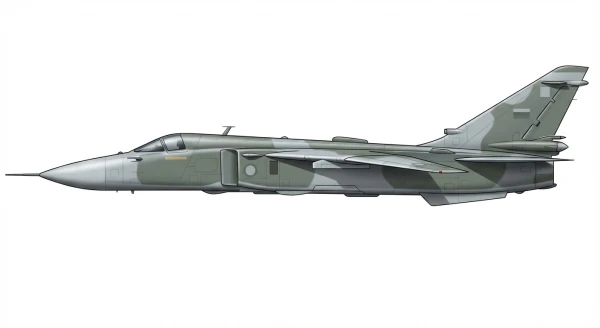
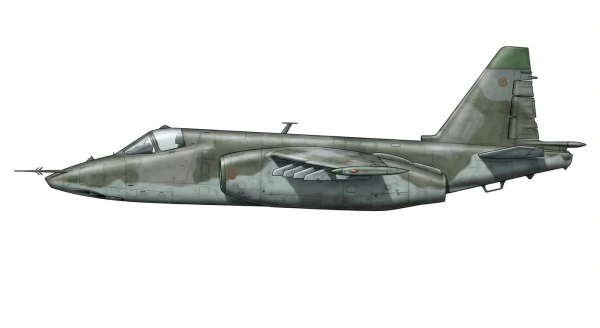
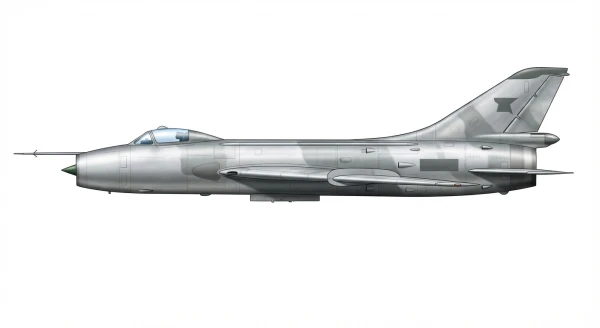
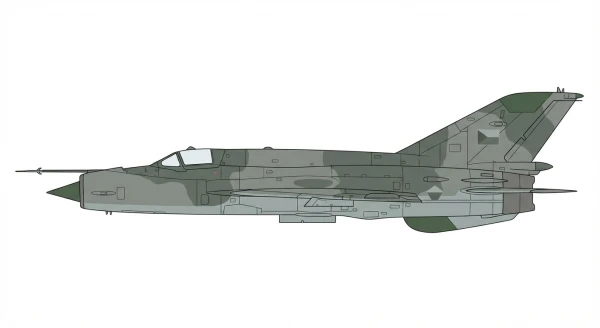
Description
The Sukhoi Su-17 (NATO reporting name: Fitter) is a variable-sweep wing fighter-bomber developed by the Sukhoi Design Bureau in the Soviet Union. Developed from the Su-7, it served primarily in ground-attack and close-air support roles while retaining tactical nuclear weapon delivery capability. Serial production began in 1969, and the type entered Soviet service with the 523rd Aviation Regiment. It was the first variable-sweep wing aircraft to enter operational service with the Soviet military.
Development
In the 1960s, the Soviet government ordered the Sukhoi Design Bureau to modernize the Su-7, appointing Nikolay Zyrin as head designer. The program integrated variable-geometry wings to improve takeoff and landing performance alongside avionics updates. The S-22I technology demonstrator made its first flight on 2 August 1966, followed by the refined S-32 prototype on 1 July 1969. Serial production began in 1969 at the Yuri Gagarin Aviation Factory and continued until 1990, producing 2,867 units across all Su-17, Su-20, and Su-22 models.
Design
The Su-17 retained the fuselage layout of the Su-7 but incorporated variable-sweep wing segments adjustable between 30° and 63°. Weight-saving design choices included removing armor protection for the pilot. Power was supplied by a Lyulka AL-7F1-250 afterburning turbojet producing 9,600 kgf of thrust on early models, with later variants introducing AL-21F-3 or R-29BS-300 engines. Onboard systems featured three independent hydraulic circuits, a pneumatic system for braking and gun charging, and the SAU-22 automatic control system.
Armament
Internal armament comprises two 30 mm NR-30 autocannons mounted in the wing roots. External stores are carried on up to ten hardpoints with a total capacity of 4,000 kg. Munitions options include unguided rockets, free-fall and cluster bombs, Kh-23, Kh-25, and Kh-29 air-to-surface missiles, Kh-28 and Kh-58 anti-radiation missiles, and R-60 or R-73 air-to-air missiles.
Operational History
Soviet Su-17s flew combat missions in the Soviet-Afghan War and the First Chechen War. Export models designated Su-20 and Su-22 were operated by Iraq during the Iran–Iraq War and 1991 Gulf War, where several were shot down by Iranian and American fighters. Libyan and Syrian units deployed the type during regional conflicts and civil wars, sustaining losses to air-to-air missiles and ground fire. Other operators included Angola, Peru, Poland, Vietnam, and Yemen. Russia retired its last Su-17M4 in 1998, while Poland retired its remaining fleet in September 2025.
Variants
-
Su-17: Initial production variant powered by the Lyulka AL-7F-1 engine, with 224 units built between 1969 and 1973.
-
Su-17M: Upgraded version featuring the Lyulka AL-21F-3 engine, an updated navigation and attack computer, and increased payload capacity.
-
Su-17M2: Variant featuring an extended nose, an undernose Doppler radar fairing, and a Fon-1400 laser rangefinder.
-
Su-17M3: Variant built on a modified two-seat airframe featuring an internal Doppler radar, a Klen-P laser designator, and extra hardpoints.
-
Su-17M4: Final production version equipped with a fixed intake cone, upgraded navigation systems, and compatibility with TV-guided and anti-radiation missiles.
Frequently Asked Questions
What type of aircraft is the Su-17 Fitter?
What is the maximum speed of the Su-17 Fitter?
What is the range of the Su-17 Fitter?
When did the Su-17 Fitter first fly?
How many Su-17 Fitter have been built?
Which countries operate the Su-17 Fitter?
How much does a Su-17 Fitter cost?
What is the service ceiling of the Su-17 Fitter?
- AUG 132026 Updated Service entry corrected to the 1970 adoption
- AUG 122026 Updated Range corrected to the ferry range
- AUG 62026 Updated Description updated
- JUL 232026 Updated Sources and cross-references refreshed
- APR 72026 Updated Sources and cross-references refreshed
- APR 52026 Updated Ejection seat added
- JAN 122026 Updated Range updated in a site-wide editorial pass