Aarok vs MQ-9 Reaper
Aarok vs MQ-9 Reaper at a glance — top speed 463 vs 300 km/h, range 7,500 vs 1,850 km, max takeoff weight 5,400 vs 4,760 kg, built 1 vs 300 units.
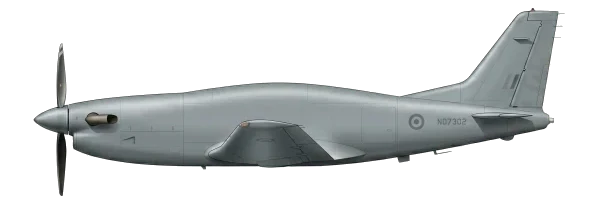
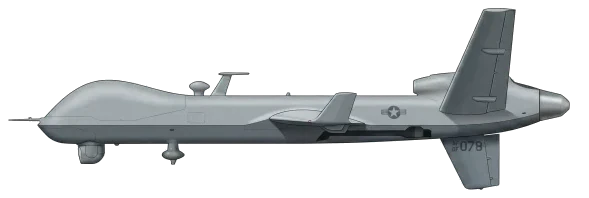
| Aarok | MQ-9 Reaper | |
|---|---|---|
| Origin country | 🇫🇷 France | 🇺🇸 United States |
| Category | Military Drones | Military Drones |
| Manufacturer | Turgis & Gaillard | General Atomics |
| First flight | 1 January 2023 | 1 February 2001 |
| Year introduced | -- | 2007 |
| Number produced | 1 units | 300 units |
| Average unit price | $7.5 million | $30 million |
| Wingspan | 22.0 m | 20.0 m |
| Length | 14.0 m | 11.0 m |
| Maximum speed | 463 km/h | 300 km/h |
| Operational range | 7,500 km | 1,850 km |
| Service ceiling | 9,000 m | 15,240 m |
| Max. takeoff weight | 5,400 kg | 4,760 kg |
| Empty weight | 2,500 kg | 2,223 kg |
| Total thrust | 1 x 560 kW | -- |
Detailed Comparison
The French Aarok and American MQ-9 Reaper present a contrast between a new-generation, sovereign-focused MALE UCAV and a globally deployed, combat-proven system. The Aarok, a private venture aimed at ITAR-free production, offers significantly longer endurance and robust field performance. The Reaper stands as the established benchmark with over two decades of development and more than 15 years of operational history in persistent intelligence, surveillance, and reconnaissance (ISR) and strike missions.
Development and Design
The MQ-9 Reaper was an evolutionary development, scaling up the successful MQ-1 Predator to carry more payload and fly higher and faster. Its design, finalized in the early 2000s, was optimized for the counter-insurgency and counter-terrorism missions of its era, prioritizing high-altitude loiter and precision strike capabilities. In contrast, the Aarok is a modern, clean-sheet design initiated in 2020. Its core design philosophy is strategic autonomy for France. A key objective is to systematically replace foreign components, notably its initial Pratt & Whitney engine, to create an ITAR-free platform for simplified export and unrestricted use. The Aarok's structure is also intentionally rugged, engineered to operate from short, semi-prepared runways, a feature that enhances its operational flexibility in diverse theaters.
Specifications and Performances
While both are single-turboprop MALE drones, the Aarok is a physically larger aircraft with a 22m wingspan and 5,400 kg maximum takeoff weight, compared to the Reaper's 20m wingspan and 4,760 kg MTOW. This size difference contributes to the Aarok's most significant performance advantage: a projected endurance of 30 hours, more than doubling the Reaper’s 14 hours when fully armed. Although the Reaper has a slightly higher maximum ordnance capacity (approx. 1,700 kg vs. Aarok's 1,500 kg), the Aarok is engineered to simultaneously carry a large sensor suite—such as the Safran Euroflir 610 and a multimode radar—along with its weapon load. The Reaper has a higher service ceiling at 15,000 m versus the Aarok's 9,000 m, offering a potential advantage in survivability against certain air defense systems.
Deployment and usage
The Reaper's primary strength is its extensive and well-documented operational history. Since its 2007 service entry, it has become a defining asset in US and allied operations, particularly in Afghanistan, Iraq, and Africa. Its combat record has established the doctrine for armed overwatch and remote precision strikes. The Aarok, having only commenced ground trials in 2024, has no operational history. Its intended mission set is broad, targeting not only ground attack and ISR but also maritime surveillance and acting as a communications relay, reflecting contemporary multi-domain operational requirements. The existence of a planned expendable Ukrainian variant suggests a design adaptable to high-intensity conflict attrition.
Conclusion
The MQ-9 Reaper is the battle-hardened incumbent, a system whose performance and limitations are thoroughly understood through years of combat. It represents a mature, reliable, and integrated capability. The Aarok is a challenger that, while unproven, offers tangible next-generation advantages, chief among them being vastly superior persistence and the promise of strategic autonomy through its ITAR-free design. For military planners, the decision between them pits the low-risk certainty of a proven system against the long-term strategic and operational benefits offered by a more modern, but as-yet untested, platform.