MQ-9 Reaper vs Shahed 136
MQ-9 Reaper vs Shahed 136 at a glance — top speed 300 vs 185 km/h, range 1,850 vs 2,500 km, max takeoff weight 4,760 vs 200 kg, built 300 vs 26,000 units.
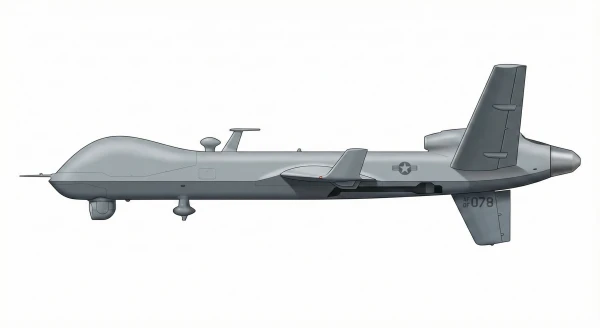

| MQ-9 Reaper | Shahed 136 | |
|---|---|---|
| Origin country | 🇺🇸 United States | 🇮🇷 Iran |
| Category | Military Drones | Military Drones |
| Manufacturer | General Atomics | HESA |
| First flight | 1 February 2001 | 1 January 2021 |
| Year introduced | 2007 | 2021 |
| Number produced | 300 units | 26000 units |
| Average unit price | $30 million | $193K |
| Wingspan | 20.0 m | 2.5 m |
| Length | 11.0 m | 3.5 m |
| Maximum speed | 300 km/h | 185 km/h |
| Operational range | 1,850 km | 2,500 km |
| Service ceiling | 15,000 m | 4,000 m |
| Max. takeoff weight | 4,760 kg | 200 kg |
| Empty weight | 2,223 kg | -- kg |
| Total thrust | -- | 1 x 37 kW |
Detailed Comparison
The Shahed 136 and MQ-9 Reaper occupy entirely separate nodes in the unmanned aerial systems taxonomy: one functions as a disposable, autonomous cruise missile, while the other operates as a reusable, sensor-dense strike platform. General Atomics built the MQ-9 to loiter in undefended airspace with persistent intelligence, surveillance, and reconnaissance (ISR) alongside precision fires. HESA engineered the Shahed 136 for volume-based saturation attacks, trading sensors and landing gear for mass production and attrition tolerance.
Development and Design
The MQ-9 emerged from a United States Air Force requirement to escalate the MQ-1 Predator's lethality. General Atomics scaled the airframe to accommodate a Honeywell TPE331-10GD turboprop, enabling simultaneous carriage of 3,750 lbs of munitions and complex electro-optical/infrared (EO/IR) arrays. In contrast, the Shahed 136 prioritizes expendability. Designed by Shahed Aviation Industries, it utilizes a fiberglass and carbon-fiber blended wing-body powered by a reverse-engineered 37 kW German Limbach piston engine. Its architecture relies on rocket-assisted take-off from portable racks to minimize infrastructure dependency. This simplicity accelerates localized cloning, generating Russia's Geran-2 and the US-manufactured LUCAS variant.
Specifications and Performances
A single MQ-9 costs $30.0 million, buying a 15,000 m service ceiling and 27-hour endurance to maintain overwatch above short-range air defenses (SHORAD). It requires paved runways, dedicated pilot crews, and continuous satellite bandwidth. The Shahed 136 costs $193,000, maxing out at 185 km/h with a 4,000 m ceiling. While the MQ-9 executes guided multi-role fires via AGM-114 Hellfires or GBU-38 JDAMs against dynamic targets, the Shahed delivers a fixed 30–50 kg warhead autonomously against static coordinates via INS and civilian-grade GNSS. The Shahed's 2,500 km range exceeds the MQ-9's 1,850 km combat radius, though the Iranian drone cannot maneuver to strike mobile assets mid-flight.
Deployment and usage
The USAF built its counter-terrorism doctrine around the MQ-9, accumulating millions of flight hours across Iraq, Afghanistan, and the Horn of Africa. However, deployments in contested zones expose severe survivability limits; Reapers have been repeatedly downed by Houthi SAMs in Yemen and damaged by Russian Su-27s over the Black Sea.
Conversely, the Shahed 136 defines operations in heavily defended airspace. In the Russo-Ukrainian War, Geran-2 swarms routinely exhaust Ukrainian interceptor stockpiles. Defenders intercept up to 85% of incoming drones using Gepard SPAAGs and MiG-29s, yet the remaining 15% reliably penetrates to strike grid infrastructure.
Conclusion
The MQ-9 and Shahed 136 hold absolute advantages in strictly divided operational domains:
- Permissive environments: The MQ-9 holds the edge in counter-insurgency and maritime patrol. Against adversaries lacking integrated air defense systems (IADS), its ISR fidelity and reusable payload cannot be matched by one-way munitions.
- Contested airspace: The Shahed 136 dictates peer-to-peer conflict. The MQ-9 is too radar-conspicuous and expensive to survive modern layered IADS. The Shahed weaponizes attrition; by forcing defenders to expend limited, million-dollar surface-to-air effectors against $193,000 airframes, it imposes an unsustainable financial arithmetic on the adversary.