Karrar vs MQ-9 Reaper
Karrar vs MQ-9 Reaper at a glance — top speed 900 vs 300 km/h, range 1,000 vs 1,850 km, max takeoff weight 700 vs 4,760 kg.
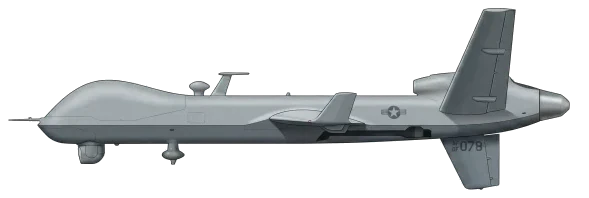
| Karrar | MQ-9 Reaper | |
|---|---|---|
| Origin country | 🇮🇷 Iran | 🇺🇸 United States |
| Category | Military Drones | Military Drones |
| Manufacturer | HESA | General Atomics |
| First flight | 1 January 2010 | 1 February 2001 |
| Year introduced | 2010 | 2007 |
| Number produced | N/A | 300 units |
| Average unit price | -- | $30 million |
| Wingspan | 2.5 m | 20.0 m |
| Length | 4.0 m | 11.0 m |
| Maximum speed | 900 km/h | 300 km/h |
| Operational range | 1,000 km | 1,850 km |
| Service ceiling | -- m | 15,000 m |
| Max. takeoff weight | 700 kg | 4,760 kg |
| Empty weight | -- kg | 2,223 kg |
| Total thrust | 1 x 4 kN | -- |
Detailed Comparison
General Atomics designed the MQ-9 Reaper as a medium-altitude, long-endurance intelligence, surveillance, and reconnaissance (ISR) and precision-strike platform requiring permissive airspace and established runway logistics. In contrast, HESA built the Karrar by reverse-engineering a 1970s American MQM-107 target drone, resulting in an expendable, jet-powered munition carrier optimized for asymmetric warfare and localized air defense. The platforms operate on opposite ends of the unmanned spectrum: one is an expensive, loitering node heavily dependent on sensor integration, while the other is a low-cost, point-and-shoot delivery system.
Development and Design
General Atomics developed the MQ-9 as a direct expansion of the MQ-1 Predator, integrating a 900-horsepower Honeywell TPE331-10GD turboprop to carry heavier ordnance. Its design centers on high-aspect-ratio wings, yielding 27 hours of endurance, and a sensor suite integrating multi-spectral targeting and synthetic aperture radar. Conversely, HESA derived the Karrar from the Beechcraft Streaker and Denel Skua designs. Utilizing a Tolloue 5 turbojet, rocket-assisted zero-length launch (ZLL), and parachute recovery, the Karrar operates independent of fixed airbases. It sacrifices sensors for simplicity; lacking integral electro-optical turrets, the airframe relies on INS/GPS waypoint navigation or the independent seekers of its attached munitions.
Specifications and Performances
The performance metrics dictate opposed tactical applications. The Reaper's 4,760 kg maximum takeoff weight accommodates 1,700 kg of external ordnance—over seven times the payload of the Karrar. This allows an MQ-9 to orbit at 15,000 meters, dispensing Hellfire missiles or 500-lb GBU-38 JDAMs across multiple engagements. The Karrar, capped at a 700 kg MTOW and a 227 kg payload, functions effectively as a reusable cruise missile. While the MQ-9 cruises at 300 km/h, making it highly vulnerable to modern air defenses, the Karrar sprints at 900 km/h. Its 1,000 km range combined with this speed profiles it for rapid, one-way or short-duration strikes using Mk 82 bombs or Majid air-to-air missiles.
Deployment and usage
The USAF integrated the MQ-9 at scale, with units like the 432nd Wing executing thousands of counter-terrorism strikes in Iraq, Afghanistan, and Syria. However, losses to Houthi surface-to-air missiles in Yemen (2017–2022) and Russian Su-27 harassment over the Black Sea (2023) expose its fragility against integrated air defense systems (IADS). Iran initially deployed the Karrar strictly to train Mersad and S-300PMU-2 crews, but combat realities in Syria shifted its doctrine. Iran and proxy groups like Hezbollah now field the Karrar as a loitering interceptor to engage helicopters, or as a rapid-response surface strike asset deploying the Balaban glide bomb.
Conclusion
The MQ-9 Reaper commands the advantage in permissive environments. Its 27-hour endurance and payload capacity make it the definitive platform for sustained ISR, target generation, and close air support where enemy air defenses are degraded. In a contested conflict, however, the Reaper is a slow target dependent on vulnerable runways. Here, the Karrar holds the operational edge. By leveraging zero-length launch, 900 km/h sprint speeds, and low unit costs, the Karrar provides decentralized, survivable point-defense and strike. The Reaper is a complex system built to loiter over insurgents, while the Karrar is a brute-force tool designed to saturate and bypass conventional air defenses.


