An-12 Cub vs C-160 Transall
An-12 Cub vs C-160 Transall at a glance — top speed 770 vs 513 km/h, range 5,700 vs 1,853 km, max takeoff weight 61,000 vs 51,000 kg, built 1,248 vs 214 units.
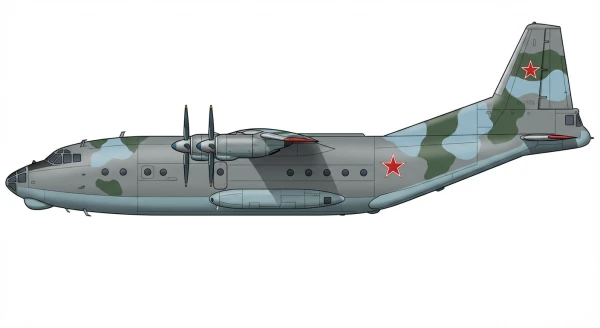
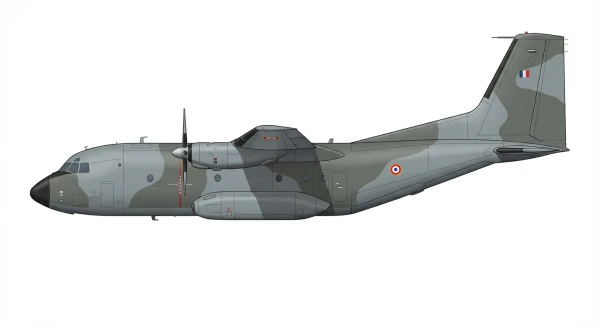
| An-12 Cub | C-160 Transall | |
|---|---|---|
| Origin country | 🇺🇦 Ukraine | 🇩🇪 Germany🇫🇷 France |
| Category | Military Transport Aircraft | Military Transport Aircraft |
| Manufacturer | Antonov | Transall |
| First flight | 16 December 1957 | 25 February 1963 |
| Year introduced | 1959 | 1967 |
| Number produced | 1248 units | 214 units |
| Average unit price | $20 million | $12 million |
| Wing area | 121.7 m² | 160.0 m² |
| Wingspan | 38.0 m | 40.0 m |
| Height | 10.5 m | 11.7 m |
| Length | 33.1 m | 32.4 m |
| Maximum speed | 770 km/h | 513 km/h |
| Operational range | 5,700 km | 1,853 km |
| Service ceiling | 10,200 m | 8,230 m |
| Max. takeoff weight | 61,000 kg | 51,000 kg |
| Empty weight | 28,000 kg | 29,000 kg |
| Total thrust | 4 x 3,126 kW | 2 x 4,549 kW |
Detailed Comparison
The Antonov An-12 Cub and Transall C-160 represent different approaches to medium military transport, shaped by their distinct Cold War-era origins. The An-12 is a four-engine Soviet workhorse designed for heavy-lift capacity and self-defense, while the C-160 is a twin-engine Franco-German platform optimized for tactical operations from austere airfields. This core difference is reflected in the An-12's larger payload, higher speed, and integrated tail turret, contrasting with the C-160's specialized short-field performance capabilities.
Development and Design
The An-12 was developed as a military counterpart to the An-10 passenger transport, a common Soviet design practice. Its lineage emphasized mass production, resulting in over 1,248 units built and a robust design that was widely exported and even reverse-engineered by China as the Y-8. A key feature reflecting its operational doctrine is the defensive tail turret armed with two 23mm cannons, a standard for Soviet-era transports operating in potentially hostile airspace. In contrast, the C-160 was a purpose-built tactical transport from a multinational European consortium. Its design was driven by a specific requirement to replace the Nord Noratlas, focusing on operations from semi-prepared airstrips. Innovations supporting this role include a landing gear that can partially retract on the ground to lower the fuselage for easier loading and a flight profile allowing for steep descents and landings on runways as short as 400 meters.
Specifications and Performances
While both are high-wing turboprops, their performance metrics diverge based on their engine configuration and intended roles. The An-12's four Ivchenko AI-20M engines give it a significant advantage in speed (770 km/h vs. the C-160's 513 km/h) and a higher service ceiling (10,200 m vs. 8,230 m). It also boasts a larger payload capacity at 20,000 kg, compared to the C-160's 16,000 kg. The C-160, powered by two more powerful but fewer Rolls-Royce Tyne engines, prioritizes efficiency and short-field capability over raw speed. Its specified range of 1,850 km with a 16,000 kg payload underscores its role as a tactical airlifter, a mission profile where its lower speed is less of a limiting factor than its ability to access forward operating bases.
Deployment and usage
The operational histories of both aircraft reflect their design philosophies. The An-12 was a ubiquitous asset for the Soviet Union and its allies, seeing extensive service in conflicts like the Soviet-Afghan War, where it earned the moniker "Black Tulip." Its ability to transport armored vehicles and its use as a makeshift bomber by the Indian Air Force highlight its versatility and ruggedness. The C-160 served as a primary tactical transport for France, Germany, and South Africa, proving crucial in expeditionary operations in Africa and the Middle East. Specialized variants like the French C-160G Gabriel for signals intelligence (SIGINT) demonstrate its adaptation into a high-value electronic warfare asset, complementing platforms like the E-3 Sentry.
Conclusion
The An-12 Cub is a strategic-tactical airlifter defined by Soviet military doctrine: a powerful, heavily armed, and mass-produced aircraft capable of moving significant loads over vast distances. Its legacy is one of global proliferation and rugged service. The C-160 Transall is a more specialized tactical transport, born from Western European collaboration. It trades the An-12's outright payload and speed for superior short-field performance and adaptability, excelling in the precise, austere-environment operations demanded by its primary users.