Noratlas
French twin-boom military transport first flown in 1949 and in service from 1953, used for cargo and paratroop missions by France, West Germany, Israel, Greece and Portugal. Key figures: top speed 440 km/h, range 2,500 km, service ceiling 7,500 m, max takeoff weight 20,603 kg, built 425.
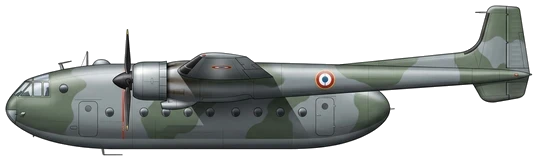
| Crew | 4–5 |
| Length | 22.0 m (72.0 ft) |
| Wingspan | 32.5 m (106.6 ft) |
| Height | 6 m (19.7 ft) |
| Wing area | 101.2 m² (1089.3 sqft) |
| Empty weight | 13,075 kg (28,825 lbs) |
| Max. takeoff weight | 20,603 kg (45,422 lbs) |
| Powerplant | 2 × radial piston engines SNECMA-built Bristol Hercules 738 1,558 kW each |
| Maximum speed | 440 km/h (273 mph) |
| Operational range | 2,500 km (1,553 mi) |
| Service ceiling | 7,500 m (24,606 ft) |
| Climb rate | 6.25 m/s (20.5 ft/s) |
Description
The Nord Noratlas is a twin-engine, twin-boom military transport aircraft developed and manufactured by Nord Aviation of France. It was designed to replace the Junkers Ju 52 and Douglas C-47 and entered Armée de l'Air service on 6 December 1953. About 425 were built before production ended in 1961. France, Israel, Greece and Portugal used it in combat, and it is best known for the French paratroop drops of the 1956 Suez Crisis.
Development
In 1947 the Direction Technique Industrielle (DTI) held a competition for a medium-weight cargo aircraft. The Ju 52 and C-47 had tailwheel landing gear, restrictive side doors and limited payload. SNCAN's Nord 2500, which had rear clamshell doors, was chosen over the Breguet BR-891R Mars and the Sud-Ouest SO-30C. Two prototypes were ordered on 27 April 1948. The first flew on 10 September 1949 with 1,600 hp Gnome-Rhône 14R engines but proved too slow. The second prototype was re-engined with SNECMA-built Bristol Hercules 738/9 engines and designated Nord 2501.
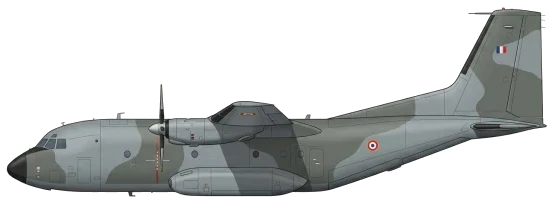
Three pre-production aircraft followed and were flown against the Fairchild C-82 Packet. This led to an order for 34 aircraft on 10 July 1951. The first Nord 2501 prototype crashed in 1952, and the type was named Noratlas on 9 January 1953. The initial 34 were delivered by 25 June 1953, and France ordered 174 more. West Germany's Flugzeugbau Nord designed and built most of the fuselage. The Transall C-160 succeeded the Noratlas.
Design
The Noratlas has a shoulder-mounted wing carrying twin booms, with a pod fuselage slung between them. For rough-field operations it has widely spaced landing gear, low-pressure tyres and high propeller clearance. Two 2,040 hp Hercules 738/9 engines drive four-bladed Rotol propellers. The cabin holds up to 6.8 t of freight or 40 passengers, loaded through clamshell doors set near ground level. A 6-ton payload can be carried 1,210 km at 320 km/h. Maximum takeoff weight is 20,603 kg and service ceiling 7,500 m.
Operational History
At Suez in 1956, French Noratlases dropped paratroopers south of Port Said and Port Fouad. After the Algerian War ended in 1962, many French aircraft were converted to secondary roles. The last of eight Gabriel electronic warfare aircraft retired in 1989.
West Germany ordered 187 aircraft from 1956, of which 173 were delivered. Its fleet had four different cockpit and avionics fits. From 1964 Germany resold aircraft, becoming the main source for smaller operators.
Israel bought three N-2501IS in 1956 because France made this a condition of the sale of 12 Dassault Ouragans. It bought three more in 1959 and 16 ex-German aircraft before 1967. Israeli Noratlases flew improvised bombing missions into Egypt (Operation Drought) and maritime reconnaissance, including tracking USS Liberty. Israel retired the type in 1978.
Greece received 50 ex-German aircraft in 1970 for the 354th Tactical Airlift Squadron at Elefsis. During Operation Niki on 21–22 July 1974, 15 aircraft airlifted the 1st Rangers Squadron from Crete to Nicosia. Twelve landed, and at least one is believed to have been shot down by friendly fire.
Portugal flew 31 aircraft across Angola, Mozambique and Portuguese Guinea from 1961 to 1975. It gave six to Angola and Mozambique and retired the rest by September 1977.
Variants
- N2500: Gnome-Rhône 14R-powered prototype, one built.
- N2501: Hercules-powered production version for the Armée de l'Air.
- N2501D: German Air Force version with German-sourced components, 186 built.
- N2502A/B: Civil version with wingtip Turbomeca Marboré turbojets for takeoff.
- N-2501 Gabriel: SIGINT/electronic warfare conversion operated by EEA 1/54 Dunkerque, eight produced.
Frequently Asked Questions
What type of aircraft is the Noratlas?
What is the maximum speed of the Noratlas?
What is the range of the Noratlas?
When did the Noratlas first fly?
How many Noratlas have been built?
Which countries operate the Noratlas?
What is the service ceiling of the Noratlas?
- SEP 302026 Created Page created: Noratlas