AW101 vs CH-53 Sea Stallion
AW101 vs CH-53 Sea Stallion at a glance — top speed 309 vs 315 km/h, range 1,389 vs 1,000 km, max takeoff weight 12,900 vs 33,300 kg, built 137 vs 284 units.
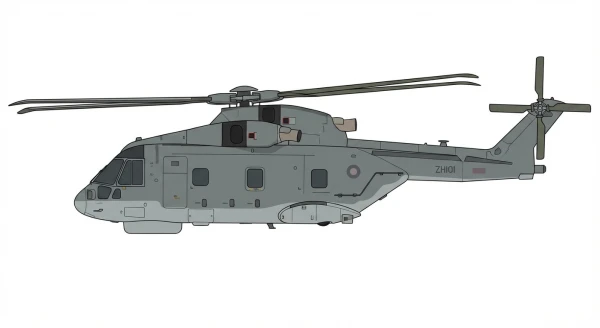
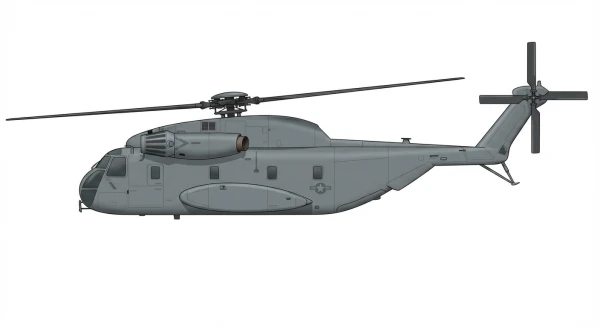
| AW101 | CH-53 Sea Stallion | |
|---|---|---|
| Origin country | 🇬🇧 United Kingdom🇮🇹 Italy | 🇺🇸 United States |
| Category | Military Helicopters | Military Helicopters |
| Manufacturer | AgustaWestland | Sikorsky |
| First flight | 19 October 1964 | 14 October 1964 |
| Year introduced | 1999 | 1966 |
| Number produced | 137 units | 284 units |
| Average unit price | $70 million | $40 million |
| Wingspan | 18.6 m | 24.1 m |
| Height | 6.6 m | 8.5 m |
| Length | 20.4 m | 30.2 m |
| Maximum speed | 309 km/h | 315 km/h |
| Operational range | 1,389 km | 1,000 km |
| Service ceiling | 2,600 m | 5,639 m |
| Max. takeoff weight | 12,900 kg | 33,300 kg |
| Empty weight | 6,850 kg | 15,071 kg |
| Total thrust | 3 x 1,044 kW | 3 x 3,270 kW |
Detailed Comparison
The AgustaWestland AW101 and the Sikorsky CH-53 operate in disparate weight classes, driven by fundamentally different doctrinal requirements. While the AW101 Merlin represents the apex of late-Cold War European multi-role refinement—balancing anti-submarine warfare (ASW) with troop transport—the CH-53, particularly in its three-engine configuration, is a utilitarian heavy-lift instrument designed solely to move massive volume and weight for the United States Marine Corps (USMC).
Development and Design
The AW101 emerged from the fragmentation of European defense procurement, merging British and Italian requirements to replace the Sea King. The resulting design prioritizes survivability and avionics integration over raw lifting power. Its three-engine configuration was dictated by safety margins for long-range over-water operations, not lift capacity. The use of aluminum-lithium alloys and active vibration control systems (ACSR) reflects a focus on airframe longevity and crew fatigue reduction, critical for endurance ASW missions.
Conversely, the CH-53 lineage is defined by the USMC’s requirement to move heavy artillery and armored vehicles from ship to shore. Sikorsky’s design philosophy favored mechanical robustness and sheer scale. While the AW101 utilizes a sophisticated glass cockpit and composite rotors to manage workload, the CH-53 relies on a massive transmission and a fully articulated six-blade rotor system to translate turbine power into vertical lift. The CH-53 is a truck; the AW101 is a systems integrator.
Specifications and Performance
The performance gap illustrates the divergence in utility. The CH-53’s Maximum Takeoff Weight (MTOW) of 33,300 kg dwarfs the AW101’s 12,900 kg. Consequently, the Sikorsky platform can lift external loads (approx. 13,000–16,000 kg) that exceed the entire weight of a fully loaded AW101.
However, the AW101 holds the advantage in range and efficiency. With a range of 1,389 km, it outpaces the CH-53’s 1,000 km, validating its design as a long-range maritime patrol asset. The AW101’s triple-turbine setup provides 1,044 kW per engine (RTM322 variants produce significantly more in service), whereas the CH-53’s powerplants generate over 3,000 kW each, resulting in a drastically higher fuel burn and logistical footprint for the American aircraft.
Deployment and Usage
Operational history favors the CH-53 in high-intensity combat logistics. From Vietnam to the "Super Stallions" in Iraq and Afghanistan, the type has been the only western rotary asset capable of recovering downed aircraft or inserting heavy infrastructure. However, its mechanical complexity and size have led to low readiness rates and high maintenance-man-hours per flight hour.
The AW101 has seen mixed success. In Royal Navy service (Merlin HM1/2), it is the premier ASW helicopter, effectively integrating the FLASH sonar and Blue Kestrel radar. In transport roles (RAF HC3), it provided critical hot-and-high capability in Afghanistan, often outperforming the CH-47 Chinook in specific agile maneuver scenarios. However, the platform suffered from high procurement costs—$70 million per unit versus the CH-53’s historical $40 million—and political procurement failures, notably the cancelled US Presidential VH-71 program.
Conclusion
The CH-53 holds the undisputed edge in logistics and power projection. If the mission requires moving howitzers, armored vehicles, or mass casualties, the AW101 is physically incapable of competing. The CH-53 remains the standard for heavy vertical lift.
The AW101 is the superior platform for maritime warfare and sophisticated utility operations. Its vibration control, sensor fusion, and range make it a more survivable and effective asset for modern naval doctrines requiring autonomy and high-tech surveillance. The AW101 wins on technical merit; the CH-53 wins on brute capability.