CH-47 Chinook vs CH-53 Sea Stallion
CH-47 Chinook vs CH-53 Sea Stallion at a glance — top speed 315 vs 315 km/h, range 740 vs 1,000 km, max takeoff weight 22,680 vs 33,300 kg, built 1,200 vs 284 units.
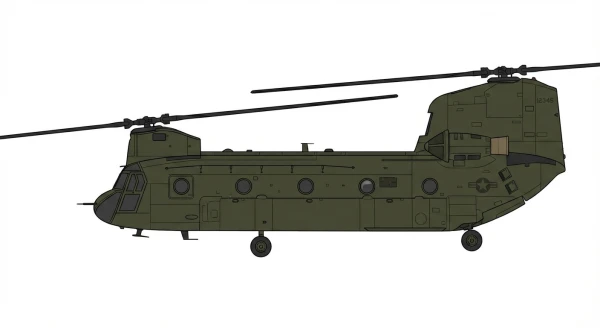
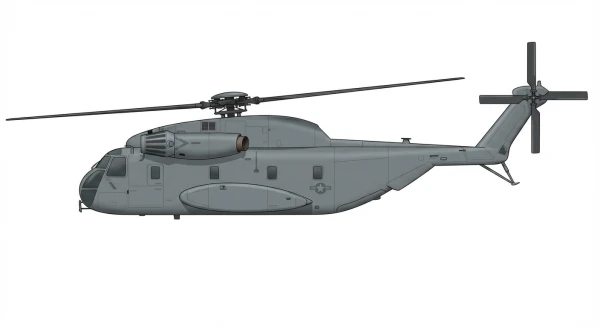
| CH-47 Chinook | CH-53 Sea Stallion | |
|---|---|---|
| Origin country | 🇺🇸 United States | 🇺🇸 United States |
| Category | Military Helicopters | Military Helicopters |
| Manufacturer | Boeing | Sikorsky |
| First flight | 21 September 1961 | 14 October 1964 |
| Year introduced | 1962 | 1966 |
| Number produced | 1200 units | 284 units |
| Average unit price | $38 million | $40 million |
| Wingspan | 18.3 m | 24.1 m |
| Height | 5.7 m | 8.5 m |
| Length | 30.1 m | 30.2 m |
| Maximum speed | 315 km/h | 315 km/h |
| Operational range | 740 km | 1,000 km |
| Service ceiling | 5,639 m | 5,639 m |
| Max. takeoff weight | 22,680 kg | 33,300 kg |
| Empty weight | 10,614 kg | 15,071 kg |
| Total thrust | 2 x 2,796 kW | 3 x 3,270 kW |
Detailed Comparison
The tandem-rotor Boeing CH-47 Chinook and the conventional single-rotor Sikorsky CH-53 Sea Stallion are foundational heavy-lift helicopters in Western military inventories, distinguished by aerodynamic designs that dictate their operational roles. The Chinook, originating from a US Army requirement, prioritizes stability and precision for slung loads, while the Sea Stallion, developed for the US Marine Corps, emphasizes greater overall lift capacity and range for amphibious and expeditionary missions.
Development and Design
The CH-47's design is a direct evolution of Vertol's work on tandem-rotor helicopters. The US Army, seeking a heavier transport than the CH-46 Sea Knight, selected the enlarged Model 114. This configuration eliminates the need for an anti-torque tail rotor, dedicating all engine power to lift and thrust. This makes the Chinook exceptionally stable, particularly when lifting or placing external cargo, as it is less sensitive to shifts in its center of gravity. Conversely, the CH-53 Sea Stallion emerged from a USMC need for a heavy-lift helicopter to replace the CH-37. Sikorsky's design was a more conventional single main rotor helicopter, essentially a scaled-up S-61R with dynamic components from the S-64 Skycrane. Its design features a six-bladed main rotor and a four-bladed tail rotor, optimized to meet the Marines' high-speed requirement. Later variants adopted a three-engine configuration for increased power.
Specifications and Performances
While both aircraft share an identical maximum speed of 315 km/h and a service ceiling of 5,639 m, their performance profiles diverge significantly. The Sea Stallion family demonstrates a substantially higher maximum takeoff weight at 33,300 kg compared to the Chinook's 22,680 kg, enabled by its three-engine configuration in later models versus the Chinook's two. This translates to a greater overall mass-moving potential. The most critical operational difference is range; the Sea Stallion boasts a ferry range of 2,075 km, far exceeding the Chinook's 420 km and making it better suited for long-distance, over-water operations. The Chinook's strength lies in its external lift. The tandem rotors provide stability for its triple-hook cargo system, allowing it to precisely handle and place up to 24,000 lb (10,886 kg) of underslung cargo, a capability critical for its role in emplacing artillery.
Deployment and usage
Operational histories reflect their design philosophies. The CH-47 became an Army logistics staple, proving invaluable in Vietnam for moving artillery into mountainous terrain and resupplying firebases. Its stability and lift capacity made it the platform of choice for construction and logistical support in Afghanistan and Iraq. The special operations variant, the MH-47, is also a key asset. The CH-53, as a core USMC asset, focused on amphibious assault, troop transport, and vehicle/equipment movement from ship to shore. Its use in aircraft recovery in Vietnam, special operations like the Son Tay raid (as the HH-53), and the aborted Operation Eagle Claw hostage rescue highlights its role in high-risk, long-range missions. The RH-53 variant also carved out a specialized niche in Airborne Mine CounterMeasures (AMCM) for the Navy.
Conclusion
The CH-47 Chinook and CH-53 Sea Stallion are not direct competitors but rather complementary systems designed for different primary users and missions. The Chinook's tandem-rotor design provides unparalleled stability and efficiency for external load operations, making it an indispensable logistical tool for land forces, particularly in challenging terrain. The Sea Stallion's conventional but more powerful design provides superior range and a higher maximum takeoff weight, aligning with the expeditionary requirements of naval infantry and special operations forces. Both platforms have been continuously upgraded and remain critical, their enduring service a testament to the success of their respective, purpose-built designs.