AW101 vs Mi-8 Hip
AW101 vs Mi-8 Hip at a glance — top speed 309 vs 250 km/h, range 1,389 vs 495 km, max takeoff weight 12,900 vs 12,000 kg, built 137 vs 17,000 units.
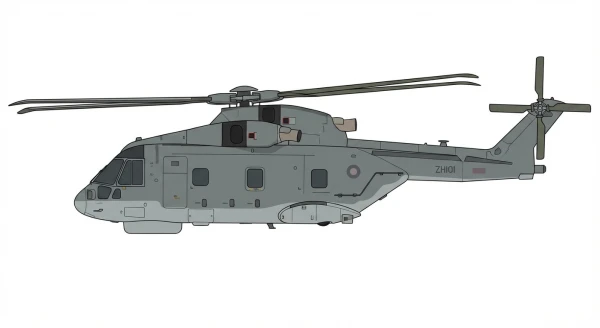
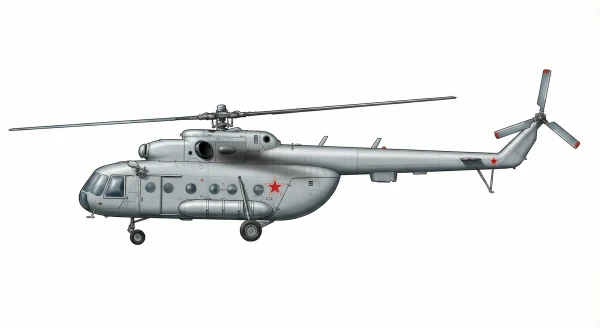
| AW101 | Mi-8 Hip | |
|---|---|---|
| Origin country | 🇬🇧 United Kingdom🇮🇹 Italy | 🇷🇺 Ex-USSR |
| Category | Military Helicopters | Military Helicopters |
| Manufacturer | AgustaWestland | Mil |
| First flight | 19 October 1964 | 24 June 1961 |
| Year introduced | 1999 | 1967 |
| Number produced | 137 units | 17000 units |
| Average unit price | $70 million | $4 million |
| Wingspan | 18.6 m | 21.3 m |
| Height | 6.6 m | 5.7 m |
| Length | 20.4 m | 25.2 m |
| Maximum speed | 309 km/h | 250 km/h |
| Operational range | 1,389 km | 495 km |
| Service ceiling | 2,600 m | 4,500 m |
| Max. takeoff weight | 12,900 kg | 12,000 kg |
| Empty weight | 6,850 kg | 7,160 kg |
| Total thrust | 3 x 1,044 kW | 2 x 1,119 kW |
Detailed Comparison
The AgustaWestland AW101 and the Mil Mi-8 Hip illustrate the sharp divergence between low-volume, high-specification systems designed for maritime and specialized utility roles, and high-volume, robust platforms built for sheer logistical ubiquity. While the AW101 emerged from a joint British-Italian requirement for advanced anti-submarine warfare (ASW) and transport, the Soviet-designed Mi-8 is a general-purpose medium turbine helicopter that became the most produced rotorcraft in history, with over 17,000 units built compared to the AW101's 137.
Development and Design
The AW101 utilizes a three-engine configuration—specifically Rolls-Royce Gnome or CT7/RTM322 turboshafts—providing significant power redundancy critical for over-water operations. Its airframe incorporates aluminum–lithium alloys and composite materials to reduce weight while maintaining damage tolerance. Notable innovations include an active vibration control system aiming to reduce structural stress by 80% and a glass cockpit capable of resisting high-impact crashes.
Conversely, the Mi-8 adheres to a utilitarian Soviet doctrine. Its structure is primarily aluminum, prioritizing ease of manufacture and field repair over advanced weight savings. It features a conventional pod-and-boom layout with two top-mounted Klimov turboshafts. The Hip’s defining characteristic is its modularity; the spacious cabin allows rapid reconfiguration between troop transport, cargo, and armed assault roles, a flexibility that has kept the design relevant for over six decades.
Specifications and Performances
Performance metrics reveal a distinct trade-off between endurance and altitude capability. The AW101 offers a substantial 1,389 km range, nearly triple the Mi-8's 495 km, reflecting its requirements for long-endurance maritime patrol. However, the Mi-8 possesses a superior service ceiling of 4,500 m compared to the AW101's listed 2,600 m, explaining the Hip's historical prevalence in high-altitude theaters like Afghanistan.
While both aircraft share a similar Maximum Takeoff Weight (approx. 12,900 kg for the AW101 vs. 12,000 kg for the Mi-8), the economic disparity is staggering. The AW101 is priced at approximately $70 million, whereas the Mi-8 costs roughly $4 million. This allows operators to field entire squadrons of Hips for the acquisition cost of a single Merlin unit.
Deployment and usage
The AW101 serves primarily in high-value, sensor-dependent roles. Naval variants (Merlin HM1/Model 110) deploy Blue Kestrel radar and FLASH dipping sonar for ASW, while transport variants (Merlin HC3) utilize extensive defensive aid suites and armor for troop movement in Iraq and Afghanistan. It is also a preferred platform for long-range Search and Rescue (SAR), such as the Canadian CH-149 Cormorant.
The Mi-8’s operational history is far broader, serving in over 50 nations. It functions as a combat transport, frequently armed with S-8 rocket pods, PKT machine guns, and AT-2 anti-tank missiles (on Mi-8MT/Mi-17 variants) to provide fire support while delivering troops. From the Cold War to modern conflicts in Syria and Ukraine, the Mi-8 remains a frontline staple, often operating in environments where logistical support is minimal.
Conclusion
Ultimately, these aircraft serve different strategic needs. The AW101 is a sophisticated, survivable platform optimized for complex missions where sensor integration and range are paramount. The Mi-8 is an attrition-tolerant logistical backbone, offering unmatched cost-effectiveness and ruggedness. For a modern navy requiring autonomous submarine hunting, the AW101 is indispensable; for a land army needing mass tactical lift and fire support on a limited budget, the Mi-8 remains the superior choice.