Mi-8 and Mi-17 Variants: Hip, Mi-171, Mi-17V-5 and Mi-8AMTSh
How to read a Mi-8 or Mi-17 designation: why the Mi-17 is a re-engined Mi-8, which number means Kazan or Ulan-Ude, what each suffix means, who upgrades them where and who flies which version in 2026.
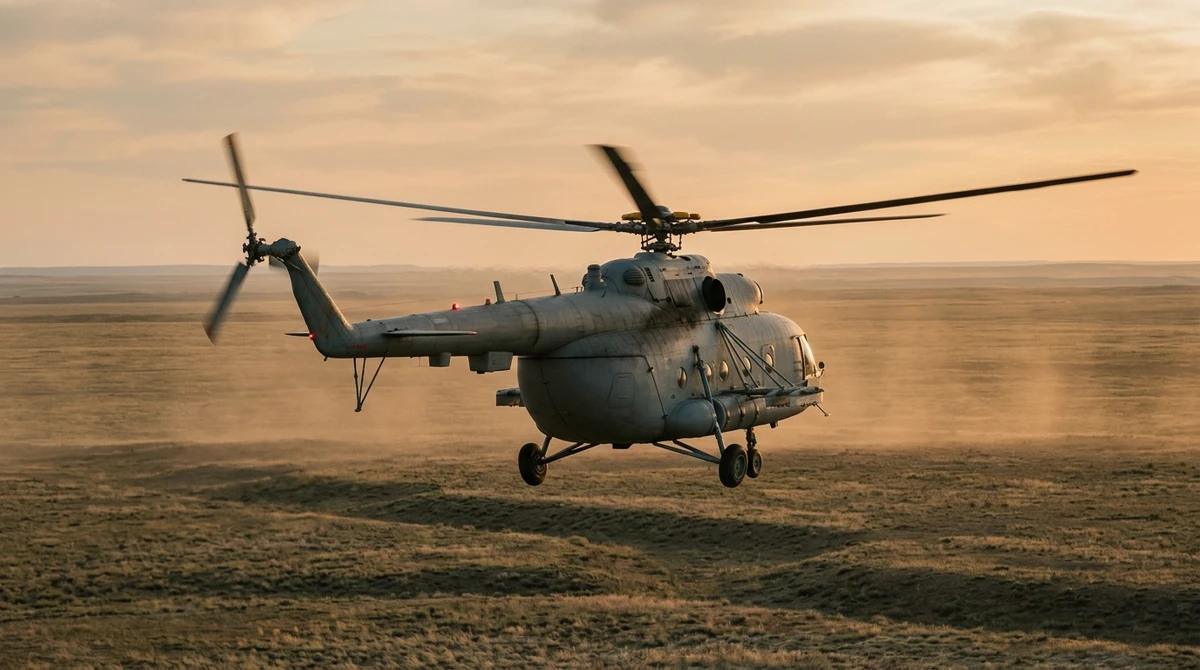
The Mi-17 is not a new helicopter. It is the export name of the Mi-8M series, the second-generation Mi-8 that Soviet forces received from 1975 as the Mi-8MT: the same fuselage, the Klimov TV3-117 engines developed for the naval Mi-14 in place of the original TV2-117, and a tail rotor moved from the right side of the fin to the left. Everything since, from the Mi-17V-5 to the Mi-171A2, descends from that change of powerplant, and the letters after "Mi-8" or "Mi-17" record the plant, the engine and whether the aircraft is armed.
The family is moving on two fronts in 2026. In Russia, the plants are being asked to replace helicopters lost in Ukraine: The Insider reported on 9 June 2026, citing Dallas Analytics, a plan for 72 Mi-8MTV-1s at Kazan over two years, against an estimated 20 military Mi-8s a year across both plants (Frontelligence Insight). In India, the largest export fleet is being overhauled at the Air Force's own depot and fitted with an Indian electronic warfare suite contracted on 7 April 2025. This guide reads the family as of October 2026.
- Mi-17 means Mi-8MT: the export designation of the Mi-8M series. The visible tell is the port-side tail rotor; the mechanical one is the TV3-117 engine. Only the first-generation Mi-8T and Mi-8P keep the TV2-117 and the starboard tail rotor.
- The number names the plant: Kazan's exports are Mi-17 and Mi-172, Ulan-Ude's are Mi-171. Mi-17V-5 is Kazan's Mi-8MTV-5; Mi-171Sh is Ulan-Ude's Mi-8AMTSh.
- Three engines, one lineage: TV2-117, then TV3-117MT and the high-altitude TV3-117VM (the V in MTV), then the VK-2500, a hot-and-high derivative that powers the Mi-8AMTSh-V and the Mi-171A2.
- Upgrades rarely rename: India's overhauled and EW-fitted Mi-17V-5s stay Mi-17V-5s and Czech Mi-171Sh stay Mi-171Sh; only Ukraine's re-engined Mi-8Ts take a new name, Mi-8MSB-V.
One airframe, two engines, two plants
The Mi-8 flew as the single-engined V-8 on 9 July 1961 and as the twin-engined V-8A, on TV2-117s, on 2 August 1962; Kazan began series production in March 1965 and Ulan-Ude followed in 1970. The TV2-117 gives about 1,500 shp; the Mi-8T utility transport (NATO Hip-C) and Mi-8P passenger version it powers are the only members of the family with the tail rotor on the right.
The second generation came from the sea. The Mi-14 (NATO Haze), an anti-submarine Mi-8 with a boat hull and retractable gear, was authorized in April 1965; its prototype flew on 1 August 1967 on TV2-117s because the TV3-117 was not ready, and the type entered service on 11 May 1976. Its TV3-117MT ("modernized, transport"), rotors and transmission were then transferred to the land-based helicopter as the Mi-8MT, in production from 1977; the stronger engines required the tail rotor to move to the left of the fin, and the MT gained dust shields and shorter engine cowls. Soviet forces called it Mi-8MT; the exporters called it Mi-17 (NATO Hip-H).
The engines. The TV3-117MT gives 1,397 kW (1,874 hp) per engine. The TV3-117VM ("high altitude, modernized"), produced from 1986, is the hot-and-high engine and the V in Mi-8MTV: 1,545 kW (2,072 shp), an automatic switch to emergency power and a 6,000 m ceiling. The VK-2500 is a high-power derivative of the TV3-117VMA for hot-and-high performance with a longer hot-section overhaul life; its -03 model, 2,400 shp at take-off, powers the Mi-8AMTSh-V and -VA and the Mi-171Sh, and the VK-2500PS-03 with full-authority digital control powers the Mi-171A2; the Mi-17V-5 is offered with it as an option.
The plants. Kazan Helicopters builds the Mi-8MT, MTV and MTV-5 line, exported as Mi-17, Mi-17-1V and Mi-17V-5, and the civil Mi-172, based on the Mi-8MTV-3 and sold with Western avionics; it built its 3,500th export Mi-17 in March 2014. Ulan-Ude Aviation Plant has built more than 4,000 Mi-8s since 1970; from 1991 it has built its own version of the MTV, the Mi-8AMT, exported as the Mi-171, and the armed Mi-8AMTSh, exported as the Mi-171Sh; the Mi-171A2 and Mi-171A3 are also its aircraft. Read the number first: 17 or 172 is Kazan, 171 is Ulan-Ude.
Reading the designation
The suffixes read left to right, each letter qualifying the one before; Russian Helicopters has never published a decoder, so the expansions below are the published conventions. A Russian military aircraft starts with Mi-8; its export version starts with Mi-17 (Kazan) or Mi-171 (Ulan-Ude) and compresses the plant's letters: Mi-8MTV-5 becomes Mi-17V-5, Mi-8AMTSh becomes Mi-171Sh.
| Reading | Example | Plant | |
|---|---|---|---|
| T | Transport, first-generation TV2-117 utility version (NATO Hip-C) | Mi-8T | Kazan, Ulan-Ude |
| P | Passenger, square windows, 28–32 seats | Mi-8P | Kazan |
| TV | Armed Mi-8T; six hardpoints and a nose gun on the Mi-8TVK (NATO Hip-E) | Mi-8TV, Mi-8TVK | Kazan |
| MT | Modernized transport: TV3-117MT engines, port-side tail rotor. Export name Mi-17 (NATO Hip-H) | Mi-8MT / Mi-17 | Kazan |
| MTV | MT with the high-altitude TV3-117VM (vysotny), 6,000 m ceiling. MTV-1 exports as Mi-17-1V, MTV-3 as Mi-17V-3 | Mi-8MTV-1 / Mi-17-1V | Kazan |
| -5 (after MTV) | Fifth MTV standard: rear loading ramp instead of clamshell doors, extra door, "dolphin nose", night-vision cockpit | Mi-8MTV-5 / Mi-17V-5 | Kazan |
| V-5, V-7 | Export compression of MTV-5; V-7 is the V-5 with VK-2500 engines and clamshell doors | Mi-17V-5, Mi-17V-7 | Kazan |
| 172 | Kazan's civil export, based on the Mi-8MTV-3 | Mi-172 | Kazan |
| AMT | Ulan-Ude's build of the MTV, from 1991. Export name Mi-171 | Mi-8AMT / Mi-171 | Ulan-Ude |
| Sh | Assault (shturmovoy): armed AMT with guided weapons, armor and self-defense suite. Export name Mi-171Sh | Mi-8AMTSh / Mi-171Sh | Ulan-Ude |
| V (after AMTSh) | VK-2500 engines and TA-14 APU, the 2014 upgrade standard | Mi-8AMTSh-V | Ulan-Ude |
| VA, VN | A: Arctic, engine heating for starts to −60 °C. N: special forces fire-support version | Mi-8AMTSh-VA, Mi-8AMTSh-VN | Ulan-Ude |
| 171 | Ulan-Ude export prefix; the letter that follows gives the version | Mi-171, Mi-171Sh, Mi-171E | Ulan-Ude |
| E | Mi-171 with VK-2500-03 engines, rated from −58 to 50 °C | Mi-171E | Ulan-Ude |
| A, A1, A2, A3 | Civil-certified standards: A and A1 to FAR/JAR 29; A2 the 2017 redesign (VK-2500PS-03, composite blades, X-shaped tail rotor, two-pilot glass cockpit); A3 the offshore version | Mi-171A2, Mi-171A3 | Ulan-Ude |
| MTPR-1 | Electronic warfare Mi-8MTV-5-1 with the Rychag-AV jammer | Mi-8MTPR-1 | Kazan |
| IV / Mi-9, PP / PPA, MB | Soviet specials: Mi-8IV airborne command post, also called Mi-9 (NATO Hip-G); Mi-8PP jammer, from 1980 with the Akatsiya system as Mi-8PPA (NATO Hip-K); Mi-8MB "Bissektrisa" ambulance | Mi-9, Mi-8PPA, Mi-8MB | Kazan |
Two names cause confusion. Mi-17 and Mi-171 are not generations: a Mi-171Sh and a Mi-17V-5 delivered in the same year are contemporaries from different plants. And Hip-H covers them all: NATO's reporting names stop at the engine generation, so Mi-8MT, Mi-17, Mi-171 and Mi-17V-5 are all Hip-H (NATO reporting names guide).
The versions in service
The Kazan line: Mi-8MT, MTV and MTV-5
Mi-8MT / Mi-17. The basic second-generation aircraft is what most air forces outside Russia still mean by "Mi-17"; India's have served since 1991. The electronic warfare versions are MT airframes with their own letters; the current one is the Mi-8MTPR-1 with the Rychag-AV jamming station, first delivered on 4 March 2014.
Mi-8MTV / Mi-17-1V. The TV3-117VM version. The radar-equipped MTV-1 is the utility standard, exported as the Mi-17-1V; the MTV-2 adds armor and seats for 30 instead of 24; the MTV-3 is the military MTV-2 with four hardpoints.
Mi-8MTV-5 / Mi-17V-5. The current Kazan military standard replaces the clamshell doors with a loading ramp, adds a second door and a new nose, and lights the cockpit for night-vision goggles; Russian deliveries began in 2012, 130 of 140 had arrived by January 2019, and an MTV-5M with a new autopilot and a passive jamming system entered service in 2025. The export Mi-17V-5 takes TV3-117VMs of 2,100 hp or VK-2500s of 2,700 hp and carries 36 troops or a 4,500 kg sling load. It is the family's biggest export success: India ordered 80 in December 2008 and 71 more in 2012–2013, all 151 delivered by February 2016; the United States bought 63 for the Afghan forces under a 2011 contract.
The Ulan-Ude line: Mi-8AMT, AMTSh and the 171s
Mi-8AMT / Mi-171. Ulan-Ude's build of the MTV, in production since 1991. The Mi-171E with VK-2500-03s is the hot-and-cold export: China contracted 32 in 2009 and 52 in 2012, then ordered 100 Mi-171s, 18 of them Mi-171Sh, in 2019.
Mi-8AMTSh / Mi-171Sh. The armed transport, in service since 2002, carries the Shturm-V system with Ataka missiles, up to 80 S-8 rockets and GSh-23L cannon. Russia's Air Force received its first ten in December 2010 and 40 in 2014. Abroad it is the Mi-171Sh: 26 for the Czech Republic and Croatia in 2005–2008, six for Peru in 2011 and 24 more ordered in December 2013, six for Ghana, 16 for Bangladesh and two for Burkina Faso. A Mi-171Sh2 for Algeria adds an optronic ball and the President-S protection suite.
Mi-8AMTSh-V, -VA and -VN. The V standard, first delivered on 2 September 2014, moved the AMTSh to VK-2500 engines and the TA-14 auxiliary power unit, raised the time between overhauls from 1,500 to 2,000 hours and the service life from 25 to 35 years. The Mi-8AMTSh-VA is its Arctic version, with an oil heating system for engine starts at −60 °C; the Defence Ministry's Arctic division accepted the first in November 2015 and the Pacific Fleet's aviation at Kamchatka received one in February 2017. The Mi-8AMTSh-VN is the special forces fire-support version: flight tests began in August 2020 and the first were reportedly delivered in December 2021 (Wikipedia, citing Russian reports).
Mi-171A2. The one member of the family with a new rotor system and cockpit rather than a new engine fit: VK-2500PS-03 engines with full-authority digital control, composite main rotor blades with 4.5 times the service life, an X-shaped tail rotor and the KBO-17 glass cockpit flown by two pilots; it cruises at 260 km/h and carries 4,000 kg internally or 5,000 kg on the hook. Flight testing began in November 2014 and Rosaviatsia issued the type certificate in August 2017.
Mi-171A3. The offshore version, developed from 2018 under a 2020 state contract, first flew in December 2021 with fuselage sections from Kazan and Progress at Arsenyev and final assembly at Ulan-Ude; it meets the IOGP standards oil companies require over water, with 24 seats and a 1,000 km range.
Military acceptance and civil certification
Military versions are accepted by the buying ministry, with no civil type certificate involved. The civil side runs through Rosaviatsia: the Mi-171A2's August 2017 certificate has been validated by Kazakhstan, India, Colombia, South Korea and, in June 2021, Vietnam, each a national authority accepting the Russian certificate; no Western authority has done so. Bangladesh and Peru each ordered two in 2021, and Gazprom was named the Mi-171A3's first customer in July 2021. Both remain civil products: the armed versions still fly on the older MTV and AMTSh airframes.
| Export name | Plant | Engines | What sets it apart | Key date | |
|---|---|---|---|---|---|
| Mi-8T / Mi-8P | Mi-8T, Mi-8P | Kazan, Ulan-Ude | TV2-117 | First generation, starboard tail rotor (Hip-C) | Series production from Mar 1965 |
| Mi-8MT | Mi-17 | Kazan | TV3-117MT | Port-side tail rotor, dust shields (Hip-H) | In production from 1977 |
| Mi-8MTV-1 / -3 | Mi-17-1V, Mi-17V-3 | Kazan | TV3-117VM | Hot-and-high engines, 6,000 m ceiling | Poland's 5 Mi-17-1V delivered by 2011 |
| Mi-8MTV-5 | Mi-17V-5 | Kazan | TV3-117VM or VK-2500 | Rear ramp, extra door, NVG cockpit | India's 151st delivered Feb 2016 |
| Mi-172 | Mi-172 | Kazan | TV3-117VM | Civil passenger version of the MTV-3 | Civil export |
| Mi-8AMT | Mi-171, Mi-171E | Ulan-Ude | TV3-117VM; VK-2500-03 on the E | Ulan-Ude's MTV | In production from 1991 |
| Mi-8AMTSh | Mi-171Sh | Ulan-Ude | TV3-117VM or VK-2500 | Armed: Ataka, S-8, GSh-23L, armor | Russia's first 10 delivered Dec 2010 |
| Mi-8AMTSh-V | Mi-171Sh | Ulan-Ude | VK-2500-03 | TA-14 APU, 2,000 h TBO, 35-year life | First four delivered 2 Sep 2014 |
| Mi-8AMTSh-VA | none confirmed | Ulan-Ude | VK-2500-03 | Arctic: oil heating, starts at −60 °C | First accepted Nov 2015 |
| Mi-8AMTSh-VN | none confirmed | Ulan-Ude | Not published | Special forces fire support | Flight tests from Aug 2020 |
| Mi-171A2 | Mi-171A2 | Ulan-Ude | VK-2500PS-03 (FADEC) | Composite blades, X tail rotor, two-pilot glass cockpit | Type certificate Aug 2017 |
| Mi-171A3 | Mi-171A3 | Ulan-Ude (final assembly) | Russian-built, model not published | Offshore, IOGP standards | First flight Dec 2021; first three to Gazprom Jun 2026 |
| Mi-14 | Mi-14 (Haze) | Kazan | TV3-117MT | Boat hull, retractable gear, ASW | 273 built 1973–1986 |
Upgrade programs
None of these programs changes a designation, Ukraine's excepted.
India: depot overhaul and an Indian EW suite. The Indian Air Force holds more than 220 Mi-17s of three standards, the Mi-17V-5, the Mi-17-1V and older versions. All are overhauled at No. 3 Base Repair Depot at Chandigarh, where private contractors perform six defined tasks under depot supervision in a "plant-in-plant" arrangement. In January 2025 Air Headquarters sought bids from Indian firms for the overhaul of 50 Mi-17V-5 engines, the first time complete engines have been outsourced. On 7 April 2025 the Ministry of Defence signed a ₹2,385.36 crore contract with Bharat Electronics for a DRDO-developed suite of radar warning receiver, missile approach warning and countermeasure dispenser, with the modification kits. Raksha Anirveda reported on 30 December 2025, citing sources, that the Defence Acquisition Council had cleared a mid-life overhaul of the Mi-17 fleet; idrw.org describes a program adding 10 to 15 years, with Russian manufacturers involved at first and the work moving to the depots. Neither has been published by the ministry in that detail, and Hindustan Aeronautics has no reported role.
Afghanistan: the fleet the United States bought. Between 2011 and 2014 the United States bought 63 Mi-17s from Rosoboronexport for the Afghan forces, 33 for the air force and 30 for the Special Mission Wing, the latter part of a $771.8 million purchase that SIGAR's audit 13-13 of 2013 said the Afghans could not operate or maintain. Congress moved to end the Rosoboronexport contracts in the fiscal 2015 defense bill over the company's sales to Syria. By July 2018 the air force had 47 Mi-17s and planned to run the fleet down to 12 by the end of 2022 as 159 UH-60As arrived, although the inspector general noted that Afghans maintained 80% of the Mi-17s and almost none of the Black Hawks, which could not match the Mi-17's lift or altitude performance; NATO had three overhauled in Bulgaria, the Czech Republic and Slovakia in 2016–2017. The fleet dispersed in August 2021: more than 45 aircraft flew to Termez in Uzbekistan, the Taliban captured at least 12 Mi-17s and seven reached the Davis-Monthan boneyard by December 2021. The United States sent 16 Mi-17s bought for Afghanistan to Ukraine in 2022 and on 23 August 2024 transferred the aircraft at Termez to Uzbekistan under the Excess Defense Articles program.
Czech Republic: NATO avionics, then a second life. The 16 Mi-171Sh were delivered by the end of 2005 under the settlement of the Soviet and Russian debt to Prague, alongside 17 Mi-35/24Vs, and received NATO-standard avionics in 2006–2008. Rather than retire them when the UH-1Y arrived, the ministry signed a CZK 1.2 billion contract with LOM Praha on 8 December 2020, running to October 2026, to fit all 15 surviving aircraft with new transponders, eight with new avionics, three with ballistic protection and one with a medevac kit, for about 15 more years of service.
Ukraine: Motor Sich re-engines the Mi-8T. The Mi-8MSB-V replaces the TV2-117s of a first-generation Mi-8T with Motor Sich TV3-117VMA-SBM1V engines, cutting fuel burn from 620 to 592 kg/h, and adds armored seats, missile warning and ICAO-compliant navigation; the Naval Aviation's 10th Brigade received two more in November 2021. It is the one upgrade here that renames the aircraft, because it moves it across the engine generation.
| Aircraft | Status | What it changes | |
|---|---|---|---|
| NATO avionics (Czech Republic) | 16 Mi-171Sh | Done 2006–2008 | Interoperability fitDesignation unchanged |
| LOM Praha modernization (Czech Republic) | 15 Mi-171Sh | Contract 8 Dec 2020, to Oct 2026 | Transponders on all, avionics on 8, ballistic protection on 3, medevac on 1 |
| AMTSh to AMTSh-V (Russia) | Mi-8AMTSh, new-build | Deliveries from Sep 2014 | VK-2500 engines, TA-14 APU, 2,000 h TBO, 35-year lifeNew suffix |
| NATO refurbishment (Afghanistan) | 3 Mi-17 | Returned to Kabul 29 Jul 2018 | Overhaul in Bulgaria, Czech Republic, Slovakia, about $8m each |
| Mi-8MSB-V re-engining (Ukraine) | Mi-8T | Deliveries since 2019 | TV3-117VMA-SBM1V engines, protection, ICAO navigationNew designation |
| Depot overhaul, plant-in-plant (India) | Mi-17 fleet, 220+ | Running since 2022 at No. 3 BRD | Private contractors on six tasks under depot supervision |
| Engine overhaul outsourcing (India) | 50 Mi-17V-5 engines | RFP Jan 2025 | First complete engine overhauls by Indian firms |
| EW suite (India) | Mi-17V-5 | Contract 7 Apr 2025, ₹2,385 crore | RWR, missile warning, countermeasure dispenserDesignation unchanged |
| Mid-life overhaul (India) | Mi-17 fleet | DAC clearance reported Dec 2025 | 10–15 more years, per idrw.org; details unpublished |
| MTV-5 to MTV-5M (Russia) | Mi-8MTV-5 | In service 2025 | Autopilot, passive jamming system |
Who flies which version
GMN's inventory data lists 75 operators, past and present, for the Mi-8, 46 for the Mi-17 and 17 for the Mi-14. The split by version follows the plants: the Kazan line is the export mainstream, with India, Afghanistan, Belarus and Thailand; the Ulan-Ude line is held by China, the Czech Republic, Croatia, Bangladesh, Peru and Kazakhstan; and Russia buys from both, the MTV-5 from Kazan and the AMTSh from Ulan-Ude.
The NATO fleets are shrinking by donation rather than retirement. Slovakia gave Ukraine four Mi-17s and a Mi-2 in June 2022, replaced by UH-60Ms; Croatia approved on 26 February 2023 the transfer of all 14 of its Mi-8s, 12 Mi-8MTV-1s and two Mi-8Ts, keeping its Mi-171Sh; and Poland is replacing its Mi-8s and Mi-17s with 32 AW149s, the first Polish-built example delivered on 27 November 2025. The United States has used Mi-8s and Mi-17s for training and treated the ex-Afghan machines as its property after 2021.
The war in Ukraine has produced the family's largest documented loss tally. Oryx's visually confirmed list, as of 3 October 2026, carries 53 Russian Mi-8 transports and seven Mi-8MTPR-1 electronic warfare helicopters, and on the Ukrainian side 32 Mi-8s, three Mi-17V-5s, one further Mi-8/17 and the Mi-14PS whose loss Ukraine confirmed on 7 May 2022; the list records only what was photographed. Frontelligence Insight estimated about 65 Russian losses with undocumented ones in December 2025.
| Version | Fleet | |
|---|---|---|
| India | Mi-17V-5, Mi-17-1V, Mi-17 | More than 220, of which 151 Mi-17V-5 delivered 2011–2018 |
| Russia | Mi-8MTV-5, AMTSh, AMTSh-V/VA/VN, MTPR-1 | 140 Mi-8MTV-5 ordered, 130 delivered by Jan 2019; 60 Mi-8-series lost since 2022 |
| China | Mi-171, Mi-171E, Mi-171Sh | 84 Mi-171E contracted 2009–2012; 100 Mi-171 ordered 2019 |
| Afghanistan (to 2021) | Mi-17V-5, Mi-17-1V | 48 air force, 33 Special Mission Wing in 2018; dispersed Aug 2021 |
| Ukraine | Mi-8MSB-V, Mi-8MTV, Mi-17V-5, ex-Croatian Mi-8MTV-1 | 16 ex-Afghan Mi-17 from the US, 14 from Croatia, 4 from Slovakia; 37 Mi-8-series lost |
| Czech Republic | Mi-171Sh | 15, modernized to 2026 |
| Croatia | Mi-171Sh | 10 delivered 2007–2008; all 14 Mi-8 donated 2023 |
| Slovakia | Mi-17 | 4 donated 2022, UH-60M replacing |
| Poland | Mi-8, Mi-17-1V | 5 Mi-17-1V bought 2010–2011; AW149 replacing |
| Belarus | Mi-8MTV-5 | 12 delivered Apr 2017 |
| Bangladesh | Mi-171Sh, Mi-171A2 | 16 Mi-171Sh ordered 2014–2017; 2 Mi-171A2 ordered 2021 |
| Peru | Mi-171Sh, Mi-171ShP | 6 delivered 2011, 24 ordered Dec 2013 |
| Thailand | Mi-17V-5 | 10 delivered 2011–2021 |
| Kazakhstan | Mi-8AMT, Mi-171 | 45 kits for local assembly, 2019–2025 |
One figure in the table needs context: Russia's 140 MTV-5s are the Kazan deliveries alone; no reliable total for the Russian Mi-8 fleet has been published since 2022.
What comes next
- Russia: the plants are the bottleneck. Frontelligence Insight estimated in December 2025 that Russia built about 20 military Mi-8s a year, while Rostec reported 40 Mi-8MTV-1s delivered to the lessor GTLK in 2024; The Insider reported on 9 June 2026, citing Dallas Analytics, a plan for 72 Mi-8MTV-1s at Kazan over two years, 37 by the end of 2026. Whether Ulan-Ude matches it is an assumption, not a report.
- Mi-171A3: the first three series aircraft reached Gazprom Avia on Sakhalin in June 2026, built from Russian components at Ulan-Ude; Rostec's chief executive told the Kremlin on 7 May 2026 that mass production begins this year.
- Mi-8AMTSh-VN: in service since late 2021 with no published fleet size; the version to watch for the lessons of Ukraine.
- India: the EW installation and the engine overhaul tender run through 2026; the mid-life overhaul cleared in December 2025 has no published contract.
- NATO operators: the Czech modernization contract ends in October 2026; Poland's AW149s will retire its last Mi-8s and Mi-17s.
- Mi-14: about 44 of the 273 built were estimated to be flying in 2016; Ukraine's 10th Naval Aviation Brigade still flies the type.
In practice, the tail rotor side gives the engine generation; the number gives the plant, 17 or 172 for Kazan and 171 for Ulan-Ude; the letters after it give the engine, the ramp and the weapons; and an upgrade program, Ukraine's Mi-8MSB-V apart, leaves the name unchanged.