B-2 Spirit vs B-52 Stratofortress
B-2 Spirit vs B-52 Stratofortress at a glance — top speed 972 vs 1,000 km/h, range 11,000 vs 14,200 km, max takeoff weight 170,200 vs 220,000 kg, built 21 vs 744 units.

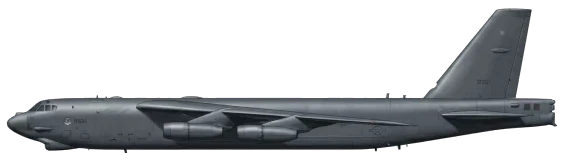
| B-2 Spirit | B-52 Stratofortress | |
|---|---|---|
| Origin country | 🇺🇸 United States | 🇺🇸 United States |
| Category | Bombers | Bombers |
| Manufacturer | Northrop | Boeing |
| First flight | 17 July 1989 | 15 April 1952 |
| Year introduced | 1993 | 1955 |
| Number produced | 21 units | 744 units |
| Average unit price | $750 million | $9.3 million |
| Wing area | 478.0 m² | 370.0 m² |
| Wingspan | 52.0 m | 56.4 m |
| Height | 5.0 m | 12.4 m |
| Length | 21.0 m | 48.5 m |
| Maximum speed | 972 km/h | 1000 km/h |
| Operational range | 11,000 km | 14,200 km |
| Service ceiling | 15,240 m | 15,000 m |
| Max. takeoff weight | 170,200 kg | 220,000 kg |
| Empty weight | 71,668 kg | 83,250 kg |
| Total thrust | 4 x 7,847 kgf | 8 x 7,747 kgf |
Detailed Comparison
The B-2 Spirit is a low-observable strategic bomber designed for penetrating contested airspace, while the B-52 Stratofortress is a long-endurance standoff munitions platform. Developed decades apart, the B-2's design is dictated by stealth requirements, resulting in a small fleet of 21 highly advanced, expensive aircraft. In contrast, the B-52 was built in large numbers (744) as a Cold War nuclear deterrent and has been adapted through continuous upgrades for versatile, high-volume payload delivery.
Development and Design
The B-2 Spirit originated from the 1970s Advanced Technology Bomber project, a direct response to the need to penetrate sophisticated Soviet air defenses. Its flying wing design, use of advanced composite materials, and surfaces engineered to deflect radar waves are all subservient to its primary characteristic: low observability. This focus on stealth allows it to operate without the extensive support packages required by non-stealthy aircraft.
The B-52 Stratofortress was a product of the early 1950s, designed for intercontinental range and high-altitude flight to deliver nuclear weapons. Its conventional design, featuring a 56.4 m swept wing and eight turbojet engines, was optimized for endurance and payload, not stealth. Its longevity is a testament to a robust airframe that has accommodated decades of avionics and weapons system upgrades, transitioning it from a nuclear bomber to a multi-role standoff weapon and conventional bombing platform.
Specifications and Performances
While both aircraft have similar subsonic speeds and high service ceilings, their operational performance is defined by payload and survivability. The B-52 has a much higher maximum takeoff weight at 220,000 kg compared to the B-2's 170,200 kg, enabling a larger overall munitions capacity. The B-2 carries its 18,000 kg payload exclusively in internal bays to maintain its stealth profile and is uniquely capable of carrying two 14,000 kg Massive Ordnance Penetrator bombs. The B-52, by contrast, leverages a mix of internal and external carriage. The B-2's survivability hinges on evading detection, whereas the B-52 relies on launching long-range standoff weapons like cruise missiles from outside the range of enemy air defenses.
Deployment and usage
The B-2 is employed for high-priority strategic attacks against the most heavily defended targets. Its operational history, including initial strikes in Kosovo and Libya, involves non-stop, multi-day missions launched directly from the United States, illustrating its role as a "first night" global strike asset. Its use is reserved for missions where surprise and penetration are paramount. The B-52 has a far more extensive and varied combat history, from carpet bombing in Vietnam to launching the opening cruise missile salvos of the 1991 Gulf War and providing persistent close air support in Afghanistan and Iraq. It serves as a cost-effective workhorse for delivering large volumes of munitions in less contested or permissive airspace.
Conclusion
The B-2 Spirit and B-52 Stratofortress are not competitors but complementary components of U.S. strategic airpower. The B-2 is a specialized, high-cost asset designed to defeat advanced anti-access/area denial (A2/AD) systems, providing a capability that no other aircraft can replicate. The B-52 provides unparalleled payload capacity and operational flexibility at a lower cost per flight hour, making it an indispensable platform for standoff attacks and large-scale conventional bombing operations. The B-2 ensures access to any target, while the B-52 provides affordable mass and firepower.