MBB Bo 105 vs SA316 Alouette III
MBB Bo 105 vs SA316 Alouette III at a glance — top speed 270 vs 210 km/h, range 657 vs 540 km, max takeoff weight 2,700 vs 2,200 kg, built 1,500 vs 2,000 units.
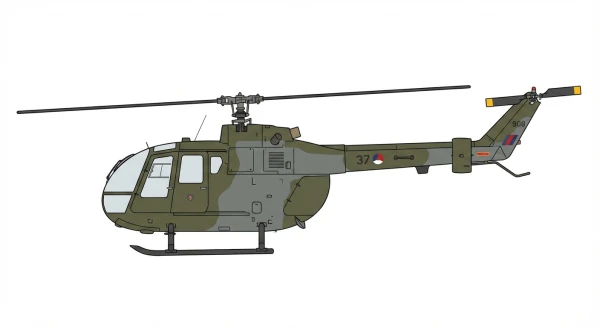
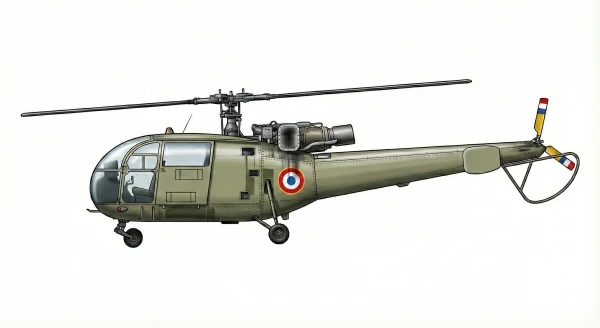
| MBB Bo 105 | SA316 Alouette III | |
|---|---|---|
| Origin country | 🇩🇪 Germany | 🇫🇷 France |
| Category | Military Helicopters | Military Helicopters |
| Manufacturer | MBB | Sud Aviation |
| First flight | 16 February 1967 | 28 February 1959 |
| Year introduced | 1970 | 1961 |
| Number produced | 1500 units | 2000 units |
| Average unit price | $550K | $1.5 million |
| Wingspan | 9.8 m | 11.0 m |
| Height | 3.0 m | 3.0 m |
| Length | 11.9 m | 10.0 m |
| Maximum speed | 270 km/h | 210 km/h |
| Operational range | 657 km | 540 km |
| Service ceiling | 5,182 m | 3,200 m |
| Max. takeoff weight | 2,700 kg | 2,200 kg |
| Empty weight | 1,675 kg | 1,143 kg |
| Total thrust | 2 x 332 kW | 1 x 713 kW |
Detailed Comparison
The MBB Bo 105 and the Sud Aviation SA316 Alouette III constitute two significant generations of light utility helicopters, diverging fundamentally in rotor technology and propulsion philosophy. While the Alouette III represents the zenith of 1960s single-engine utility design focused on cabin volume and simplicity, the Bo 105 introduced advanced composite materials and twin-engine redundancy, shifting the operational paradigm toward high maneuverability and survivability.
Development and Design
Sud Aviation developed the SA316 Alouette III as an enlarged, streamlined derivative of the Alouette II, entering service in 1961. The design philosophy prioritized aerodynamic efficiency and internal capacity, accommodating up to seven seats or stretchers. It retained a conventional articulated rotor system powered by a single Turbomeca Artouste turboshaft. In contrast, the Bo 105, which entered service in 1970, was a technological pioneer. MBB implemented a hingeless rotor system featuring a solid titanium rotor head and glass-fiber reinforced plastic blades. This rigid rotor design eliminated mechanical hinges, significantly reducing maintenance while enabling aerobatic capabilities previously impossible for helicopters. Furthermore, the Bo 105 integrated two Allison 250 engines, providing a safety margin for engine failure that the single-engine Alouette III could not offer.
Specifications and Performance
The structural and performance data reflect the differing roles of these aircraft. The Bo 105 is the heavier platform with a Maximum Takeoff Weight (MTOW) of 2,700 kg, compared to the Alouette III's 2,200 kg. The Bo 105 also exhibits superior vertical performance with a service ceiling of 5,182 m, substantially higher than the 3,200 m limit listed for the Alouette III. While the Alouette III relies on a single powerplant (listed at 713 kW), the Bo 105 distributes propulsion across two engines (332 kW each), enhancing survivability. Logistically, the Bo 105 features rear clamshell doors for rapid loading of cargo and stretchers, whereas the Alouette III utilizes side entry. The Bo 105's rigid rotor contributes to a vibration-free flight and immediate control response, contrasting with the more conventional handling characteristics of the Alouette.
Deployment and Usage
Operational history highlights the Alouette III as a rugged utility and counter-insurgency platform, while the Bo 105 excelled in specialized combat and maritime roles. The Alouette III saw extensive combat with Portuguese and Rhodesian forces, adapted into "K-Car" gunships with 20mm cannons and "G-Car" troop transports for air assault. It became a staple in austere environments due to its mechanical simplicity. Conversely, the Bo 105 was heavily utilized for anti-armor and maritime duties. The German Army's Bo 105 PAH-1 variant was a dedicated tank hunter armed with six HOT missiles, utilizing its nap-of-the-earth agility. The Bo 105's twin-engine configuration made it preferable for overwater operations with the Mexican Navy and Indonesian Armed Forces, whereas the French Navy eventually phased out the Alouette III due to the risks associated with single-engine operations over the sea.
Conclusion
The SA316 Alouette III remains a benchmark for cost-effective, high-capacity utility transport in permissive environments, celebrated for its ruggedness and ease of maintenance. However, the Bo 105 offered a superior technological solution for high-threat and maritime environments. Its rigid rotor system and twin-engine architecture provided the redundancy and agility required for modern anti-tank warfare and all-weather operations, establishing the design standards for future light multi-role helicopters.