C-17 Globemaster III vs Il-76 Candid
C-17 Globemaster III vs Il-76 Candid at a glance — top speed 930 vs 850 km/h, range 4,480 vs 5,000 km, max takeoff weight 259,460 vs 195,000 kg, built 279 vs 960 units.
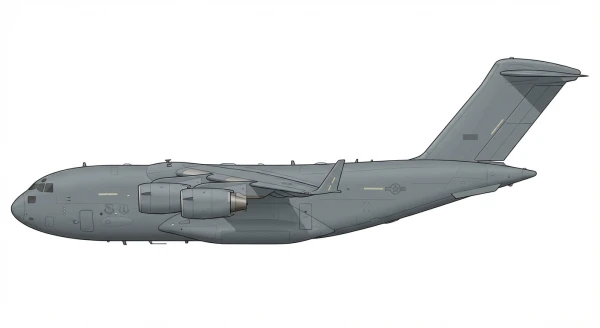
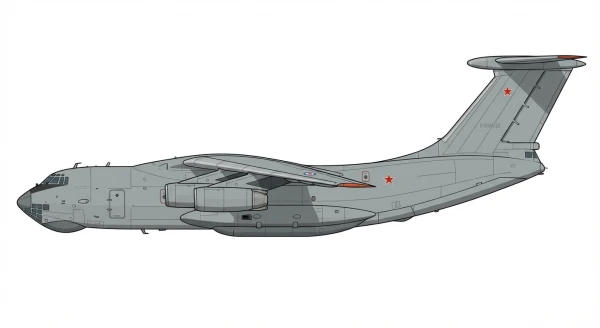
| C-17 Globemaster III | Il-76 Candid | |
|---|---|---|
| Origin country | 🇺🇸 United States | 🇷🇺 Ex-USSR |
| Category | Military Transport Aircraft | Military Transport Aircraft |
| Manufacturer | McDonnell Douglas | Ilyushin |
| First flight | 15 September 1991 | 25 March 1971 |
| Year introduced | 1993 | 1974 |
| Number produced | 279 units | 960 units |
| Average unit price | $340 million | -- |
| Wing area | 353.0 m² | 300.0 m² |
| Wingspan | 51.8 m | 50.5 m |
| Height | 16.8 m | 14.8 m |
| Length | 53.0 m | 46.6 m |
| Maximum speed | 930 km/h | 850 km/h |
| Operational range | 4,480 km | 5,000 km |
| Service ceiling | 13,715 m | 13,000 m |
| Max. takeoff weight | 259,460 kg | 195,000 kg |
| Empty weight | 122,000 kg | 92,500 kg |
| Total thrust | 4 x 18,909 kgf | 4 x 14,500 kgf |
Detailed Comparison
Emerging from the tail end of the Cold War, the McDonnell Douglas C-17 Globemaster III was procured to bridge the gap between tactical intratheater airlift and strategic intertheater transport, allowing the USAF to bypass staging bases. In contrast, the Ilyushin Il-76 Candid was fielded two decades earlier to replace the An-12, explicitly built to project Soviet airborne forces and heavy machinery into austere, poorly developed airfields across the vast Eurasian landmass and client states.
Development and Design
USAF doctrine dictated that the C-17 carry outsized cargo—specifically the 60-plus ton M1 Abrams tank—directly to short, forward runways. This required an advanced fly-by-wire system, externally blown flaps for short-field performance (2,500 m takeoff), and an automated glass cockpit reducing the crew to three. The Soviet requirement for the Il-76 prioritized mechanical resilience over automation, resulting in a labor-intensive seven-person crew, including a navigator stationed in a glass chin cone. While the C-17 utilizes a T-tail and supercritical wing to maximize high-altitude cruise efficiency, the Il-76 relies on a ruggedized landing gear system with 20 low-pressure tires to sustain repeated impacts on unpaved Siberian or Afghan strips.
Specifications and Performances
The payload and thrust metrics delineate their respective weight classes:
- The C-17 operates with a Maximum Takeoff Weight (MTOW) of 259,460 kg, powered by four Pratt & Whitney F117 turbofans generating 18,909 kgf of thrust each.
- The Il-76 peaks at an MTOW of 195,000 kg, with its Aviadvigatel PS-90A-76 engines producing 14,500 kgf of thrust.
This thrust disparity dictates payload capacity. The C-17 hauls up to 77,500 kg of cargo, whereas the Il-76 caps at approximately 48,000 kg. The Il-76 yields a marginal advantage in unrefueled range—5,000 km compared to the C-17’s 4,480 km baseline—though the USAF routinely mitigates this via aerial refueling.
Deployment and usage
The Il-76 formed the logistical spine of the 1979-1989 Soviet-Afghan War. Flying into Kabul and Bagram, it absorbed heavy ground fire, validating its damage-tolerant airframe. Over 960 units were built, making it a ubiquitous platform for Indian and Chinese forces, and serving as the baseline airframe for A-50 AEW&C and Il-78 tanker variants. The C-17’s combat debut occurred during Operation Enduring Freedom. It later executed direct insertion airdrops of the 173rd Airborne Brigade into northern Iraq in 2003. Its $340 million price tag capped production at 279 airframes, restricting its export to high-budget operators like the UK, Australia, and Qatar.
Conclusion
The C-17 holds the definitive edge in force projection for modern, mechanized militaries. Its ability to maneuver main battle tanks directly into tactical airstrips with a three-person crew justifies its high acquisition cost for Western forces. The Il-76 wins on scale, affordability, and bare-base operations. For nations denied access to the C-17, the Il-76 remains the only viable heavy airlift option, but evaluated strictly as an engineering solution for rapid global mobility, the C-17’s payload-to-crew ratio and outsized cargo capacity render it the superior aircraft.