Diamond DA62 vs GlobalEye
Diamond DA62 vs GlobalEye at a glance — top speed 372 vs 1,110 km/h, range 2,380 vs 11,000 km, max takeoff weight 2,300 vs 45,100 kg, built 120 vs 5 units.

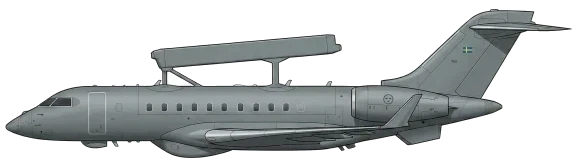
| Diamond DA62 | GlobalEye | |
|---|---|---|
| Origin country | 🇦🇹 Austria | 🇨🇦 Canada🇸🇪 Sweden |
| Category | Military Special Mission Aircraft | Military Special Mission Aircraft |
| Manufacturer | Diamond | Saab |
| First flight | 1 April 2012 | 14 March 2018 |
| Year introduced | 2015 | 2020 |
| Number produced | 120 units | 5 units |
| Average unit price | $1.9 million | $350 million |
| Wing area | 17.1 m² | 94.9 m² |
| Wingspan | 14.6 m | 29.0 m |
| Height | 2.8 m | 7.8 m |
| Length | 9.2 m | 30.3 m |
| Maximum speed | 372 km/h | 1110 km/h |
| Operational range | 2,380 km | 11,000 km |
| Service ceiling | 6,069 m | 16,000 m |
| Max. takeoff weight | 2,300 kg | 45,100 kg |
| Empty weight | 1,590 kg | 23,690 kg |
| Total thrust | 2 x 132 kW | 2 x 6,690 kgf |
Detailed Comparison
At $350 million per airframe, the Saab GlobalEye dictates theater-level, multi-domain airspace control using a heavily modified business jet, while the $1.9 million Diamond DA62 MPP occupies the extreme lower tier of localized ISR, leveraging a piston-engine civilian architecture. The disparity in scale dictates their employment: Saab’s platform acts as a central C2 node for layered air defense, whereas the Diamond airframe provides unrefueled persistent surveillance for austere, permissive environments.
Development and Design
Saab integrated the Erieye ER gallium nitride (GaN) AESA radar onto the Bombardier Global 6000/6500 airframe, a process requiring structural reinforcement, an extended tailfin, and ventral strakes to counteract the aerodynamic drag of the one-tonne dorsal radome. The architecture links five onboard operator stations to manage simultaneous air, maritime (Leonardo Seaspray 7500E), and ground tracks. Diamond Aircraft adapted the single-engine DA50 civilian fuselage into a twin-engine platform powered by Austro AE330 diesels. The DA62 MPP variant bypasses complex onboard C2 integration, relying instead on bolt-on EO/IR turrets and lightweight maritime radars, pushing raw sensor data via datalink to ground stations.
Specifications and Performances
The GlobalEye operates at 16,000 meters and speeds up to 1,110 km/h, enabling its Erieye ER to push its detection horizon out to 550 km. It manages an 11-hour endurance on turbofan power, projecting coverage over massive geographical areas. The DA62 matches this persistence with a 10-hour endurance via diesel fuel efficiency, burning Jet-A at 6,069 meters. The speed gap dictates their response times: the GlobalEye transits at near Mach 0.9, while the DA62 tops out at 372 km/h. Takeoff requirements strictly govern basing: the 45,100 kg GlobalEye demands 2,000 meters of paved runway, whereas the 2,300 kg DA62 operates from 480-meter dirt strips near the forward edge of the battle area.
Deployment and usage
The UAE Air Force operationalized the GlobalEye in 2020, integrating it into an air defense network to track ballistic missile launches and low-flying drone incursions. Sweden and France have subsequently ordered the platform to replace older turboprop and E-3 Sentry aircraft. The DA62 MPP serves isolated, low-threat requirements. The Nigerian Air Force acquired four units in 2023 for counter-insurgency ISR, prioritizing low operating costs and high sortie generation over sensor fidelity. Greece purchased three units in 2024 for civil defense and firefighting coordination, roles that do not justify tying up high-tier AEW&C assets.
Conclusion
The GlobalEye is the only viable option between the two in contested theaters where early warning, ballistic missile tracking, and airborne C2 are mandatory. Its $350 million price tag buys theater-level airspace dominance and 550-km standoff detection. Conversely, the DA62 MPP wins out in low-intensity conflicts, counter-insurgency, and border security. At roughly 0.5% the acquisition cost of a GlobalEye, militaries can procure fleets of DA62s to maintain continuous, localized EO/IR coverage, trading radar horizon for the financial ability to keep eyes over a target 24/7.