E-2 Hawkeye vs E-3 Sentry AWACS
E-2 Hawkeye vs E-3 Sentry AWACS at a glance — top speed 648 vs 853 km/h, range 2,708 vs 7,400 km, max takeoff weight 57,500 vs 147,417 kg, built 313 vs 68 units.
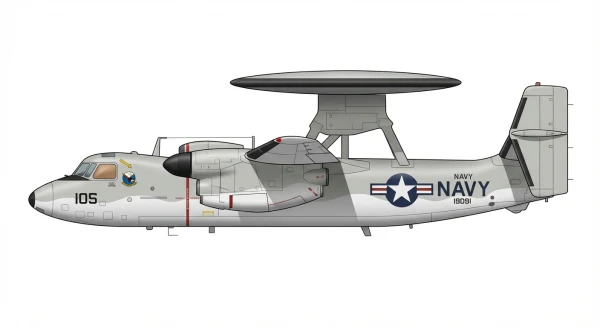
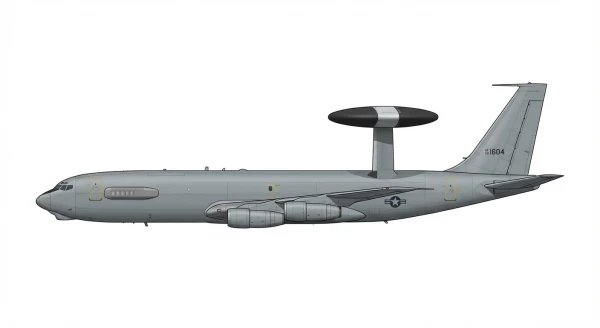
| E-2 Hawkeye | E-3 Sentry AWACS | |
|---|---|---|
| Origin country | 🇺🇸 United States | 🇺🇸 United States |
| Category | Military Special Mission Aircraft | Military Special Mission Aircraft |
| Manufacturer | Grumman | Boeing |
| First flight | 21 October 1960 | 9 February 1972 |
| Year introduced | 1964 | 1977 |
| Number produced | 313 units | 68 units |
| Average unit price | $232 million | $270 million |
| Wing area | 65.0 m² | 283.0 m² |
| Wingspan | 24.6 m | 44.4 m |
| Height | 5.6 m | 12.6 m |
| Length | 17.6 m | 46.6 m |
| Maximum speed | 648 km/h | 853 km/h |
| Operational range | 2,708 km | 7,400 km |
| Service ceiling | 10,577 m | 10,668 m |
| Max. takeoff weight | 57,500 kg | 147,417 kg |
| Empty weight | 19,536 kg | 83,915 kg |
| Total thrust | 2 x 3,803 kW | 4 x 9,752 kgf |
Detailed Comparison
The E-3 Sentry and E-2 Hawkeye are both airborne early warning and control (AEW&C) aircraft, but they are fundamentally shaped by their intended operating environments. The E-3, based on a Boeing 707 jetliner, is a strategic, land-based asset designed for theater-level command and control. In contrast, the E-2 is a carrier-capable, twin-turboprop aircraft, designed from inception as a tactical platform to extend the electronic horizon of a naval carrier strike group.
Development and Design
The E-3 Sentry's development in the late 1960s leveraged a large, existing commercial airframe, allowing for a spacious, pressurized cabin to house a large mission crew (15 operators) and extensive C2 infrastructure, including 14 consoles. Its most prominent feature, the 30-foot rotodome housing the AN/APY-1/2 radar, is supported by a robust hydraulic system. The design prioritizes endurance and on-station time for managing large-scale air operations.
The E-2 Hawkeye was a more complex engineering challenge, constrained by the requirements of CATOBAR carrier operations. Developed in the late 1950s, it was the first aircraft designed specifically for the AEW mission. Its compact airframe, high-wing configuration, and distinctive quad-vertical tail were dictated by the need for carrier compatibility, including hangar deck clearance and stability. The Grumman Sto-Wing folding mechanism is a critical design feature that prevents the wings from impacting the 24-foot rotodome. Its small crew of five reflects its more focused tactical role.
Specifications and Performances
The performance differences directly reflect their distinct missions. The four-engine jet-powered E-3 possesses a significantly greater range (9,250 km vs. 2,480 km) and higher maximum speed (853 km/h vs. 648 km/h), enabling it to deploy rapidly over intercontinental distances and survey vast areas of responsibility. Its maximum takeoff weight of 147,417 kg is more than double that of the E-2, allowing for greater fuel loads and mission system capacity. The E-2's twin turboprops are optimized for fuel efficiency during long, lower-altitude patrols and provide the necessary power for carrier launches. Its smaller size and lower weight (57,500 kg MTOW) are non-negotiable for carrier operations. While the E-3's AN/APY-2 provides surveillance from the ground to the stratosphere, the E-2D's modern AN/APY-9 radar is specifically tailored for detecting small, low-observable targets in a cluttered naval environment.
Deployment and Usage
Operationally, the E-3 Sentry functions as an airborne command post. During the Persian Gulf War, it orchestrated coalition air power, directing strike packages and managing the air-to-air battlespace. Its large crew enables comprehensive battle management, surveillance, and communications relay across a theater. The E-2 Hawkeye operates as the "eyes of the fleet." Its primary function is to provide a protective AEW bubble around the carrier strike group, detecting incoming threats like anti-ship missiles and low-flying aircraft, and directing carrier air wing fighters for intercepts, as demonstrated in the 1981 Gulf of Sidra incident. While the E-3 is operated by major air forces like the USAF and NATO, the E-2 is a staple of carrier-equipped navies (U.S., France) and nations with significant maritime surveillance needs (Japan, Taiwan).
Conclusion
The E-3 Sentry and E-2 Hawkeye are not direct competitors; they are purpose-built solutions for different operational echelons. The E-3 is a strategic asset, providing high-level command and control over large land or maritime theaters from established airbases. The E-2 is a tactical enabler, a vital and integrated component of naval power projection, providing essential early warning and fighter control from the mobile and constrained environment of an aircraft carrier. The Sentry's design emphasizes scale and scope, whereas the Hawkeye's design is a masterclass in capability optimization within severe physical constraints.