E-3 Sentry AWACS vs GlobalEye
E-3 Sentry AWACS vs GlobalEye at a glance — top speed 853 vs 1,110 km/h, range 7,400 vs 11,000 km, max takeoff weight 147,417 vs 45,100 kg, built 68 vs 5 units.
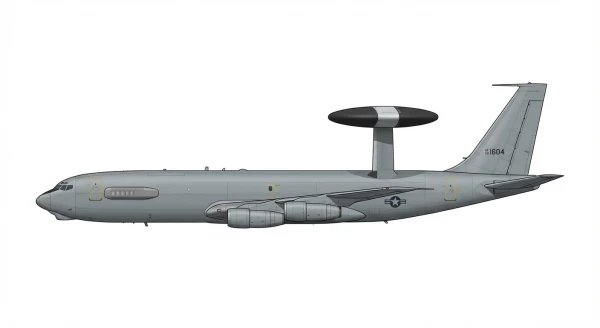
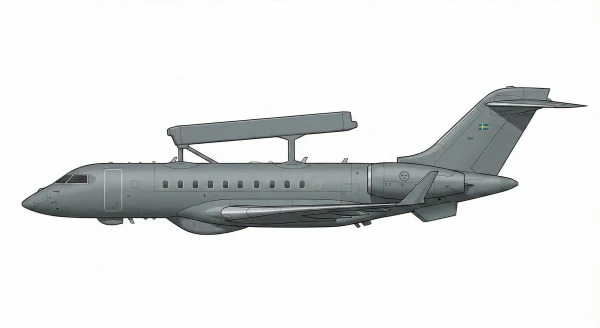
| E-3 Sentry AWACS | GlobalEye | |
|---|---|---|
| Origin country | 🇺🇸 United States | 🇨🇦 Canada🇸🇪 Sweden |
| Category | Military Special Mission Aircraft | Military Special Mission Aircraft |
| Manufacturer | Boeing | Saab |
| First flight | 9 February 1972 | 14 March 2018 |
| Year introduced | 1977 | 2020 |
| Number produced | 68 units | 5 units |
| Average unit price | $270 million | $350 million |
| Wing area | 283.0 m² | 94.9 m² |
| Wingspan | 44.4 m | 29.0 m |
| Height | 12.6 m | 7.8 m |
| Length | 46.6 m | 30.3 m |
| Maximum speed | 853 km/h | 1110 km/h |
| Operational range | 7,400 km | 11,000 km |
| Service ceiling | 10,668 m | 16,000 m |
| Max. takeoff weight | 147,417 kg | 45,100 kg |
| Empty weight | 83,915 kg | 23,690 kg |
| Total thrust | 4 x 9,752 kgf | 2 x 6,690 kgf |
Detailed Comparison
The Boeing E-3 Sentry utilizes a modified 1960s commercial airliner airframe to house a mechanically scanning pulse-Doppler radar system, defining the Airborne Warning and Control System (AWACS) standard for the late 20th century. In contrast, the Saab GlobalEye integrates modern Active Electronically Scanned Array (AESA) technology onto a smaller, long-range business jet, reflecting a doctrinal shift toward multi-role surveillance platforms with reduced logistical footprints and higher automation.
Development and Design
The E-3 Sentry, derived from the Boeing 707-320B, features a distinct 30-foot rotating radome mounted 11 feet above the fuselage. This rotodome houses the Westinghouse AN/APY-1 or AN/APY-2 passive electronically scanned array radar, mechanically rotating to provide 360-degree coverage. The design required significant structural reinforcement and uprated hydraulics (345 bar) to manage the rotation mechanism.
Saab developed the GlobalEye by modifying the Bombardier Global 6000/6500 airframe. The design incorporates a fixed dorsal "ski-box" housing the Erieye ER (Extended Range) radar. Unlike the E-3's mechanical rotation, the GlobalEye utilizes Gallium Nitride (GaN) transmit/receive modules for electronic scanning. The airframe includes ventral strakes and an extended tailfin for stability. While the E-3 focuses solely on air battle management, the GlobalEye integrates a Leonardo Seaspray 7500E maritime radar and electro-optical sensors for simultaneous air, sea, and land surveillance.
Specifications and Performances
The physical disparity between the platforms is substantial. The E-3's maximum takeoff weight of 147,417 kg is more than three times that of the GlobalEye (45,100 kg). Powered by four Pratt & Whitney TF33 turbojets, the Sentry achieves a range of 7,400 km and an endurance of 8 hours. The twin-engine GlobalEye leverages the efficiency of the business jet platform to reach a range of 11,000 km and an endurance of 11 hours.
Operational altitudes differ significantly; the GlobalEye operates up to 16,000 m (52,000 ft), compared to the E-3's 10,668 m (35,000 ft) ceiling, allowing the Saab platform a superior line-of-sight horizon. The E-3 accommodates a mission crew of 15 to man 14 onboard consoles. Conversely, the GlobalEye relies on higher automation and data links, requiring only five operator stations to manage its sensor suite.
Deployment and Usage
The E-3 Sentry possesses an extensive combat record. During the 1991 Persian Gulf War, it logged 5,052 surveillance hours and facilitated 38 of 41 coalition air-to-air kills. It provided command and control for NATO during Operation Allied Force (1999) and the USAF during Operation Inherent Resolve (2015). It serves as the primary AEW&C asset for the USAF, NATO, France, the UK, and Saudi Arabia.
The GlobalEye entered service in 2020 with the United Arab Emirates Air Force as a Swing Role Surveillance System (SRSS), utilized for tasks ranging from border security to ballistic missile detection. Sweden has ordered the platform (designated S 106) to replace its ASC 890 fleet, and France announced an order in June 2025.
Conclusion
The E-3 Sentry remains a high-capacity Command and Control (C2) node, optimized for managing large-scale theater air campaigns where high numbers of onboard battle management staff are required. The GlobalEye represents a generation operational leap, prioritizing sensor range (550 km), multi-domain flexibility, and operational efficiency. While the E-3 offers greater onboard distinct staffing capacity, the GlobalEye provides superior flight performance, endurance, and sensor fidelity for modern network-centric warfare.