Hawk vs T-38 Talon
Hawk vs T-38 Talon at a glance — top speed 1,028 vs 1,381 km/h, range 2,520 vs 1,835 km, max takeoff weight 8,340 vs 5,670 kg, built 1,000 vs 1,189 units.
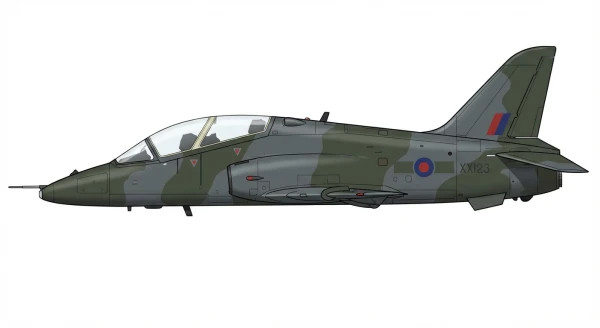
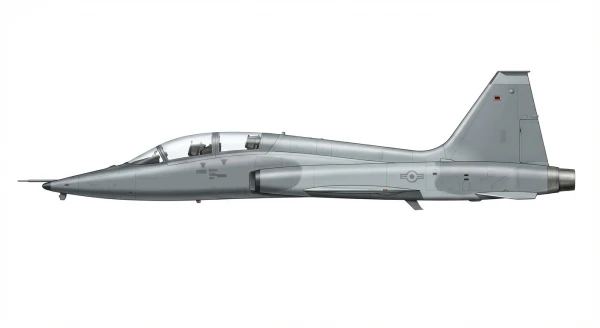
| Hawk | T-38 Talon | |
|---|---|---|
| Origin country | 🇬🇧 United Kingdom | 🇺🇸 United States |
| Category | Military Training Aircraft | Military Training Aircraft |
| Manufacturer | British Aerospace | Northrop |
| First flight | 21 August 1974 | 10 March 1959 |
| Year introduced | 1976 | 1961 |
| Number produced | 1000 units | 1189 units |
| Average unit price | $18 million | -- |
| Wing area | 16.7 m² | 16.0 m² |
| Wingspan | 9.4 m | 7.7 m |
| Height | 4.1 m | 3.9 m |
| Length | 11.9 m | 14.1 m |
| Maximum speed | 1028 km/h | 1381 km/h |
| Operational range | 2,520 km | 1,835 km |
| Service ceiling | 15,000 m | 15,240 m |
| Max. takeoff weight | 8,340 kg | 5,670 kg |
| Empty weight | 3,635 kg | 3,266 kg |
| Total thrust | 1 x 2,420 kgf | 2 x 1,216 kgf |
Detailed Comparison
The Northrop T-38 Talon and BAE Systems Hawk represent two distinct generations of military jet training. The T-38 is a pure, high-performance supersonic trainer designed in the 1950s to prepare pilots for Cold War-era fighters and bombers. In contrast, the Hawk, developed in the 1970s, is a more versatile platform, combining advanced training with a potent light attack and point-defense fighter capability, a key factor in its significant export success.
Development and Design
The T-38 Talon emerged from Northrop's N-156 project, sharing its airframe design with the F-5 Freedom Fighter. Its design is singularly focused on performance: a sleek, lightweight airframe, twin afterburning General Electric J85 engines, and a trapezoidal wing optimized to minimize drag at high speeds. The goal was to provide a safe, reliable, and cost-effective vehicle for supersonic flight instruction.
The Hawk was conceived by Hawker Siddeley to meet a Royal Air Force requirement for a new advanced trainer, but with a crucial eye toward the export market. Its design emphasizes a balance of performance, maneuverability, and combat utility. Key features include:
- A single, reliable Rolls-Royce Turbomeca Adour turbofan engine.
- A low-mounted wing and robust airframe stressed to +9 g for high agility.
- Tandem seating with the instructor raised for superior visibility.
- Inherent design provisions for significant armament, which was a secondary consideration for the T-38.
Specifications and Performances
A performance comparison reveals their differing priorities. The T-38 is the faster aircraft, capable of Mach 1.3 (1381 km/h) and reaching a higher service ceiling of 15,240 m, a direct result of its twin afterburning engines and aerodynamic design. The Hawk is a high-subsonic aircraft (Mach 0.88 in level flight), prioritizing agility and handling characteristics over raw speed.
The most significant divergence is in payload. The T-38 is primarily unarmed. The Hawk, however, has a substantially higher maximum takeoff weight (8340 kg vs. the T-38's 5670 kg) and was designed from the outset to carry ordnance. Later Hawk variants can carry over 3,000 kg of weapons, including air-to-air missiles and guided munitions, a capability far beyond the Talon's scope.
Deployment and usage
The T-38 has served a remarkably long and focused career, primarily as the advanced jet trainer for the United States Air Force and NASA for over six decades. Its role has been almost exclusively to train pilots in high-performance flight, with some use in adversary and chase plane roles. It has never been used in combat.
The Hawk's operational history is far more varied. While a primary trainer for the RAF and numerous other air forces, its dual-role design has seen it deployed in combat. Malaysia used its Hawk 208s for ground-attack missions, and Zimbabwe deployed its fleet during the Second Congo War. This combat utility, combined with its training capabilities, has made it a popular choice for air forces seeking a multi-role platform without the expense of a dedicated front-line fighter.
Conclusion
The T-38 Talon is a master of its specialized craft: a pure supersonic trainer that has successfully prepared generations of pilots for high-speed aircraft. Its longevity is a testament to its effective, though narrow, design philosophy. The BAE Systems Hawk, by contrast, represents a more modern and pragmatic approach. By integrating a credible light combat capability into an advanced training airframe, it created a new market category. While the T-38 taught pilots how to fly fast, the Hawk taught them how to fly and fight, making it a more versatile and commercially successful military asset on the global stage.