Hawk vs T-50 Golden Eagle
Hawk vs T-50 Golden Eagle at a glance — top speed 1,028 vs 1,840 km/h, range 2,520 vs 1,851 km, max takeoff weight 8,340 vs 13,472 kg, built 1,000 vs 200 units.
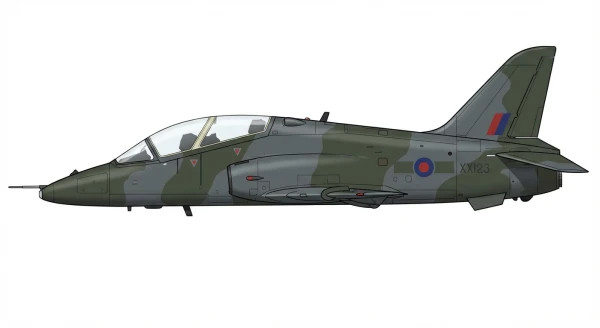
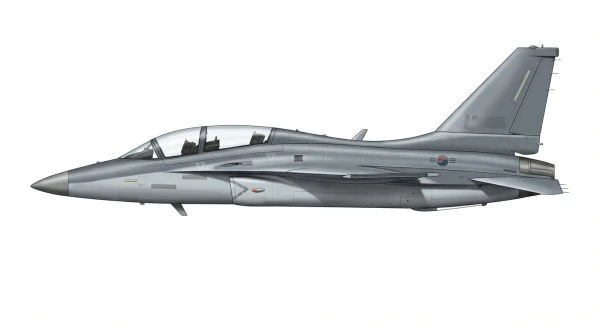
| Hawk | T-50 Golden Eagle | |
|---|---|---|
| Origin country | 🇬🇧 United Kingdom | 🇰🇷 South Korea |
| Category | Military Training Aircraft | Military Training Aircraft |
| Manufacturer | British Aerospace | KAI |
| First flight | 21 August 1974 | 20 August 2002 |
| Year introduced | 1976 | 2005 |
| Number produced | 1000 units | 200 units |
| Average unit price | $18 million | $25 million |
| Wing area | 16.7 m² | 23.7 m² |
| Wingspan | 9.4 m | 9.2 m |
| Height | 4.1 m | 4.8 m |
| Length | 11.9 m | 13.0 m |
| Maximum speed | 1028 km/h | 1840 km/h |
| Operational range | 2,520 km | 1,851 km |
| Service ceiling | 15,000 m | 16,764 m |
| Max. takeoff weight | 8,340 kg | 13,472 kg |
| Empty weight | 3,635 kg | 6,441 kg |
| Total thrust | 1 x 2,420 kgf | 1 x 5,409 kgf |
Detailed Comparison
The British Aerospace Hawk and the KAI T-50 Golden Eagle represent two distinct generations of advanced jet trainer acquisition. The Hawk serves as a subsonic, mechanically robust platform developed in the 1970s, while the T-50 is a supersonic, fly-by-wire aircraft developed in the 2000s with design assistance from Lockheed Martin to bridge the gap to 4th and 5th-generation fighters.
Development and Design
The Hawk originated from Hawker Siddeley's HS.1182 project to replace the Folland Gnat, prioritizing structural durability (+9g limit) and instructor visibility via stepped cockpits. It utilizes a mechanical flight control system with hydraulic assist and a non-afterburning propulsion system. Conversely, the T-50 incorporates digital fly-by-wire controls, a variable camber wing with Leading-Edge Root Extensions (LERX), and avionics mirroring the F-16 Fighting Falcon. While the Hawk relies on the Rolls-Royce Adour turbofan, the T-50 utilizes the afterburning General Electric F404, necessitating a larger airframe and distinctly different intake geometry to support supersonic airflow.
Specifications and Performance
Performance metrics diverge significantly due to the design eras and intended roles. The T-50 achieves a maximum speed of 1,840 km/h (Mach 1.5), nearly double the Hawk’s level flight speed of 1,028 km/h (Mach 0.88). The T-50's GE F404 engine generates 5,409 kgf of thrust compared to the Hawk's 2,420 kgf, accommodating a heavier Maximum Takeoff Weight (13,472 kg vs 8,340 kg).
Regarding armament, the Hawk requires a centerline pod for gun capabilities (30mm ADEN), whereas the T-50 integrates an internal three-barrel 20mm cannon. The T-50 offers seven hardpoints compared to the Hawk’s standard three (expanded to five on later variants like the Hawk 128/100 series). The T-50’s service ceiling of 16,764 m exceeds the Hawk's 15,000 m, reflecting its fighter-oriented kinematic performance.
Deployment and Usage
The Hawk has been procured by 18 nations with over 1,000 units produced since 1974. It has seen combat with the Zimbabwean Air Force in the Second Congo War and the Royal Malaysian Air Force during the 2013 Lahad Datu standoff, primarily utilizing unguided rockets and bombs. The T-50, with approximately 200 units built since 2002, serves primarily in the Asia-Pacific and Middle East. The FA-50 light combat variant saw active combat with the Philippine Air Force during the Battle of Marawi in 2017, conducting close air support missions using precision-guided munitions.
Conclusion
The BAE Hawk remains a cost-efficient solution for air forces requiring subsonic advanced training, particularly where simplified maintenance and lower operating costs are prioritized over raw kinematic performance. The T-50 Golden Eagle serves a different requirement set, offering flight characteristics that replicate modern frontline fighters. Consequently, the T-50 functions effectively as a Lead-In Fighter Trainer (LIFT) for supersonic platforms or as a dedicated light multirole fighter, whereas the Hawk occupies the role of an established advanced trainer with secondary strike utility.