Hawk vs T-7 Red Hawk
Hawk vs T-7 Red Hawk at a glance — top speed 1,028 vs 1,300 km/h, range 2,520 vs 1,830 km, max takeoff weight 8,340 vs 5,500 kg, built 1,000 vs 2 units.
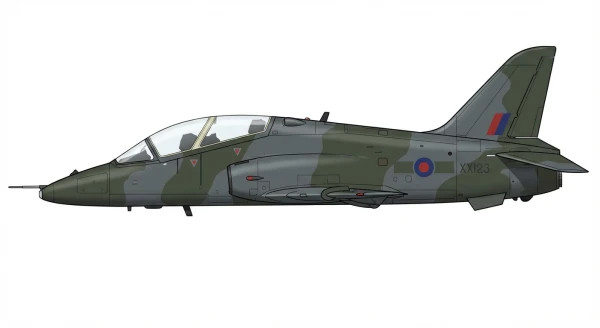
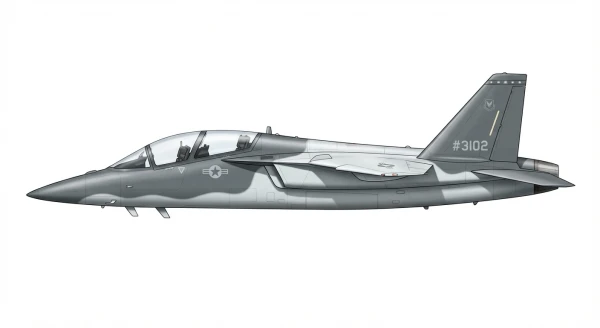
| Hawk | T-7 Red Hawk | |
|---|---|---|
| Origin country | 🇬🇧 United Kingdom | 🇺🇸 United States |
| Category | Military Training Aircraft | Military Training Aircraft |
| Manufacturer | British Aerospace | Boeing |
| First flight | 21 August 1974 | 20 December 2016 |
| Year introduced | 1976 | 2028 |
| Number produced | 1000 units | 2 units |
| Average unit price | $18 million | $22 million |
| Wing area | 16.7 m² | -- m² |
| Wingspan | 9.4 m | 10.0 m |
| Height | 4.1 m | 4.0 m |
| Length | 11.9 m | 15.2 m |
| Maximum speed | 1028 km/h | 1300 km/h |
| Operational range | 2,520 km | 1,830 km |
| Service ceiling | 15,000 m | 15,240 m |
| Max. takeoff weight | 8,340 kg | 5,500 kg |
| Empty weight | 3,635 kg | 3,250 kg |
| Total thrust | 1 x 2,420 kgf | 1 x 8,029 kgf |
Detailed Comparison
The BAE Systems Hawk is a mechanical-era airframe optimized for basic fast-jet transition and secondary light attack, sustaining a 50-year production run across 1,000 units. The Boeing T-7A Red Hawk is a digitally engineered system explicitly tailored to bridge the gap between primary trainers and fifth-generation fighters like the F-35, prioritizing high angle-of-attack aerodynamics over dual-role utility.
Development and Design
British Aerospace developed the Hawk in the 1970s to replace the Folland Gnat, prioritizing ruggedness, tandem visibility, and immediate exportability as a light combat aircraft. Its conventional low-wing, single-tail layout relies on the Rolls-Royce/Turbomeca Adour engine, shared with the SEPECAT Jaguar. The airframe is stressed for +9 g, reflecting cold-war requirements for dogfighting fundamentals. Boeing and Saab bypassed physical prototyping for the T-7A, utilizing digital thread engineering to transition from concept to first flight in 36 months. The T-7A uses a twin-tail design and a General Electric F404 afterburning turbofan, chosen to replicate the handling qualities of the F-22 and F-35. Unlike the Hawk, the T-7A integrates directly with ground-based augmented reality simulators, treating the physical aircraft as one node in a broader digital training network.
Specifications and Performances
The performance data reflects a doctrinal shift in pilot training. The Hawk operates subsonically at Mach 0.88 (1,028 km/h) in level flight, requiring a dive to break the sound barrier. It relies on a high maximum takeoff weight (8,340 kg) relative to its empty weight (3,635 kg) to accommodate up to 3,085 kg of ordnance on combat-capable variants like the Hawk 128. The T-7A abandons payload capacity for kinematics. Powered by the F404 engine generating 4,990 kgf of thrust—more than double the Hawk’s 2,420 kgf—the T-7A achieves 1,300 km/h and a 170 m/s climb rate. At 5,500 kg maximum takeoff weight, the T-7A operates lighter than a loaded Hawk, trading mass for a thrust-to-weight ratio that permits sustained high-G maneuvering.
Deployment and usage
The Hawk has executed both advanced flight training and frontline combat missions. Beyond training pipelines, export variants routinely fly kinetic strikes:
- The Royal Malaysian Air Force deployed Hawk 208s for close air support during the 2013 Lahad Datu standoff.
- Zimbabwe operated armed Hawks in ground attack roles during the Second Congo War.
- The RAF armed Hawk T1As with AIM-9L Sidewinders for point defense during the 1980s.
The T-7A currently holds zero operational history. Scheduled for service in 2028, its deployment profile focuses exclusively on replacing the USAF's Northrop T-38 Talon. While Boeing proposes light attack or aggressor variants, the immediate trajectory addresses USAF training shortfalls rather than overseas combat deployment.
Conclusion
For air forces requiring a dual-role platform capable of bridging advanced training and kinetic strike missions, the Hawk holds the absolute advantage. Its combat record, integrated hardpoints, and high payload fraction make it a low-cost substitute for multirole fighters in permissive airspace. However, for militaries operating fifth-generation fleets, the T-7A is the mandatory choice. The Hawk’s aerodynamics cannot replicate the high angle-of-attack regimes, digital interfaces, and energy retention of an F-35. The T-7A intentionally discards the Hawk's combat utility to provide an exact aerodynamic match for modern stealth fighters.