L-39 Albatros vs MB-339
L-39 Albatros vs MB-339 at a glance — top speed 750 vs 898 km/h, range 1,100 vs 1,760 km, max takeoff weight 4,700 vs 5,897 kg, built 2,900 vs 230 units.
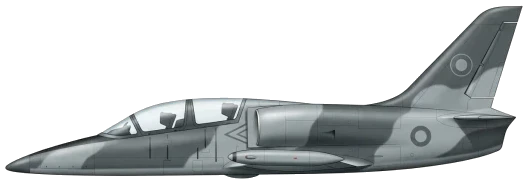
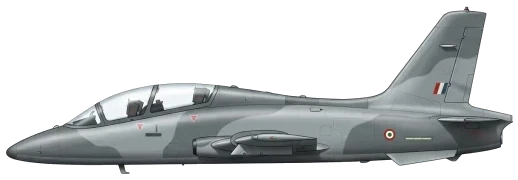
| L-39 Albatros | MB-339 | |
|---|---|---|
| Origin country | 🇨🇿 Czechia | 🇮🇹 Italy |
| Category | Military Training Aircraft | Military Training Aircraft |
| Manufacturer | Aero | Aermacchi |
| First flight | 4 November 1968 | 12 August 1976 |
| Year introduced | 1972 | 1979 |
| Number produced | 2900 units | 230 units |
| Average unit price | $1 million | -- |
| Wing area | 18.8 m² | 19.0 m² |
| Wingspan | 9.5 m | 10.9 m |
| Height | 4.8 m | 3.6 m |
| Length | 12.1 m | 11.0 m |
| Maximum speed | 750 km/h | 898 km/h |
| Operational range | 1,100 km | 1,760 km |
| Service ceiling | 11,500 m | 14,630 m |
| Max. takeoff weight | 4,700 kg | 5,897 kg |
| Empty weight | 3,459 kg | 3,075 kg |
| Total thrust | 1 x 1,720 kgf | 1 x 1,814 kgf |
Detailed Comparison
The L-39 Albatros and Aermacchi MB-339 are products of their respective Cold War-era design philosophies, with the Czechoslovakian L-39 emphasizing mass production, simplicity, and ruggedness for Warsaw Pact training needs, while the Italian MB-339 was developed as a more refined and performant successor to an existing Western platform, with a greater initial focus on a secondary light-attack role. The L-39's production run of over 2,900 units dwarfs the MB-339's 230, underscoring its role as a standardized, cost-effective trainer for a vast military alliance.
Development and Design
The L-39 Albatros was conceived in the late 1960s as a clean-sheet replacement for the L-29 Delfin. Its design prioritizes operational simplicity and ease of maintenance. Key features include a robust tricycle landing gear for operations from unprepared airstrips and a single Ivchenko AI-25TL turbofan mounted externally above the rear fuselage, allowing for straightforward engine access. The straight, mid-mounted wings enhance stability, which is a critical attribute for a primary trainer.
Conversely, the MB-339 is an evolutionary design, leveraging the airframe of its predecessor, the MB-326. Its main design alteration was a redesigned forward fuselage creating a stepped tandem cockpit, significantly improving visibility for the instructor in the rear seat. Powered by a Rolls-Royce Viper turbojet, its systems architecture was more readily adaptable for advanced combat roles. Later variants, like the MB-339C, incorporated modern features such as a MIL-STD-1553B databus and HOTAS controls, making it a more sophisticated training and attack system.
Specifications and Performances
Analysis of performance data reveals the MB-339's superiority in key metrics. It possesses a higher maximum speed (898 km/h vs. the L-39's 750 km/h), a greater service ceiling (14,630 m vs. 11,500 m), and a faster rate of climb (33.5 m/s vs. 22.0 m/s). This performance advantage is directly linked to its significantly higher maximum takeoff weight (5,897 kg vs. 4,700 kg), which also enables a much larger ordnance payload of up to 1,815 kg, compared to the L-39's approximate 1,000 kg capacity. The L-39’s performance is tailored for the subsonic training environment, whereas the MB-339’s envelope extends further into the light attack domain.
Deployment and usage
Both aircraft have seen combat, though their primary role remains training. The L-39 became the standard jet trainer for over 30 nations, primarily within the Soviet sphere of influence. Its combat use in conflicts like the Syrian Civil War and the war in Ukraine has typically been in low-intensity environments where its limited payload and lack of advanced defensive systems were acceptable risks. The armed L-39ZA variant, with its internal 23mm cannon, offered a modest integrated attack capability. The MB-339 saw notable combat use with the Argentine Naval Aviation during the Falklands War and by Eritrea. Its design proved more capable in these roles, being qualified to carry a wider range of ordnance, including anti-ship and air-to-surface missiles like the Marte and Maverick.
Conclusion
The L-39 Albatros stands out for its production volume, low operating cost, and robust design, making it one of the most successful jet trainers ever built. Its legacy is one of accessibility and reliability. The Aermacchi MB-339, while produced in far smaller numbers, represents a more capable dual-role platform, offering higher performance and a more potent and flexible armament suite from its inception. Its combat record reflects a design that was better optimized for the light attack mission. While modernized versions like the L-39NG seek to close the capability gap, the original models remain clear reflections of the distinct operational requirements and technological philosophies of the Cold War blocs they were designed to serve.


