MB-326K
Italian trainer/light attack jet, extensively employed during the late 20th century, notable for global military deployment. Key figures: top speed 806 km/h, range 1,850 km, service ceiling 12,497 m, max takeoff weight 3,765 kg, built 800.
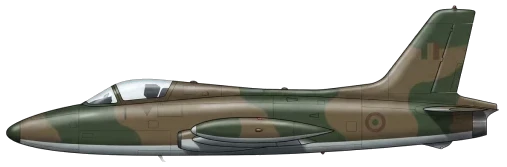
| Length | 10.7 m (34.9 ft) |
| Wingspan | 10.6 m (34.6 ft) |
| Height | 3.7 m (12.2 ft) |
| Wing area | 19 m² (204.5 sqft) |
| Empty weight | 2,237 kg (4,932 lbs) |
| Max. takeoff weight | 3,765 kg (8,300 lbs) |
| Powerplant | 1 × turbojet Bristol-Siddeley Viper Mk11 1,134 kgf each |
| Ejection seat | Martin-Baker Mk 4 |
| Maximum speed | 806 km/h (501 mph) |
| Operational range | 1,850 km (1,150 mi) |
| Service ceiling | 12,497 m (41,001 ft) |
| Climb rate | 22.3 m/s (73.2 ft/s) |
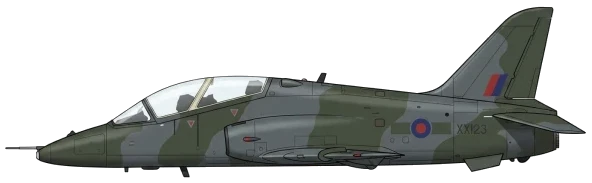
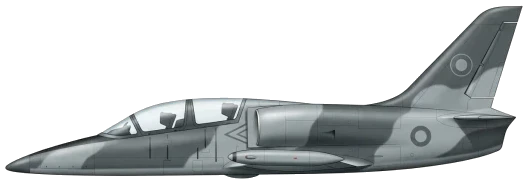
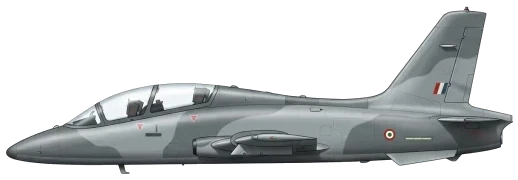
Description
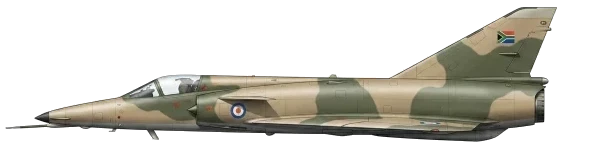
The Aermacchi MB-326K is a single-seat light attack aircraft produced by the Italian manufacturer Aermacchi, derived from the two-seat MB-326 jet trainer. Originally designated MB-336, it first flew on 22 August 1970 and was the last-generation model of the family. It was exported to Dubai, Tunisia, Ghana and Zaire, and built under licence in South Africa as the Atlas Impala Mk II, in which form it saw combat during the South African Border War.
Development
The MB-326K was developed from the MB-326G, one of which was converted as the basis for the new model. Two prototypes were flown, registered I-AMKK and I-KMAK, the first on 22 August 1970. The second cockpit was deleted in favour of avionics, fuel and internal cannon, and the aircraft was fitted with the Viper Mk 600 engine rated at 1,814 kg of thrust. Dubai ordered three in 1974 and a further three in 1978, with additional deliveries to Tunisia, Ghana and Zaire. South Africa bought seven Italian-built examples and assembled a further 15 from kits before beginning licence production of around 78 aircraft at the Atlas Aircraft Corporation from 1974. The MB-326K and the two-seat MB-326L were the direct ancestors of the Aermacchi MB-339.
Design
The MB-326K retained the low-wing all-metal airframe of the trainer, with the fuselage and wing each built in three sections and the wing centre section integral to the fuselage. Engine air was drawn through low-profile wing-root intakes, and fuel was carried in a fuselage tank and wingtip tanks. The cockpit was pressurised and covered by a bubble canopy, with a Martin-Baker ejection seat. The Viper Mk 600 gave higher thrust than the Viper 11 and Viper 20 of earlier variants. South African-built Impala Mk IIs were fitted with French armament and a locally developed ECM suite.
Armament
Two 30 mm autocannon with 300 rounds were installed internally, replacing the gun pods carried by two-seat versions. Six underwing hardpoints were provided. The South African Air Force employed loads of up to six 120 kg or four 250 kg bombs, and 68 mm SNEB rocket launchers in four six-tube or two 18-tube configurations. Single-seat Impala Mk IIs were sometimes armed with Matra R550 Magic air-to-air missiles for self-defence.
Operational History
The South African Defence Force used Impalas against FAPLA and Cuban forces in Angola between 1975 and 1989, typically flying at 550–650 km/h at 15 m altitude to avoid air defences. One was shot down by an SA-7; another returned with an unexploded missile lodged in its exhaust. In 1985, Impala Mk IIs shot down six Mi-8 and Mi-24 helicopters using cannon only: two Mi-24s in a first encounter, escorting MiG-21s flying too high to intervene, and two Mi-24s and two Mi-17s two days later. Six SAAF squadrons operated the Impala Mk II during the 1970s and 1980s.
Variants
- MB-326K: Single-seat ground-attack version with Viper Mk 600 engine and two internal 30 mm cannon.
- MB-326KB: Single-seat ground-attack aircraft for Zaire, six built.
- MB-326KD: Single-seat ground-attack aircraft for Dubai, three built.
- MB-326KT: Single-seat ground-attack aircraft for Tunisia, seven built.
- Impala Mk II: South African Air Force designation of the MB-326K, licence-built by Atlas Aircraft Corporation.
Frequently Asked Questions
What type of aircraft is the MB-326K?
What is the maximum speed of the MB-326K?
What is the range of the MB-326K?
When did the MB-326K first fly?
How many MB-326K have been built?
Which countries operate the MB-326K?
What is the service ceiling of the MB-326K?
- AUG 302026 Updated Description updated
- APR 72026 Updated Sources and cross-references refreshed
- FEB 72026 Updated Range added