CH-53 Sea Stallion vs MH-53J Pave Low III
CH-53 Sea Stallion vs MH-53J Pave Low III at a glance — top speed 315 vs 310 km/h, range 1,000 vs 1,100 km, max takeoff weight 33,300 vs 20,865 kg, built 284 vs 41 units.
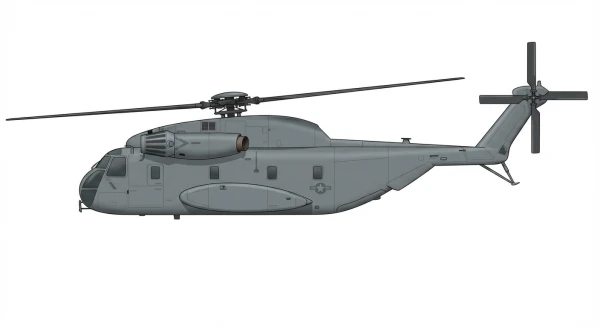
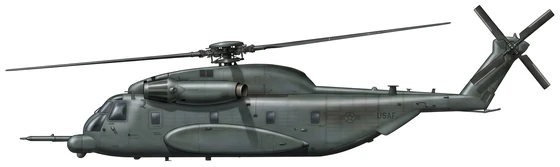
| CH-53 Sea Stallion | MH-53J Pave Low III | |
|---|---|---|
| Origin country | 🇺🇸 United States | 🇺🇸 United States |
| Category | Military Helicopters | Military Helicopters |
| Manufacturer | Sikorsky | Sikorsky |
| First flight | 14 October 1964 | -- |
| Year introduced | 1966 | 1988 |
| Number produced | 284 units | 41 units |
| Average unit price | $40 million | -- |
| Wing area | -- m² | 378.4 m² |
| Wingspan | 24.1 m | 22.0 m |
| Height | 8.5 m | 7.6 m |
| Length | 30.2 m | 27.0 m |
| Maximum speed | 315 km/h | 310 km/h |
| Operational range | 1,000 km | 1,100 km |
| Service ceiling | 5,639 m | 4,900 m |
| Max. takeoff weight | 33,300 kg | 20,865 kg |
| Empty weight | 15,071 kg | 14,515 kg |
| Total thrust | 3 x 3,270 kW | 2 x 3,230 kW |
Detailed Comparison
The Sikorsky H-53 airframe spawned two strictly divergent platforms: the US Marine Corps’ CH-53 Sea Stallion, built for vertical heavy lift, and the US Air Force’s MH-53J Pave Low III, modified for clandestine special operations. The CH-53 maximizes payload for amphibious assault, while the MH-53J trades cargo capacity for avionics, armor, and terrain-following capabilities.
Development and Design
The CH-53 originated from a 1962 USMC requirement to replace the piston-engined CH-37. Sikorsky integrated the dynamic systems of the S-64 Skycrane with twin General Electric T64 turboshafts. The design prioritized rapid loading and high-speed transit via a rear ramp and a fully-articulated six-bladed main rotor. The MH-53J Pave Low III, built via conversions of older HH-53 and CH-53 airframes in the late 1980s, addressed Air Force requirements for deep penetration. It incorporated 1,000 pounds of titanium armor. The addition of the AN/APQ-158 terrain-following radar and AN/AAQ-18 FLIR allowed crews to operate below enemy radar coverage at night and in zero-visibility weather.
Specifications and Performances
The baseline CH-53 airframe prioritizes raw lift. Early variants lifted 13,000-pound external loads, while specialized RH-53D mine-countermeasure variants managed 25,000 pounds on the hook. The MH-53J operates with a different performance envelope. Added armor, radar domes, and a six-person crew increased its empty weight, requiring upgraded T64-GE-100 engines outputting 4,380 shaft horsepower to maintain a 20,865 kg MTOW. Structural differences dictate their flight profiles:
- The CH-53 Sea Stallion relies on mechanical flight controls and three independent hydraulic systems to manage bulk cargo transport.
- The MH-53J integrates digital avionics, GPS, and Doppler radar navigation to automate low-level flight paths, reducing maximum payload.
Both platforms maintain maximum speeds near 310-315 km/h, though the MH-53J’s drag profile from external tanks and sensors reduces its operational cruise speed. Data attributing a 33,300 kg MTOW and a three-engine configuration to the Sea Stallion reflects the later CH-53E evolution; the baseline Sea Stallion and Pave Low III operate strictly on twin T64s.
Deployment and usage
Marine CH-53s executed mass evacuations during Operation Frequent Wind and provided logistics in Grenada, Iraq, and Afghanistan. The platform suffered heavy losses during the aborted 1980 Operation Eagle Claw, exposing the limitations of standard Navy RH-53Ds in austere desert conditions. The MH-53 series was built specifically for these environments. Following early CSAR operations in Vietnam, the MH-53J led the 1989 Operation Just Cause insertions in Panama. In 1991, MH-53Js guided AH-64 Apaches to destroy Iraqi early warning radar sites, opening the air corridor for Desert Storm. The platform retired in 2008 in favor of the CV-22 Osprey.
Conclusion
The MH-53J Pave Low III holds the edge in contested, low-visibility environments. Its integrated terrain-avoidance radar and heavy armor allow it to survive deep penetrations that would destroy a standard transport helicopter. For logistical throughput and expeditionary basing, the CH-53 Sea Stallion retains the advantage. The USMC's continued reliance on the CH-53 lineage proves that while AFSOC requires specialized avionics for night insertions, amphibious doctrine demands an uncluttered, high-capacity heavy lifter.