CH-53 Sea Stallion vs Mi-8 Hip
CH-53 Sea Stallion vs Mi-8 Hip at a glance — top speed 315 vs 250 km/h, range 1,000 vs 495 km, max takeoff weight 33,300 vs 12,000 kg, built 284 vs 17,000 units.
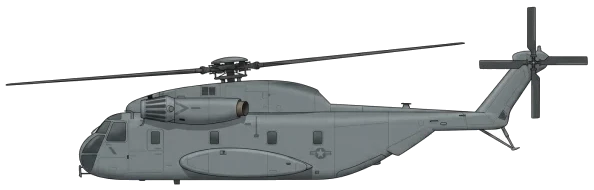
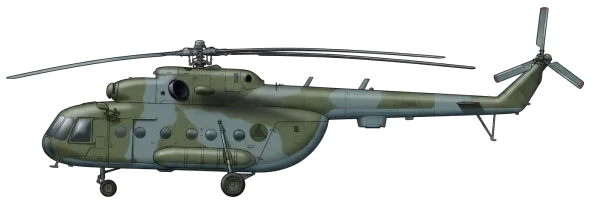
| CH-53 Sea Stallion | Mi-8 Hip | |
|---|---|---|
| Origin country | 🇺🇸 United States | 🇷🇺 Ex-USSR |
| Category | Military Helicopters | Military Helicopters |
| Manufacturer | Sikorsky | Mil |
| First flight | 14 October 1964 | 24 June 1961 |
| Year introduced | 1966 | 1967 |
| Number produced | 284 units | 17000 units |
| Average unit price | $40 million | $4 million |
| Wingspan | 24.1 m | 21.3 m |
| Height | 8.5 m | 5.7 m |
| Length | 30.2 m | 25.2 m |
| Maximum speed | 315 km/h | 250 km/h |
| Operational range | 1,000 km | 495 km |
| Service ceiling | 5,639 m | 4,500 m |
| Max. takeoff weight | 33,300 kg | 12,000 kg |
| Empty weight | 15,071 kg | 7,160 kg |
| Total thrust | 3 x 3,270 kW | 2 x 1,119 kW |
Detailed Comparison
The Sikorsky CH-53 Sea Stallion and the Mil Mi-8 Hip illustrate divergent military requirements: specialized heavy lift for expeditionary warfare versus versatile medium utility for mass mobilization. While the CH-53 was engineered to meet the US Marine Corps' demanding speed and lift requirements for amphibious operations, the Mi-8 was designed as a rugged, mass-produced workhorse for the Soviet doctrine of combined arms and widespread utility.
Development and Design
Developed from a 1962 USMC requirement, the CH-53 introduced a heavy-lift capability utilizing a fully-articulated six-bladed main rotor and General Electric T64 turboshaft engines. Its design prioritizes rapid loading via a rear power-operated ramp and suitability for maritime environments, including blade folding and a watertight hull. Conversely, the Mi-8, introduced in 1961, reflects a philosophy of robust simplicity and modularity. Utilizing a conventional five-blade rotor and twin Klimov engines, the Mi-8 features a flexible cabin architecture adaptable for transport, medical evacuation, or armed assault. While the CH-53 focuses on maximizing payload for specialized insertion, the Mi-8 emphasizes structural durability, ease of maintenance in austere field conditions, and production scalability.
Specifications and Performance
The performance gap highlights the categorization difference between heavy and medium lift. The CH-53 possesses a Maximum Takeoff Weight (MTOW) of 33,300 kg, nearly triple the Mi-8's 12,000 kg limit. This allows the Sea Stallion to manage external sling loads up to 13,000 lbs (or 25,000 lbs on the RH-53D), whereas the Mi-8 is restricted to significantly lighter logistical footprints. Speed metrics further favor the American platform, which achieves 315 km/h compared to the Hip's 250 km/h, a critical factor for rapid deployment. Additionally, the CH-53 offers double the operational range (1,000 km) of the Mi-8 (495 km), enabling deeper strategic reach without aerial refueling. However, the Mi-8's sheer volume of production—over 17,000 units compared to 284 CH-53s—offsets these performance deficits through ubiquity.
Deployment and Usage
Operational history underscores the Mi-8's versatility and the CH-53's specialization. The Mi-8 serves globally as a primary assault transport and gunship, heavily utilized in the Soviet-Afghan War and ongoing conflicts like Ukraine. Its ability to mount heavy armaments, including rockets and anti-tank missiles (Mi-8MT/Mi-17), allows it to function as a flying infantry fighting vehicle. The CH-53, while armed for self-defense, focuses on logistics and specialized missions such as Airborne Mine Countermeasures (AMCM) and aircraft recovery. It saw extensive service from Vietnam to Operation Iraqi Freedom, often conducting high-value heavy transport or long-range rescue missions (CSAR) rather than direct frontline fire support.
Conclusion
Ultimately, the CH-53 Sea Stallion and Mi-8 Hip are not direct competitors but complementary archetypes of rotary-wing aviation. The CH-53 represents a high-cost, high-performance solution for specific heavy-lift and long-range naval requirements. The Mi-8 stands as the quintessential multi-role platform, prioritizing availability and adaptability over raw kinematic performance. While the Sea Stallion offers superior logistical throughput, the Hip provides an accessible, armed utility capability that remains the backbone of air mobility for dozens of nations.
-
 United States
175
United States
175
-
 Germany
81
Germany
81
-
 Israel
22
Israel
22
- All 4 operators →


